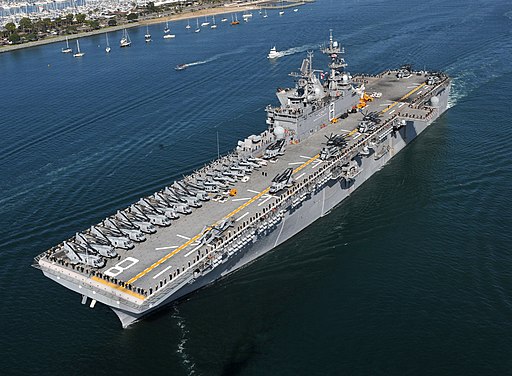
USS Makin Island (LHD-8)
USS Makin Island (LHD-8): A Modern Amphibious Assault Powerhouse
The USS Makin Island (LHD-8) represents the cutting edge of U.S. naval amphibious assault capability. As a Wasp-class landing helicopter dock, this vessel is designed to project power ashore, provide rapid humanitarian assistance, and support Marine Expeditionary Units (MEUs) with unmatched flexibility. Named in honor of the historic Makin Island raid in World War II, USS Makin Island carries forward a legacy of bold initiative and operational excellence while embodying the advanced engineering and multi-mission versatility of modern naval architecture.
Historical Background
Namesake and Legacy
USS Makin Island derives her name from the celebrated battle of Makin Island, where U.S. Marine Raiders conducted a daring raid early in World War II. This storied episode in Pacific warfare underscores the values of courage, ingenuity, and relentless pursuit of mission success that continue to define the U.S. Navy today. By carrying this name, LHD-8 not only honors military heritage but also symbolizes the determination to overcome challenges in dynamic and contested environments.
Construction and Commissioning
Commissioned on 24 October 2009, USS Makin Island was built by Ingalls Shipbuilding (now part of Huntington Ingalls Industries) at its shipyard in Pascagoula, Mississippi. The construction process was marked by several critical milestones:
- Contract Award: Initiated in the early 2000s, reflecting the Navy’s emphasis on expanding amphibious capabilities.
- Keel Laid Down: February 2004
- Christening and Launch: Christened on 19 August 2006 and launched on 22 September 2006
- Commissioning: Entered active service on 24 October 2009
Now homeported in San Diego, California, USS Makin Island serves as a central node in the Pacific Fleet, ready to respond to a spectrum of military and humanitarian missions.
Design and Construction
Innovative Naval Architecture
USS Makin Island is the culmination of decades of refinement in amphibious warfare design. As a Wasp-class vessel, she features a well-integrated flight deck, extensive well deck, and robust command and control facilities. Her design emphasizes survivability, flexibility, and rapid response. The ship’s layout is optimized to seamlessly transition between supporting air operations and conducting amphibious landings, reflecting the Navy’s drive toward multi-domain operations.
Hybrid Propulsion and Efficiency
A key element of USS Makin Island’s design is her hybrid propulsion system. Utilizing a CODLOG (COmbined Diesel-eLeCtric and Gas turbine) configuration, the vessel achieves both fuel efficiency and high-performance speed. This propulsion architecture supports extended deployments and reduces the logistical footprint by optimizing operational economies.
Technical Specifications Overview
Below is an in-depth look at USS Makin Island’s technical specifications, highlighting the design features that make her one of the most capable amphibious assault ships in the U.S. fleet.
Dimensions and Displacement
USS Makin Island’s sheer size supports a wide range of capabilities:
- Full-Load Displacement: Approximately 40,500 long tons
- Length: 843 feet (257 meters)
- Beam: 104 feet (approximately 32 meters)
- Draft: Approximately 27 feet (8.1 meters)
These dimensions provide a stable operating platform for a large complement of embarked Marines, aircraft, landing craft, and essential support systems while maintaining excellent sea-keeping characteristics.
Propulsion and Performance
Hybrid Propulsion System
USS Makin Island is powered by an integrated propulsion package that combines high-output gas turbines with diesel-electric motors:
- Gas Turbines: 2 × 35,000 shaft horsepower (shp) GE LM2500-30 turbines
- Electric Motors: 2 × 5,000 shp, supported by 6 × 4,000 kW diesel generators
- Total Power Output: Approximately 70,000 shp driving two shafts
- Propellers: Two controllable pitch propellers, each with a diameter of approximately 16.5 feet (5.0 meters)
This CODLOG system delivers a top speed of roughly 28 knots and an impressive operational range of about 9,500 nautical miles at 20 knots, ensuring rapid global mobility and operational endurance.
Armament and Defensive Systems
While USS Makin Island’s primary mission centers on amphibious operations and power projection rather than frontline combat, she is equipped with an array of self-defense armaments to protect against aerial and surface threats.
- Missile Systems:
- 2 × RIM-116 Rolling Airframe Missile (RAM) launchers for short-range air defense
- 2 × RIM-7 Sea Sparrow missile launchers for medium-range interception
- Close-In Weapon Systems:
- 2 × 20 mm Phalanx CIWS systems providing rapid-fire defense against incoming threats
- Secondary Weaponry:
- 3 × 25 mm Mk 38 chain guns
- 4 × .50-caliber Browning machine guns
These systems combine to form a layered defensive envelope, ensuring that the vessel remains secure while executing its embarked missions.
Aviation Capabilities
A cornerstone of USS Makin Island’s operational versatility is her extensive aviation facilities. She is designed to deploy and recover a diverse range of aircraft, adapting to mission-specific requirements.
- Aircraft Carried:
- Fixed-Wing Fighters: Depending on the mission profile, the ship can embark up to 6 AV-8B Harrier II attack aircraft or the more advanced F-35B Lightning II, providing stealth strike and air support capabilities.
- Rotary Wing and Tiltrotor Aircraft: Typically, the flight deck supports 4 attack helicopters (such as AH-1Z Viper variants), and it has the capacity to host up to 12 MV-22B Osprey tiltrotors, which are crucial for rapid assault and transport operations.
- Utility Helicopters: The ship may also deploy additional utility helicopters like the UH-1Y Venom and the CH-53E Super Stallion, expanding its logistical and rescue capabilities.
The ship’s flight deck and hangar are engineered to handle high sortie rates and rapid aircraft turnaround, enabling swift projection of air power in support of amphibious or contingency operations.
Amphibious Operations and Well Deck
Central to USS Makin Island’s mission is its ability to project Marine Corps forces ashore:
- Well Deck Dimensions: Approximately 266 feet by 50 feet with a height of around 28 feet
- Landing Craft Capability: The well deck is configured to accommodate 3 Landing Craft Air Cushion (LCAC) vehicles or 2 Landing Craft Utility (LCU) vessels, facilitating the rapid transfer of troops, vehicles, and equipment directly onto unprepared beaches.
This capability ensures that Marine forces can be swiftly embarked, transported, and deployed with minimal delay during amphibious assaults or humanitarian missions.
Sensor and Communication Systems
To maintain situational awareness and command in complex operational environments, USS Makin Island is outfitted with a sophisticated suite of sensors and communication devices:
- Radar Systems:
- AN/SPQ-9B surface search and fire control radar
- AN/SPS-49 2-D air search radar and AN/SPS-48 3-D air search radar
- AN/SPS-67 surface search radar
- Target Acquisition and Navigation:
- Mk23 Target Acquisition System (TAS) for precise threat tracking
- Air traffic control radars including AN/SPN-43 and AN/SPN-35
- TACAN navigation (AN/URN-25) and IFF systems (AN/UPX-24)
These systems, integrated into a robust communications network, ensure that the ship remains connected with fleet headquarters and joint force assets, a critical factor in executing coordinated multi-domain operations.
Operational Capabilities and Missions
Amphibious Assault and Marine Deployment
As a premier amphibious assault ship, USS Makin Island is expressly designed to embark, transport, and deploy elements of a Marine Expeditionary Unit. Through its well deck and extensive aviation facilities, the vessel can rapidly launch amphibious assaults, ensuring that Marines, equipped with vehicles and landing craft, are poised to secure objectives under hostile conditions.
Sea Control and Power Projection
Beyond amphibious operations, USS Makin Island is a potent tool for sea control and power projection. Her embarked air wing—ranging from rotary-wing attack aircraft to fixed-wing stealth fighters—and integrated defensive systems enable the vessel to exert influence over contested littoral zones, extend maritime surveillance, and provide rapid stratagems in joint force tasks.
Multi-Domain Command and Support
USS Makin Island also functions as a command and control platform in complex, multi-domain operations. Her advanced communication systems foster seamless integration with other naval and joint force assets, allowing the ship to serve as a mobile headquarters during crises, humanitarian relief missions, and combat operations.
Future Outlook and Modernization
Continued Upgrades and Adaptability
Designed with modularity and future-proofing in mind, USS Makin Island can be retrofitted with evolving technologies. The integration of next-generation sensor systems, cyber-defense enhancements, and upgraded weaponry will ensure that she remains at the forefront of naval capability into the future.
Expanding Operational Roles
As the nature of global conflict evolves, the role of amphibious assault ships like USS Makin Island continues to expand. From heightened focus on power projection in contested maritime environments to coordinated humanitarian relief operations, the vessel is poised to adapt to new strategic challenges while maintaining a steadfast commitment to U.S. national defense objectives.
Conclusion
USS Makin Island (LHD-8) stands as an enduring testament to the fusion of innovative design, advanced engineering, and operational versatility. With her hybrid CODLOG propulsion system, robust defensive and offensive armaments, expansive aviation and well deck capabilities, and state-of-the-art sensor suite, she is engineered to meet the demands of modern amphibious warfare. Whether launching a rapid Marine deployment, projecting air power over contested waters, or supporting multi-domain command and control operations, USS Makin Island remains a critical asset in ensuring maritime stability and U.S. global power projection. Her legacy, built on the storied heritage of the Makin Island raid, continues to inspire and drive the evolution of naval warfare for decades to come.
