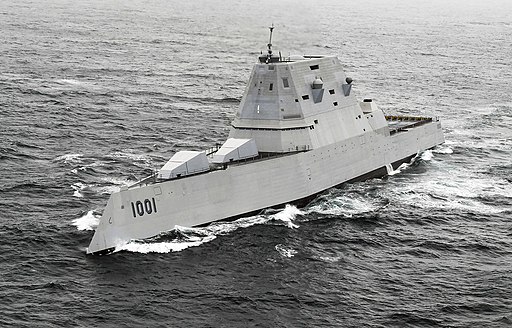
USS Michael Monsoor (DDG-1001)
USS Michael Monsoor (DDG‑1001) is the second ship of the three‑ship Zumwalt‑class—a series of guided missile destroyers designed for multi‑mission operations encompassing land attack, surface warfare, and littoral operations. Named in honor of Master-At-Arms Second Class Michael A. Monsoor, a Navy SEAL who posthumously received the Medal of Honor for his valor in Iraq, the vessel embodies a proud tradition of sacrifice and excellence in service. Commissioned on 26 January 2019 and homeported in San Diego, she represents a significant evolution in U.S. naval capability, combining stealth, advanced technologies, and a unique design philosophy intended to dominate modern maritime battlespaces .
Design and Construction
Historical Context and Namesake
USS Michael Monsoor carries forward the legacy of heroism by honoring its namesake—a symbol of bravery and selflessness. The decision to name the destroyer after Michael A. Monsoor reflects the Navy’s commitment to remembering outstanding acts of courage while inspiring future generations of sailors to uphold these ideals.
Hull Design and Stealth Features
The Zumwalt‑class is famed for its radical departure from traditional destroyer aesthetics. USS Michael Monsoor features a distinctive, angular hull design that reduces radar cross‑section and enhances stealth capabilities. The near‑featureless bow and slab‑sided superstructure minimize acoustic and radar signatures, enabling her to operate in environments where stealth and low observability are critical. Constructed at Bath Iron Works, her build process utilized advanced composite materials and digital design techniques to ensure both durability and a reduced logistical footprint .
Advanced Construction Techniques
One of the hallmarks of Michael Monsoor’s construction is its integration of complex system architectures with state‑of‑the‑art manufacturing. Assembly techniques—centered on modular construction—allowed for various sections of the ship to be built concurrently and then seamlessly integrated. This approach not only bolsters efficiency but also ensures that the vessel’s advanced sensors, propulsion, and tactical systems are harmoniously integrated into one cohesive platform.
Technical Specifications
The technical attributes of USS Michael Monsoor highlight her status as one of the most advanced surface combatants in the world today.
Dimensions and Displacement
- Length: Approximately 600 feet (182.9 meters)
- Beam: Approximately 80.7 feet (24.6 meters)
- Draft: About 27.6 feet (8.4 meters)
- Displacement: Roughly 14,564 long tons (14,798 tonnes)
These dimensions not only provide the ship with exceptional seakeeping and stability but also afford ample space for advanced electronic suites, weapons systems, and living spaces optimized for a lean crew .
Propulsion and Performance
- Propulsion System:
- 2 × Rolls‑Royce MT30 gas turbines (each delivering about 35.4 MW)
- Additional support from 2 × Rolls‑Royce RR4500 turbine generators (approximately 3.8 MW each)
- Total Propulsion Power: Approximately 78 MW (105,000 shaft horsepower)
- Maximum Speed: Approximately 30.3 knots
The state‑of‑the‑art propulsion system enables rapid maneuverability and swift transit across vast expanses, ensuring that Michael Monsoor can be rapidly deployed across theaters of operation. The integration of gas turbines with electric drive mechanisms not only boosts efficiency but also contributes to the vessel’s remarkably low acoustic signature—a critical advantage in modern naval warfare .
Armament and Weapon Systems
USS Michael Monsoor boasts an innovative and highly flexible armament suite designed for multi‑domain operations.
Vertical Launch System (VLS)
- Configuration:
- 20 × MK57 Vertical Launch Modules
- Each module contains 4 cells, totaling 80 cells
- Missile Capabilities:
- Evolved Sea Sparrow Missiles (ESSM): For air defense
- Tactical Tomahawk Cruise Missiles: Enabling long‑range land striking capability
- Vertical Launch Anti‑Submarine Rocket (ASROC): For anti‑submarine warfare
This modular VLS configuration allows for rapid re‑arming and the flexibility to tailor the missile load‑out based on mission requirements.
Gun Systems
- Advanced Gun Systems (AGS):
- 2 × 155 mm AGS, each originally supplied with a 920‑round magazine
- Though the specialized ammunition procurement has been canceled, these systems remain emblematic of the class’s ambition to integrate precision naval artillery into modern surface combat
Additional Defensive Measures
- Complementing the primary weapons systems are advanced electronic warfare (EW) suites and counter‑measures which, together with a reduced radar profile, provide layers of active and passive defense against modern threats.
Sensor and Combat Systems
The combat effectiveness of Michael Monsoor is amplified by its suite of sophisticated sensors and command systems.
Radar and Multispectral Sensors
- AN/SPY‑3 Multi‑Function Radar (MFR):
- An X‑band, scanned‑array radar offering high resolution and multitarget tracking capability
- Volume Search Radar (VSR):
- Operating in the S‑band frequency, this radar enables broader surveillance and tracking
- Integrated Combat Systems:
- These sensors feed data into an advanced combat management system that enhances situational awareness and decision‑making during high‑intensity operations
The synergy between these sensors and the ship’s low‑observability design ensures that Michael Monsoor can detect and engage threats long before they become critical .
Aviation Capabilities
- Aircraft Carried:
- Typically supports 2 × SH‑60 LAMPS helicopters or 1 × MH‑60R helicopter
- Aviation Facilities:
- Though relatively compact compared to larger carriers, the helicopter deck and hangar offer vital capabilities such as anti‑submarine warfare, reconnaissance, and search and rescue operations
The ability to deploy rotary‑wing assets significantly extends the ship’s operational reach and versatility, particularly in multi‑domain warfare scenarios.
Advanced Technologies and Stealth Design
Digital Integration
USS Michael Monsoor is at the forefront of digital warfare and networked combat. Its battle management systems integrate data from various sensors and external sources, providing a comprehensive picture of the battlespace in real time. This digital integration is critical for timely decision‑making and precise execution of combat operations.
Stealth and Reduced Signatures
The Zumwalt‑class design represents a major innovation in naval stealth. By incorporating:
- An angular, wave‑piercing hull form
- Advanced composite materials
- Integrated electronic counter‑measures the vessel maintains a dramatically reduced radar, infrared, and acoustic signature compared to traditional destroyers. This stealth capability allows Michael Monsoor to operate closer to contested zones with diminished risk of detection .
Modular and Flexible Systems
The use of modular construction and flexible systems architecture means that USS Michael Monsoor can be upgraded with emerging technologies over her service life. Whether it’s refining sensor capabilities, integrating unmanned systems, or adapting to new missile technologies, the ship is built to evolve alongside modern warfare requirements.
Operational Capabilities and Mission Profile
Multi‑Domain Warfare
With its blend of advanced propulsion, stealth technology, and a flexible weapons suite, USS Michael Monsoor is designed to excel in multi‑domain warfare. Whether engaging in long‑range land−attack operations, defending against aerial and missile threats, or neutralizing underwater adversaries, the ship’s integrated design supports diversified tactical scenarios.
Surface and Littoral Combat
The Zumwalt‑class is uniquely positioned to operate in both open oceans and near‑shore environments. Michael Monsoor’s minimal radar cross‑section, combined with advanced missile systems, makes it particularly suited for littoral operations where engagement ranges are shorter and threats may emerge rapidly from multiple vectors.
Command and Control
Equipped with sophisticated communication networks and integrated battle management systems, USS Michael Monsoor serves as a potent command node. This capability not only enhances its own combat effectiveness but also enables effective coordination with other naval and joint forces during complex operations.
Crew, Habitability, and Future Potential
Crew Efficiency and Automation
Despite its advanced systems, the human footprint on Michael Monsoor is comparatively lean—typically around 140 personnel. High levels of automation and digital integration reduce crew workload, allowing personnel to focus on decision‑making and mission‑critical tasks. This efficiency is reflective of a broader trend toward streamlined, digitally empowered naval forces.
Future Upgrades and Adaptability
The modular design of the Zumwalt‑class ensures that USS Michael Monsoor remains adaptable to evolving threats. Planned and potential upgrades include:
- Next‑generation sensor and radar enhancements
- Integration of advanced electronic warfare and cyber‑defense capabilities
- Incorporation of unmanned systems—both aerial and underwater—to further extend the ship’s reach and versatility
These future prospects highlight how Michael Monsoor is not merely a product of current naval technology, but also a platform designed for continuous evolution in response to emerging operational challenges.
Conclusion
USS Michael Monsoor (DDG‑1001) stands as a testament to innovative naval design and technological integration. From her stealth‑shaped hull and advanced propulsion systems to an arsenal of flexible, state‑of‑the‑art weapons and sensors, the ship represents the cutting edge of U.S. naval power. As part of the revolutionary Zumwalt‑class, Michael Monsoor is poised to play a critical role in multi‑domain warfare for decades to come, merging digital supremacy with tactical agility in a complex global security landscape.
