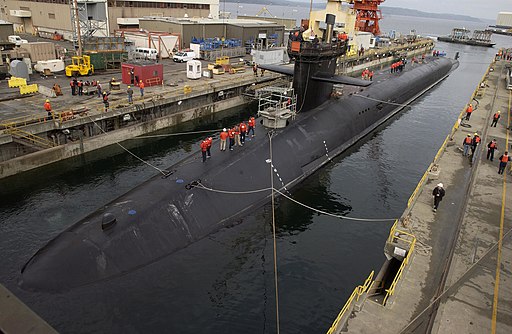
USS Michigan (SSGN-727)
USS Michigan (SSGN‑727) is the third vessel to bear the name of the U.S. state of Michigan and an integral member of the Ohio‑class submarine fleet. Originally designed and commissioned as a ballistic missile submarine (SSBN‑727) on September 11, 1982, she was built to provide strategic deterrence during the Cold War. In response to evolving operational needs in the 21st century, USS Michigan underwent an extensive conversion to a guided missile submarine (SSGN) in 2007. This transformation enhanced her role to include precision land‑attack capabilities, special operations support, and theater security missions.
Named for the state that has long been a symbol of industrial strength and innovation, USS Michigan carries a legacy of resilient design and operational versatility. Her service under the motto “Tuebor” (“I will defend”) reflects the enduring commitment of the U.S. Navy to protect national interests across the globe.
Design and Construction
Historical Background and Naming
USS Michigan’s design and construction were driven by the strategic requirements of the Cold War. Ordered on February 28, 1975, her keel was laid down on April 4, 1977, at the Electric Boat Division of General Dynamics in Groton, Connecticut. Launched on April 26, 1980 and commissioned in 1982, the vessel was originally built to deploy submarine-launched ballistic missiles (SLBMs) as part of the nation’s strategic deterrent force.
Conversion from SSBN to SSGN
In recognition of changing global dynamics, USS Michigan was converted from an SSBN to an SSGN at the Puget Sound Naval Shipyard, with the conversion process completed in June 2007. The SSGN conversion involved substantial internal modifications:
- Removal of SLBM Systems: The original ballistic missile tubes were repurposed.
- Installation of Guided Missile Capabilities: The conversion enabled the submarine to carry up to 154 BGM‑109 Tomahawk cruise missiles, organized into multiple launch groups.
- Enhanced Support for Special Operations: Modifications provided improved accommodations and support facilities for the embarkation and deployment of special forces.
This transformation shifted USS Michigan’s mission from strategic nuclear deterrence to a versatile platform capable of power projection and precision strike against high‑value targets.
Technical Specifications
The technical characteristics of USS Michigan (SSGN‑727) highlight the sophisticated design of Ohio‑class submarines and underscore the enhancements realized through her conversion.
Dimensions and Displacement
- Length: Approximately 560 feet (170 meters)
- Beam: Approximately 42 feet (13 meters)
- Draft: Around 38 feet (12 meters)
- Displacement:
- Surfaced: Roughly 16,765 long tons (17,033 tonnes)
- Submerged: Approximately 18,750 long tons (19,050 tonnes)
These dimensions provide USS Michigan with excellent seakeeping qualities and ample internal volume to accommodate advanced weapons, sensor systems, and crew support facilities.
Propulsion and Performance
- Propulsion System:
- 1 × S8G pressurized-water nuclear reactor
- 2 × geared steam turbines
- 1 × shaft delivering approximately 60,000 shaft horsepower (45,000 kW)
- Auxiliary motor with 325 horsepower (242 kW) support
- Maximum Speed: In excess of 25 knots
- Test Depth: Greater than 800 feet (240 meters)
Powered by its nuclear reactor, USS Michigan is capable of extended patrols with virtually unlimited range, limited only by food supplies and crew endurance. The propulsion system’s design also ensures a relatively low acoustic signature, an essential feature for stealth operations.
Armament and Weapon Systems
Torpedo Tubes and Missile Capacity
USS Michigan is outfitted with a comprehensive suite of armaments that support both traditional anti-submarine warfare and modern precision strike missions.
Torpedo Armament
- Torpedo Tubes: 4 × 21‑inch (533 mm) torpedo tubes
- Capability: These launch systems can deploy a variety of lightweight torpedoes for defense against enemy submarines and surface vessels.
Guided Missile Capability
- Tomahawk Cruise Missiles:
- The submarine is cleared to carry up to 154 BGM‑109 Tomahawk missiles.
- These missiles provide long‑range precision land‑attack capabilities, enabling the submarine to strike strategic and tactical targets without exposing friendly forces to risk.
The conversion to an SSGN has redefined USS Michigan’s role by allowing her to efficiently support land attack operations while maintaining robust undersea defenses.
Sensor and Combat Systems
Integrated Sensor Suite
While much of USS Michigan’s sensor capabilities are classified, Ohio‑class submarines are known to incorporate advanced sonar systems, electronic support measures, and other detection technologies. These systems are designed to:
- Detect and Track: Identify potential threats, both underwater and on the surface.
- Ensure Situational Awareness: Provide real‑time data to the crew during high‑intensity operations.
- Support Stealth Operations: Maintain low detectability through advanced processing and counter‑detection measures.
Command and Control
The submarine’s combat systems integrate sensor data with networked command systems that facilitate rapid decision‑making. This digital integration allows USS Michigan to:
- Coordinate Multi‑Domain Operations: Seamlessly share information with other naval assets and joint forces.
- Execute Precision Strikes: Utilize guided missile systems based on real‑time intelligence.
- Enhance Survivability: Through responsive counter‑measures and evasive maneuvers enabled by digital situational awareness.
Operational History and Modernization
Service Record and Missions
Since her commissioning, USS Michigan has completed dozens of strategic deterrent patrols as an SSBN. Following her conversion to an SSGN, she embarked on a new operational chapter. Her first deployment as an SSGN was completed in December 2009, and she has since participated in theater security cooperation engagements, power projection missions, and special operations support.
Strategic Role in Contemporary Warfare
As an SSGN, USS Michigan plays a multifaceted role in modern naval strategy. Her capabilities include:
- Precision Land‑Attack: The extensive Tomahawk missile load enables deep strike operations against high‑value targets.
- Deterrence and Presence: Her continued operation provides an enduring deterrent effect in strategically sensitive regions.
- Special Operations Support: The submarine’s configuration supports the discreet insertion and extraction of special forces, enhancing the U.S. Navy’s operational versatility.
Future Prospects and Upgrades
Technological Evolution
USS Michigan is built on a platform designed for longevity and adaptability. Future upgrades could include:
- Enhanced Sensor Systems: Next‑generation sonar and electronic support measures to further improve detection and threat tracking.
- Networked Warfare Integration: Upgraded communications systems to better integrate with other naval assets in a multi‑domain battle space.
- Upgraded Weapons Systems: Potential integration of new missile technologies or modifications to existing systems to extend her operational capabilities.
Sustaining Operational Superiority
Modernizing platforms like USS Michigan ensures that even as global threats evolve, the U.S. Navy remains capable of projecting power and maintaining a strategic advantage. Continuous upgrades and periodic overhauls are key to sustaining the vessel’s relevance well into the future.
Conclusion
USS Michigan (SSGN‑727) stands as a prime example of naval innovation and adaptation. From her origins as a ballistic missile submarine to her transformation into a guided missile platform, she embodies the evolution of U.S. naval strategy and technology. With robust dimensions, powerful nuclear propulsion, a versatile armament suite, and a sophisticated sensor and combat system, USS Michigan continues to play a pivotal role in maintaining maritime superiority.
Her operational history, enhanced by a significant conversion and ongoing modernization efforts, ensures that she remains a critical asset in today’s complex and dynamic threat environment. As the submarine fleet adapts to new challenges, USS Michigan’s blend of legacy strength and modern capability serves as a beacon of technological progress and strategic resolve.
.jpg)