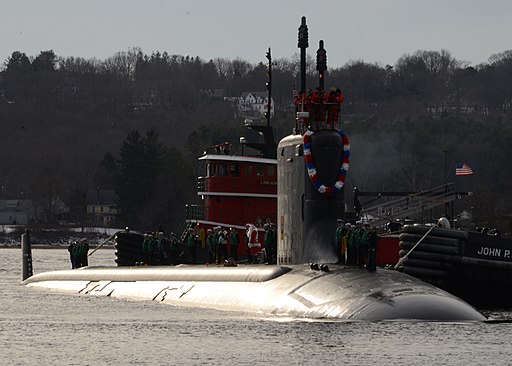
USS Missouri (SSN-780)
The USS Missouri (SSN‑780) is the fourth U.S. Navy vessel to bear the name in honor of the state of Missouri. As a Virginia‑class attack submarine, Missouri combines advanced nuclear propulsion, cutting‑edge sensor suites, and an array of lethal armaments. Her role is to provide strategic deterrence, perform intelligence, surveillance, and reconnaissance (ISR) missions, and engage in both anti‑submarine and land‑attack operations. Missouri stands as a testament to modern naval engineering—a versatile platform designed for both high‑intensity conflict and covert operations .
Historical Background
Contract and Construction
The journey of USS Missouri (SSN‑780) began when the contract to build her was awarded on August 14, 2003, to a collaborative team led by General Dynamics Electric Boat and Northrop Grumman Shipbuilding-Newport News. With components constructed at both shipyards and final assembly alternating between them at Groton, Connecticut, Missouri’s construction showcased an innovative distributed manufacturing approach. Her keel was laid down on September 27, 2008, marking the formal beginning of her integration into a family of underwater warriors built to meet emerging maritime threats .
Launching, Christening, and Commissioning
Following a swift construction period characterized by rigorous quality control and budget-conscious management, USS Missouri was launched on November 20, 2009. The vessel was christened on December 5, 2009, with Rebecca “Becky” Gates—wife of then‐Secretary of Defense Robert Gates—serving as her sponsor. Missouri was officially commissioned on July 31, 2010, entering active service and setting out to serve with distinction among the U.S. Navy’s submarine squadrons .
Technical Specifications
A detailed examination of USS Missouri reveals a blend of precision engineering, stealth-optimized design, and advanced combat capabilities.
Dimensions and Displacement
USS Missouri is engineered to balance internal capacity with superior hydrodynamic performance. Key dimensional features include:
- Length: 377 feet (115 meters)
- Beam: 34 feet (10 meters)
- Displacement: Approximately 7,800 tons when submerged
These dimensions not only contribute to Missouri’s agility and maneuverability in the challenging undersea environment but also help maintain a low acoustic signature essential for covert operations .
Propulsion and Performance
Nuclear Reactor and Power Generation
At the heart of Missouri’s performance lies the state‑of‑the‑art S9G pressurized water reactor. This nuclear power plant is designed to deliver nearly 280,000 shaft horsepower (210 MW), providing Missouri with virtually unlimited range and the capability to maintain high speeds over extended patrol durations. Energy from the reactor is transferred via a series of steam turbines that drive a single-shaft pump‑jet propulsor, optimized for both quiet operation and rapid acceleration.
Speed, Range, and Deep-Dive Capabilities
- Speed: In excess of 25 knots (28+ mph or 46+ km/h) while submerged
- Range: Essentially unlimited operational range, determined largely by maintenance cycles and crew endurance rather than fuel limitations
- Test Depth: The submarine is rated for depths greater than 800 feet (240 meters), enabling her to operate effectively in diverse environmental conditions
The combination of these systems enables Missouri to execute stealthy, high-speed maneuvers while remaining undetected in contested waters .
Crew and Habitability
Missouri is designed with an operational complement of approximately 134 officers and enlisted personnel. Despite the confined nature of a submarine, her interior spaces incorporate ergonomic design principles that optimize crew efficiency and comfort:
- Control Centers: High-tech navigation and combat information centers facilitate rapid tactical decision-making.
- Crew Quarters: Modern berthing and recreational facilities ensure sustained morale during long patrols in an isolated underwater environment.
These features underscore the Navy’s commitment to both mission effectiveness and crew welfare under extended deployment conditions .
Armament and Combat Systems
Vertical Launch Systems and Tomahawk Missiles
One of USS Missouri’s defining offensive features is her integrated Vertical Launch System (VLS). Missouri is equipped with 12 VLS tubes designed primarily to deploy Tomahawk cruise missiles. These missiles provide long‑range land-attack capability, affording the submarine the flexibility to strike high-value targets from a safe distance while operating covertly beneath the waves .
Torpedo Armament
Complementing her missile capabilities, Missouri is also outfitted with four 533‑mm torpedo tubes. These tubes launch heavyweight Mark 48 Advanced Capability (ADCAP) torpedoes, which are rapidly deployable against both undersea and surface threats. This dual capability ensures that Missouri can both initiate offensive strikes and maintain a robust self‑defense posture .
Sensors and Electronic Warfare
Sonar Systems for Undersea Detection
Missouri’s sensor suite plays a crucial role in her operational effectiveness. The submarine features a multi‑tiered sonar system that integrates both active and passive sonar arrays:
- Spherical Active/Passive Arrays: Enable detection and classification of distant contact in the vast underwater environment.
- Light Weight Wide Aperture (TLWA) Arrays: Enhance Missouri’s ability to monitor her surroundings with high resolution.
These systems are designed to work in concert, providing comprehensive situational awareness even under challenging acoustic conditions .
Electronic Countermeasures and Combat Integration
To complement her sensor capabilities, Missouri incorporates advanced electronic warfare (EW) systems. These systems are designed to detect, analyze, and counteract enemy radars and acoustics while providing decoy capabilities against incoming torpedoes and missiles. Integrated within a sophisticated combat control system, Missouri’s EW suite allows real-time responses to emerging threats, ensuring maximum survivability during high‑intensity encounters .
Construction Innovations and Design Features
Advanced Hull Design
The design of USS Missouri is rooted in stealth and durability. Her pressure hull is constructed using a combination of high-strength steel and advanced composite materials that reduce her acoustic signature while enhancing structural integrity. The hull’s shape and internal compartmentalization have been optimized to minimize noise and vibration—critical factors for reducing detection risks by enemy sensors .
Collaborative Shipbuilding Approach
Missouri’s construction benefited from a synergistic collaboration between General Dynamics Electric Boat and Northrop Grumman Shipbuilding-Newport News. This innovative building strategy allowed for streamlined production processes, leveraging the unique capabilities of each shipyard, and resulted in the vessel being completed ahead of schedule and under budget. The successful integration of multiple manufacturing approaches serves as a model for future submarine construction programs .
Operational Role and Strategic Impact
Multi‑Mission Versatility
USS Missouri is built to perform an array of missions that include:
- Intelligence, Surveillance, and Reconnaissance (ISR): Covert operation in contested environments to gather critical data.
- Anti‑Submarine Warfare (ASW): Engaging enemy submarines with advanced torpedo systems and sensor arrays.
- Land Attack Operations: Precision engagement of high-value targets using Tomahawk cruise missiles.
This multi‑mission capability makes Missouri an invaluable asset, able to adapt to a wide range of operational scenarios while maintaining the element of surprise .
Strategic Deployment and Force Projection
Originally assigned to Submarine Squadron 4 at Naval Submarine Base New London, Missouri has since contributed significantly to the strategic deterrence posture of the Navy. Her deployment patterns, advanced systems, and stealth capabilities ensure that she remains a key component of U.S. maritime power, capable of performing forward-deployed operations in some of the world’s most strategic theaters .
Future Enhancements and Conclusion
Continued Modernization
As naval warfare evolves, so too will the systems aboard USS Missouri. Future upgrades may include:
- Enhanced Sonar and EW Systems: Integration of next‑generation sensors to further improve detection capabilities.
- Software and Combat System Updates: Modular upgrades that can be seamlessly integrated to enhance overall performance and interoperability with joint forces.
These improvements will ensure that Missouri remains at the cutting edge of submarine warfare technology throughout her operational life .
Conclusion
The USS Missouri (SSN‑780) represents the pinnacle of modern undersea warfare. With its advanced S9G nuclear reactor, stealth‑optimized design, and versatile combat systems, Missouri embodies the U.S. Navy’s commitment to innovation and strategic deterrence. Whether tasked with intelligence collection, anti‑submarine operations, or land‑attack missions, this Virginia‑class submarine is engineered to excel in every facet of underwater combat.
For those intrigued by the future of naval engineering, the ongoing evolution of systems aboard vessels like USS Missouri offers rich insights into how modern technology continues to redefine maritime strategy in an ever-changing global security environment .
_arrives_at_New_London_in_December_2103.JPG)