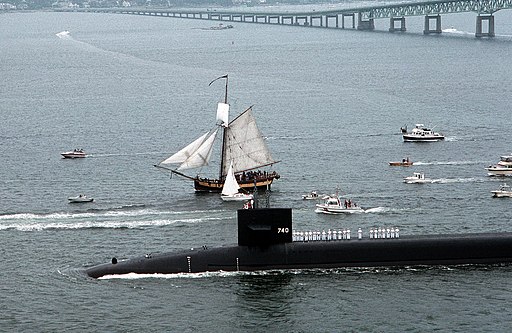
USS Rhode Island (SSBN-740)
USS Rhode Island (SSBN-740) stands as a cornerstone of the United States Navy’s sea-based nuclear deterrent. Commissioned in July 1994, she embodies the Ohio-class submarine design optimized for strategic patrols with ballistic missiles. Operating from her East Coast homeport, she maintains a continuous at-sea presence, ensuring a survivable leg of America’s nuclear triad.
Design and Construction
Contract Award and Keel Laying
The contract to build Rhode Island was awarded to General Dynamics Electric Boat in Groton, Connecticut, on 5 January 1988. Her keel was laid down on 15 September 1988, marking the formal start of assembly. This phase encompassed hull module fabrication, system integration, and pressure hull welding under exacting naval standards.
Launch and Commissioning
Rhode Island was launched on 17 July 1993, sliding into the Thames River to begin outfitting. Over the next year, technicians installed combat systems, sonar arrays, and missile tubes. She was formally commissioned on 9 July 1994, joining the strategic submarine force in Kings Bay, Georgia.
Dimensions and Displacement
Hull Characteristics
Rhode Island’s hull spans 560 feet (170.7 meters) in length, with a beam of 42 feet (12.8 meters) and a draft of 38 feet (11.6 meters). Her teardrop-shaped design reduces drag and noise, enabling stealthy transit at depth.
Displacement Overview
| Condition | Displacement |
|---|---|
| Surfaced | 16,764 long tons |
| Submerged | 18,750 long tons |
High-strength HY-80 steel and anechoic coatings furnish structural integrity and acoustic dampening, crucial for evading sophisticated sonar.
Propulsion and Performance
Nuclear Reactor
Powered by a single S8G pressurized-water reactor, Rhode Island generates steam to drive her turbines throughout her 40-year service life without refueling. The core uses highly enriched uranium to maintain continuous output.
Turbine and Shaft System
The reactor feeds two geared turbines linked to a single shaft, producing up to 60,000 shaft horsepower (45,000 kW). An auxiliary motor supplying 325 horsepower aids maneuvering at low speeds.
Speed and Endurance
Cruising submerged speeds exceed 20 knots (37 km/h), with a maximum reported in excess of 25 knots (46 km/h). Unlimited by fuel constraints, her endurance is limited only by provisions for crew and stores, enabling patrols lasting over three months.
Armament
Ballistic Missile Capability
Rhode Island carries 24 vertical launch tubes for Trident II D-5 submarine-launched ballistic missiles. Each missile, with a range exceeding 7,000 nautical miles, can deliver multiple independently targetable reentry vehicles.
Self-Defense Weaponry
To counter close-in threats, she is fitted with four 21-inch (533 mm) torpedo tubes. Mark 48 ADCAP heavyweight torpedoes provide defense against enemy submarines and surface ships.
Sensor and Electronic Suites
Sonar Arrays
Her sensor suite combines a bow-mounted spherical sonar, conformal hull arrays, and a towed array sonar system. This layered arrangement ensures detection of contacts at varied frequencies and ranges.
Navigation and Communication
An inertial navigation system augmented by GPS offers continuous position fixes. Secure satellite communications and ultra-low-frequency antennas enable reliable contact with national command authorities even while submerged.
Crew Accommodations
Dual-Crew Rotation
Rhode Island employs a Blue and Gold crew rotation, each consisting of approximately 15 officers and 140 enlisted personnel. This dual-crew model doubles operational availability by minimizing turnaround time between patrols.
Living and Support Facilities
Interior spaces include berthing for up to 155 sailors, a galley, mess decks, exercise areas, and a small medical bay. Efficient compartmentalization balances operational functions and crew morale on extended missions.
Operational Role and Strategic Impact
Rhode Island’s primary mission is continuous deterrent patrol, quietly patrolling designated ocean areas to guarantee second-strike capability. Her survivable posture under the sea is a strategic linchpin, dissuading adversaries from contemplating nuclear aggression.
Modernization and Upgrades
During her Engineered Refueling Overhaul, completed in 2018, Rhode Island received:
- Reactor core replacement for extended service life
- Combat system electronics upgrade with digital signal processing
- Improved sonar processing hardware
- Habitability enhancements, including LED lighting and climate control
These upgrades maintain her cutting-edge status well into the mid-21st century.
Conclusion
USS Rhode Island (SSBN-740) exemplifies the fusion of nuclear propulsion, stealth design, and potent firepower. Her strategic patrols reinforce global stability through credible deterrence. As she continues operations, Rhode Island remains a silent sentinel beneath the waves, safeguarding peace through strength.
.jpg)