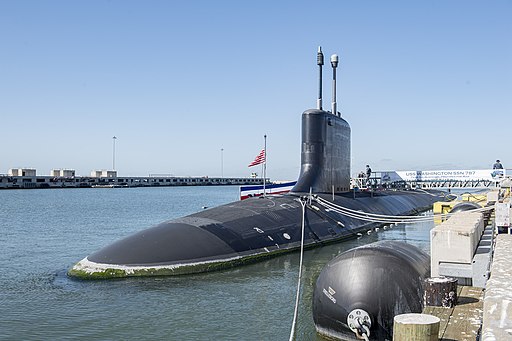
USS Washington (SSN-787)
USS Washington (SSN-787) is a Virginia-class nuclear-powered attack submarine in the United States Navy. She honors the state of Washington and embodies the Block III improvements in stealth, payload flexibility, and modular design. Commissioned in October 2017, Washington operates under Submarine Group 2 with a homeport at Naval Station Norfolk, Virginia.
Development and Construction
Naming and Contract Award
The contract to build USS Washington was awarded on 22 December 2008 to Huntington Ingalls Industries in partnership with Electric Boat. The selection of the name Washington continues the tradition of naming attack submarines after U.S. states, emphasizing the connection between naval power and the Pacific Northwest region.
Keel Laying and Launch Milestones
Washington’s keel was laid on 22 November 2014 at Newport News Shipbuilding. She was christened on 5 March 2016, launched on 13 April 2016, and delivered to the Navy on 26 May 2017. The submarine was officially commissioned on 7 October 2017 in Norfolk, marking her entry into active service.
Hull Architecture and Stealth Features
Pressure Hull and Low-Observable Coating
The internal pressure hull is built from high-yield HY-100 steel, designed to withstand depths beyond 240 meters. An outer hydrodynamic casing is covered with anechoic tiles that absorb incoming sonar pings, reducing the submarine’s acoustic signature and making detection by enemy sensors far more difficult.
Block III Bow Redesign
As a Block III ship, Washington features a revised bow section with two large-diameter Virginia Payload Tubes replacing the previous twelve smaller vertical launch tubes. Each tube can carry up to six Tomahawk cruise missiles, streamlining reload operations and simplifying future integration of new payloads such as unmanned undersea vehicles or advanced munitions.
Propulsion and Performance
Nuclear Reactor and Turbine Plant
Power is provided by a single S9G pressurized-water nuclear reactor fueled with 93 percent highly enriched uranium. The reactor’s steam output drives two turbines rated at a combined 210 MW (280,000 shaft horsepower), supplying virtually unlimited endurance and allowing the submarine to operate for over 30 years without refueling.
Pump-Jet Propulsor and Secondary Motor
Thrust is delivered through a single pump-jet propulsor, which reduces cavitation noise compared to a conventional propeller. A secondary electric motor provides ultra-quiet maneuvering capability for covert operations in littoral and deep-water environments.
Speed, Depth, and Endurance
USS Washington can exceed 25 knots submerged and sustain operations at test depths greater than 240 meters. Her nuclear propulsion grants an essentially unlimited range, constrained only by food and maintenance requirements, enabling patrols lasting up to 90 days on station without surfacing.
Sensors and Combat Systems
Integrated Sonar Suite
The submarine employs a multi-frequency sonar array, combining a bow-mounted spherical array, conformal flank arrays, and a towed passive array. This configuration enables long-range detection and classification of contacts in both deep ocean and shallow littoral zones.
Combat Management System
An advanced combat management system fuses sonar, navigation, fire control, and electronic support measures into a unified tactical display. The system automates target tracking and weapon assignment, allowing rapid engagement of multiple threats.
Armament
Tomahawk and VLS Capability
Washington’s two Virginia Payload Tubes can accommodate up to twelve BGM-109 Tomahawk cruise missiles for long-range strike missions. The large-diameter tubes simplify missile handling and support future integration of next-generation payloads without major structural changes.
Torpedo Tubes and Mine Warfare
Four 533 mm torpedo tubes launch Mk 48 heavyweight torpedoes for anti-submarine and anti-surface warfare. These tubes also have the flexibility to deploy naval mines or launch unmanned undersea vehicles for reconnaissance and special-operations support.
Crew and Habitability
USS Washington is crewed by approximately 134 officers and enlisted personnel. Modular berthing areas and workspaces support rotating watch sections, while life-support systems manage air quality, freshwater production, and waste treatment. Common spaces include a galley, mess decks, a small gym, and secure communication centers.
Technical Specifications
| Parameter | Value |
|---|---|
| Class & Block | Virginia-class, Block III |
| Displacement | 7,800 t surfaced; 7,800 t submerged |
| Length | 114.9 m |
| Beam | 10.3 m |
| Draft | 9.3 m |
| Test Depth | >240 m |
| Reactor | 1 × S9G PWR reactor (93 % HEU) |
| Power Output | 210 MW (280,000 shp) |
| Propulsion | 2 × steam turbines; 1 × single-shaft pump-jet propulsor; 1 × electric motor |
| Speed | >25 knots |
| Endurance | Unlimited nuclear fuel; ~90 days supplies |
| Complement | ~134 officers and enlisted |
| Vertical Launch Tubes | 2 × large-diameter VPT (up to 6 missiles each) |
| Torpedo Tubes | 4 × 533 mm |
| Primary Armament | Tomahawk cruise missiles; Mk 48 torpedoes |
| Hull Material & Stealth Features | HY-100 steel; anechoic tiles |
Further insights into USS Washington’s operations include her role in undersea deterrence patrols, multinational exercises, and integration of unmanned systems for enhanced situational awareness. Continuous upgrades to her combat systems and payload flexibility ensure she remains a formidable asset in twenty-first-century naval warfare.
_at_Naval_Station_Norfolk_on_4_October_2017_(171004-N-NX690-073).JPG)