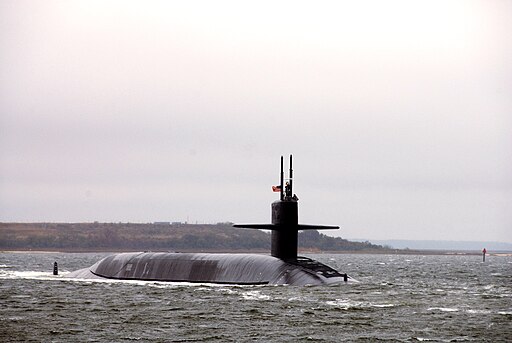
USS West Virginia (SSBN-736)
USS West Virginia (SSBN-736) is an Ohio-class ballistic missile submarine serving as a key strategic deterrent in the United States Navy. Commissioned in October 1990, she operates under the “Great Lakes” motto Montani Semper Liberi (Mountaineers Are Always Free). Forward-deployed from Naval Submarine Base Kings Bay, Georgia, West Virginia sails on continuous deterrent patrols, transmitting the nation’s commitment to global security beneath the world’s oceans.
Development and Construction
Naming and Contract Award
The third naval vessel to bear West Virginia’s name, SSBN-736 was authorized in late 1983 when the Navy placed an order for new Ohio-class submarines to sustain and expand its sea-based leg of the nuclear triad. Her name selection reflected both the state’s mountainous heritage and its symbolic role in American union.
Keel Laying and Launch
On 24 December 1987, shipbuilders at General Dynamics Electric Boat in Groton, Connecticut, laid her keel. Precision welding of HY-80 steel plates formed the pressure hull, while modular sections incorporated missile tubes and habitability compartments. She slid into the Thames River on 14 October 1989, and a six-month fitting out and sea trials program culminated in her commissioning on 20 October 1990.
Hull Architecture and Stealth
Dual-Hull Construction
West Virginia employs a dual-hull design: a robust inner pressure hull and an outer hydrodynamic casing. The inner hull withstands extreme undersea pressures, while the outer hull’s streamlined form minimizes flow noise and drag. Space between the hulls houses ballast tanks, piping, and acoustic insulation.
Acoustic Quieting Measures
To evade advanced sonar arrays, the submarine’s machinery mounts on vibration-damping skids, and onboard systems use quiet-flow hydraulics. Anechoic tiles adhere to her outer casing, absorbing incoming active sonar pings. Together, these features make her one of the stealthiest platforms in the fleet.
Propulsion and Performance
S8G Nuclear Reactor and Turbine Plant
Powered by a single S8G pressurized-water reactor, West Virginia generates high-pressure steam for two main turbines. These turbines deliver up to 60,000 shaft horsepower through a single low-noise propulsor. An auxiliary electric motor supplements propulsion for ultra-quiet operations during close contact tracking or habitat transits.
Speed, Test Depth, and Endurance
West Virginia exceeds 25 knots submerged, enabling rapid transit between patrol areas. Her estimated test depth surpasses 800 feet, providing ample buffer against adversary depth charges. Fuel for her reactor core lasts the vessel’s planned 42-year service life, with at-sea endurance limited only by food, spare parts, and crew stamina.
Armament
Trident II D-5 Ballistic Missile System
At her heart are 24 vertical launch tubes for Trident II D-5 submarine-launched ballistic missiles. Each missile carries multiple independently targetable reentry vehicles with ranges exceeding 7,500 miles. Automated handling systems and shock-absorbent launch canisters ensure safe, reliable missile readiness under all sea conditions.
MK 48 Heavyweight Torpedoes and Countermeasures
Four 533 mm torpedo tubes deploy MK 48 ADCAP torpedoes for self-defense. The submarine also carries decoy launchers and can deploy countermeasure packages that mimic her acoustic signature, drawing hostile torpedoes away from the hull.
Sensors and Electronics
Sonar Suite
West Virginia’s sensor array blends active and passive detection. A bow-mounted spherical array provides focused active sonar sweeps. Flank-mounted passive arrays on either side extend her acoustic aperture, while a towed passive array trails behind, listening silently to distant contacts across a wide frequency band.
Navigation, Communication, and Fire Control
Inertial navigation systems link with submarine navigation periscopes or photonic masts when near the surface for precise positioning. Secure extremely low-frequency (ELF) and very low-frequency (VLF) antennas receive strategic messages from national command authorities. The combat system integrates sonar data, navigation solutions, and fire control to calculate launch solutions for both missiles and torpedoes.
Crew and Habitability
Dual-Crew Rotation
Operated by Gold and Blue crews, each with 15 officers and 140 enlisted personnel, West Virginia sustains a continuous deterrent presence. Rotating crews maximize time at sea while preserving crew readiness and morale ashore.
Living Spaces and Life-Support
Submarine life-support systems scrub carbon dioxide, generate oxygen, and desalinate seawater for drinking and cooling systems. Berthing areas use fold-away racks to conserve space. Common areas include a galley, mess decks, a fitness corner, and secure communication stations—vital for prolonged submerged patrols.
Operational Role and Patrols
Sea-Based Strategic Deterrence
West Virginia conducts two-to-three-month deterrent patrols, positioning quietly beneath the Atlantic and Pacific to guarantee second-strike capability in the event of a nuclear attack. Her presence deters aggression by ensuring any adversary contemplates the assured retaliatory power held underwater.
Overhauls and Modernization
Naval Shipyards periodically refuel and overhaul her reactor and upgrade combat systems. Modernization programs have enhanced her navigation suite, electronic warfare equipment, and data links to maintain interoperability with evolving fleet architectures and secure satellite communications.
Technical Specifications
| Parameter | Value |
|---|---|
| Class & Type | Ohio-class ballistic missile submarine |
| Displacement | 16,764 long tons surfaced; 18,750 long tons submerged |
| Length | 560 ft (170 m) |
| Beam | 42 ft (13 m) |
| Draft | 38 ft (12 m) |
| Hull Material | HY-80 high-yield steel |
| Propulsion | 1 × S8G PWR reactor; 2 × steam turbines; 1 × auxiliary motor |
| Power Output | 60,000 shaft horsepower |
| Speed | > 25 knots submerged |
| Test Depth | > 800 ft |
| Endurance | Reactor core life: > 40 years; patrols: ~ 70–90 days supplies |
| Complement | 15 officers; 140 enlisted (per crew) |
| Missile Tubes | 24 × Trident II D-5 SLBMs |
| Torpedo Tubes | 4 × 533 mm tubes |
| Primary Defense | MK 48 ADCAP heavyweight torpedoes; acoustic decoys |
| Sensor Suite | Bow spherical active array; flank passive arrays; towed array |
| Navigation & Comms | Inertial navigation; photonic mast; ELF/VLF antennas |
Through rigorous training, advanced stealth technologies, and a potent missile load, USS West Virginia remains a silent sentinel of nuclear deterrence, safeguarding national security beneath the waves.
