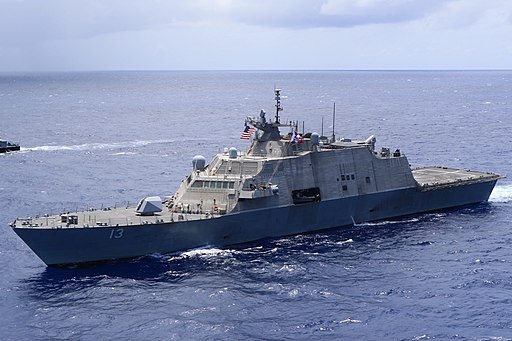
USS Wichita (LCS-13)
USS Wichita (LCS-13) is a Freedom-class littoral combat ship designed for high-speed operations in near-shore environments. Commissioned in January 2019, she combines modular mission packages, shallow draft capability, and advanced propulsion to address asymmetric threats close to coastal waters while maintaining over-the-horizon reach through aviation and unmanned systems.
Historical Context
Namesake and Symbolism
Wichita honors the largest city in Kansas, reflecting the region’s heritage with a crest that features a bison skull and wheat sheaves to symbolize native plains culture and agricultural traditions. Her motto, “Keeper of the Seas,” underscores a protective role over key maritime approaches.
Development and Construction
Awarded on 4 March 2013 and built by Marinette Marine in Wisconsin, Wichita’s keel was laid on 9 February 2015. She was launched on 17 September 2016, underwent fitting-out and trials, and was officially commissioned on 12 January 2019 in Mayport, Florida.
Design and Structure
Hull Form and Materials
The ship utilizes a steel monohull for strength and damage tolerance, paired with an aluminum superstructure to reduce top-weight. Hydrodynamic optimization—including an extended stern transom and buoyancy tanks—enhances stability at high speeds and improves seakeeping in rough seas.
Modular Construction
Block-modular construction allowed parallel assembly of machinery, weapons, and accommodations. This approach accelerates build timelines, simplifies mid-life upgrades, and supports rapid reconfiguration of mission modules without major structural work.
Propulsion and Performance
CODAG Propulsion System
USS Wichita employs a combined diesel and gas (CODAG) arrangement: two Rolls-Royce MT30 gas turbines (36 MW each) for high-speed dashes and two Colt-Pielstick diesels (6 300 kW each) for cruising efficiency. Four waterjets translate power into over 45 knots of top speed under favorable conditions.
Speed, Range, and Endurance
With a shallow draft of 4.0 m and light displacement of 3 500 t, Wichita reaches up to 45 knots in sea state 3. At an economical speed of 18 knots, she can transit roughly 3 500 nautical miles, sustaining deployments of up to 21 days without replenishment.
Mission Modules and Capabilities
Surface Warfare Module
Configurable for surface warfare, Wichita can mount up to two Mk 44 Bushmaster 30 mm guns, Longbow Hellfire missiles, and additional .50 cal mounts. A BAE Systems Mk 110 57 mm deck gun provides rapid-fire support against small craft and shoreline targets.
Anti-Submarine Warfare Module
The ASW package integrates Mk 50 torpedoes, variable-depth sonar, and sonobuoy launchers. Embarked MH-60R Seahawks extend sonar reach and deploy torpedoes, enabling layered prosecution of submarine contacts beyond the ship’s hull-mounted array.
Mine Countermeasures Module
For mine clearance, Wichita carries unmanned surface vehicles and robotic minehunting platforms. High-resolution imaging sonars map littoral seabeds, while remotely operated vehicles classify and neutralize moored and bottom-laid mines without endangering the ship or crew.
Armament and Defense Systems
Primary Gun and Missiles
The forward-mounted Mk 110 57 mm gun fires programmable ammunition at up to 220 rounds per minute, supporting both anti-surface and limited air defense. RIM-116 Rolling Airframe Missiles provide short-range point defense against incoming missiles and aircraft threats.
Secondary and Close-In Weapons
Two Mk 49 RAM launchers, four .50 cal heavy machine guns, and provisions for Phalanx CIWS create overlapping defensive layers. Electronic decoys and chaff dispensers enhance survivability by degrading enemy targeting sensors.
Aviation Facilities
Flight Deck and Hangar
A flight deck aft supports simultaneous operations of MH-60 helicopters and MQ-8 Fire Scout UAVs. A foldable hangar shelter houses one Seahawk and one UAV, with aviation fuel storage and handling equipment enabling sustained airborne surveillance and strike missions.
Unmanned Aerial Vehicle Operations
The MQ-8 Fire Scout adds persistent reconnaissance capability with electro-optical and infrared sensors. Data links feed live imagery to the combat information center, augmenting surface and subsurface situational awareness without risking manned aircraft.
Electronic and Sensor Suite
Radar and Sonar Systems
A multi-function X-band radar provides surface and low-altitude air tracking, supplemented by navigation radar for littoral maneuvering. Hull-mounted sonar and towed arrays feed an integrated ASW combat system for rapid detection and targeting of underwater threats.
Electronic Warfare and Communications
The AN/SLQ-32(V) electronic warfare suite delivers radar warning, jamming, and decoy deployment. A fiber-optic interconnect system ties sensors, weapons, and command posts into a high-bandwidth network for real-time data fusion and cooperative engagement.
Crew and Habitability
Core operations are maintained by a 50-member ship’s company, expandable by up to 75 mission specialists tailored to the embarked modules. Modular berthing units, automated maintenance sensors, and digital damage-control stations reduce fatigue and streamline watch rotations during extended deployments.
Operational Deployment
Since entering service, USS Wichita has participated in joint exercises, freedom-of-navigation patrols, and humanitarian assistance missions. Her modular flexibility and high transit speed enable rapid switching between surface combat, submarine hunting, and mine countermeasure roles in dynamic maritime environments.
Technical Specifications
| Parameter | Specification |
|---|---|
| Class & Type | Freedom-class littoral combat ship |
| Displacement (full load) | 3 500 metric tons |
| Length | 115.3 m (378.3 ft) |
| Beam | 17.5 m (57.4 ft) |
| Draft | 4.0 m (13.0 ft) |
| Propulsion | CODAG: 2 × Rolls-Royce MT30; 2 × Colt-Pielstick diesels; 4 × waterjets |
| Speed | 45 knots (sea state 3) |
| Range | 3 500 nm @ 18 knots |
| Endurance | 21 days |
| Core Crew / Mission Crew | 50 / up to 75 |
| Main Gun | 1 × BAE Mk 110 57 mm |
| VLS Cells | None |
| Surface & ASW Armament | RIM-116 RAM; Mk 50 torpedoes; Hellfire missiles; Mk 44 30 mm |
| Secondary Weapons | .50 cal heavy MGs; optional Phalanx CIWS |
| Aviation Facilities | Flight deck; hangar for 1 MH-60 & 1 MQ-8 Fire Scout |
| Power Generation | 4 × Isotta Fraschini V1708 diesels (800 kW each) |
Conclusion
USS Wichita exemplifies a new generation of agile, mission-tailorable warship. Her pioneering CODAG propulsion, modular payload system, and unmanned platforms position her to confront evolving littoral threats with speed, adaptability, and lethal precision. As part of the U.S. Navy’s littoral combat force, she stands ready to safeguard coastal approaches and project power where traditional vessels cannot operate.
_and_Jamaica_Defence_Force_Coast_Guard_patrol_vessel_HMJS_Cornwall_conduct_a_live-fire_exercise_in_April_2021_-_3_(cropped).jpg)