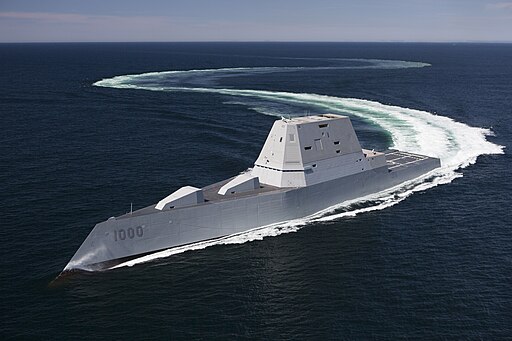
USS Zumwalt (DDG-1000)
Historical Background
Namesake and Program Origins
USS Zumwalt honors Admiral Elmo R. “Bud” Zumwalt, Jr., the youngest Chief of Naval Operations who championed technological innovation in the Vietnam era. The vessel emerged from the DD(X) advanced destroyer program launched in 2001 to deliver unprecedented fire support in littoral environments and reduced detectability against modern sensors.
Construction Timeline
Bath Iron Works began assembling the Zumwalt hull on 17 November 2011. She was launched on 28 October 2013, christened in April 2014, and officially commissioned into the Pacific Fleet on 15 October 2016. The total program cost has been estimated between $3.5 billion and $4.4 billion, reflecting the ship’s cutting-edge systems and low–observability design.
Hull Design and Stealth Features
Tumblehome Hull and Composite Superstructure
Zumwalt’s hull employs a inward-sloping “tumblehome” profile that deflects radar energy away from the source. The superstructure uses composite materials to minimize weight and infrared signature, enabling a radar cross-section comparable to a small fishing vessel despite her 183 m length and 24.6 m beam.
Radar Cross-Section Reduction
Anechoic deck coatings, flush-mounted fittings, and internalized weapon bays all contribute to stealth. The absence of traditional masts and overhangs reduces radar returns, allowing Zumwalt to operate within contested littorals with far less chance of early detection.
Propulsion and Power Generation
Integrated Power System Architecture
At the core is an Integrated Power System (IPS) that delivers up to 78 MW of electrical power across all ship services, from propulsion to combat systems. Unlike conventional mechanical drives, IPS routes generated power via switchboards to either propulsion motors or mission loads, providing unmatched operational flexibility.
Gas Turbines, Generators, and Electric Motors
Two Rolls-Royce MT30 gas turbines (35.4 MW each) and a pair of Rolls-Royce RR4500 turbine generators (3.8 MW each) feed two advanced induction motors driving the twin shafts. This arrangement supports speeds over 30 knots and supplies ample reserve capacity for future high-energy weapons and sensors.
Weapon Systems and Combat Capabilities
Vertical Launch System
Zumwalt carries 80 Mk 57 vertical launch cells arranged in 20 modular canisters. The adaptable VLS accommodates Tomahawk cruise missiles, Standard SM-2/SM-6 air defenses, Evolved Sea Sparrow Missiles, and ASROC anti-submarine rockets, enabling multi-domain strike and defense missions.
Advanced Gun System and Future Armament
Initially outfitted with two 155 mm Advanced Gun Systems (AGS) boasting a 920-round magazine for precision naval fire support, the class is transitioning to the Interim Common-Hull Ballistic Missile (IRCPS) system. This conversion will enable rapid-fire hypersonic projectiles with extended range.
Secondary and Close-In Weapons
Defensive suites include two Mk 46 30 mm automatic guns for fast surface targets and provisions for Rolling Airframe Missile or Phalanx CIWS installations. Electronic decoys and chaff dispensers further degrade incoming threat guidance.
Sensor and Electronic Warfare Suite
Dual-Band Radar System
Zumwalt integrates an X-band multi-function radar and an S-band volume search array into a dual-band radar system. This sensor fusion delivers simultaneous horizon-to-horizon tracking of air, surface, and ballistic threats, feeding the ship’s open-architecture combat management system.
Combat Management and Open Architecture
An open-system combat management framework enables rapid software upgrades and integration of emerging sensors and weapons. All combat functions—from track generation to fire control—operate over a fiber-optic network, ensuring low latency and high data throughput.
Aviation and Unmanned Systems
Flight Deck and Hangar Facilities
The flight deck and hangar support two SH-60 class helicopters or a mix of one MH-60R Seahawk and up to three MQ-8 Fire Scout unmanned aerial vehicles. Integrated refueling and handling equipment sustain extended airborne operations without external support.
Unmanned Aerial Vehicle Operations
The MQ-8 Fire Scout UAVs enhance over-the-horizon surveillance and targeting with electro-optical/infrared sensors. Real-time video and data links provide the command center immediate situational awareness, crucial for littoral reconnaissance and precision strike preparation.
Crew and Habitability
Personnel Complement and Living Quarters
A core crew of approximately 142 sailors operates Zumwalt, supported by automation that reduces watchstanding requirements. Accommodations feature modular berthing zones, individual staterooms for officers, and improved noise and vibration isolation for greater comfort on long deployments.
Automation and Maintenance
Automated condition-based maintenance sensors continuously monitor machinery health, streamlining repair cycles and reducing downtime. Ship systems are zonal-based, allowing localized isolation for casualty control without full-ship shutdowns.
Performance and Endurance
Speed and Range
Zumwalt routinely exceeds 30 knots in sea state 3 while sustaining a range of more than 4,000 nautical miles at cruising speeds. IPS power reserves support future integration of directed-energy weapons without compromising propulsion performance.
Stealth Mission Endurance
The combination of low-observability design, automated systems, and flexible power generation enables extended stealthy patrols near contested coastlines. Zumwalt can loiter in littoral zones for intelligence gathering, special operations support, or precision strike missions with minimal logistical footprint.
Technical Specifications
| Parameter | Specification |
|---|---|
| Class & Type | Zumwalt-class guided-missile destroyer |
| Displacement (full load) | 14,798 t |
| Length | 182.9 m |
| Beam | 24.6 m |
| Draft | 8.4 m |
| Propulsion | IPS: 2 × Rolls-Royce MT30 (35.4 MW); 2 × Rolls-Royce RR4500 (3.8 MW); 2 × induction motors |
| Installed Power | 78 MW |
| Speed | > 30 kn |
| Crew | Approximately 142 |
| VLS Cells | 80 Mk 57 canisters |
| Main Guns | 2 × 155 mm Advanced Gun System (to be replaced by IRCPS) |
| Secondary Weapons | 2 × 30 mm Mk 46; CIWS/RAM provisions |
| Radars & Sensors | Dual-band X/S-band; towed array sonar; EO/IR cameras |
| Aviation Facilities | Hangar and deck for 2 helicopters or 1 MH-60R + 3 MQ-8 |
.jpg)