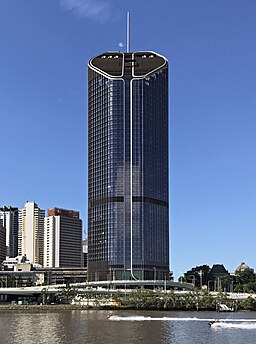
1 William Street, Brisbane
1 William Street: Brisbane’s Tower of Government and Innovation
Standing prominently along the northern banks of the Brisbane River, 1 William Street is one of Queensland’s most iconic modern skyscrapers. Known for its shimmering glass façade and organic design, the building represents a new era for Brisbane’s government infrastructure and urban skyline. Completed in 2016, it consolidates many Queensland Government departments into a single, state-of-the-art office tower, combining architectural elegance with cutting-edge engineering and sustainability.
Architectural Concept
The architectural design of 1 William Street was undertaken by Woods Bagot, a global architecture and consulting firm renowned for its innovative projects. The building’s sculptural form was inspired by natural geological formations and organic river curves, creating a flowing, elegant silhouette distinct from the traditional rectangular high-rises nearby.
Its sinuous, tapering structure rises gracefully from a wide base, narrowing towards the roof, which not only gives it aesthetic appeal but also reduces wind loads — an important consideration for tall buildings in Brisbane’s subtropical climate.
1 William Street is designed to promote openness, collaboration, and transparency, aligning with the Queensland Government’s aspirations for modern public service.
Technical Specifications
- Height to roof: 259.8 meters (852 feet)
- Floor count: 49 floors above ground (plus mechanical and basement levels)
- Construction period: 2013 – 2016
- Primary use: Government offices and commercial spaces
- Total floor area: Approximately 119,000 square meters
- Elevators: 24 high-speed elevators organized into destination control zones
- Architects: Woods Bagot
- Structural engineer: Aurecon
- Developer: Cbus Property
- Main contractor: Multiplex
At the time of its completion, 1 William Street became the tallest building in Brisbane, surpassing the Riparian Plaza and setting a new benchmark for office skyscrapers in the city.
Structural Design and Engineering
The structural engineering behind 1 William Street had to address several challenges, including Brisbane’s subtropical storms, flood-prone location, and geotechnical conditions.
Key features of the structural system include:
- Reinforced concrete core: A central concrete spine houses elevators, stairwells, and service ducts, providing torsional rigidity against wind and seismic forces.
- Perimeter columns: Spaced regularly around the external footprint, these columns help distribute vertical loads and contribute to the building’s lateral stability.
- Transfer trusses and plates: Located at podium levels to distribute loads where column lines change between the low-rise podium and the tower structure.
- Deep foundations: Bored piles extending into stable substrata, designed to withstand the complex soil conditions along the riverbank.
Advanced wind tunnel testing was conducted at the University of Sydney to refine the aerodynamic shape of the tower, ensuring optimal performance under Brisbane’s sometimes cyclonic wind conditions.
Façade Design
The façade of 1 William Street is one of its most striking features:
- Glass curtain wall system: The tower uses high-performance, low-emissivity (low-E) glass panels that provide excellent thermal insulation while maximizing daylight penetration.
- Ceramic frit patterns: Integrated into the glass to reduce solar heat gain and glare, helping maintain a comfortable internal environment.
- Reflectivity: The glass reflects the sky and river, giving the tower a shimmering, ever-changing appearance depending on the weather and time of day.
The curvilinear design of the façade helps mitigate wind forces while also symbolizing fluidity and transparency — values important to the building’s government occupants.
Interior Layout and Facilities
Designed to be flexible and efficient, the internal floorplates of 1 William Street offer wide spans and column-free zones, encouraging open-plan workspaces that foster collaboration.
Key interior features include:
- Sky lobbies: Located at key intervals to facilitate vertical transportation and minimize lift wait times.
- Meeting hubs: Distributed throughout the tower to provide shared, flexible spaces for conferences, meetings, and training sessions.
- End-of-trip facilities: State-of-the-art amenities for cyclists and joggers, including showers, lockers, and secure bicycle storage.
- Public spaces: The podium levels include a grand atrium and public areas that open onto landscaped plazas, enhancing connectivity to the Brisbane River waterfront.
Additionally, the top levels of the building house ministerial offices and Cabinet rooms, offering panoramic views over Brisbane’s cityscape and natural surroundings.
Sustainability and Environmental Performance
From its conception, 1 William Street was designed to achieve high environmental and sustainability benchmarks. The building has achieved:
- 6 Star Green Star Office Design and As Built ratings: Certified by the Green Building Council of Australia (GBCA).
- 4.5 Star NABERS Energy Rating: Reflecting the tower’s energy-efficient operations.
Key sustainability initiatives include:
- Chilled beam air conditioning: Highly energy-efficient cooling system minimizing air movement and providing better occupant comfort.
- Greywater recycling: On-site treatment systems to reuse water for landscape irrigation and toilet flushing.
- Energy-efficient lighting: LED lighting systems with motion and daylight sensors throughout.
- Material selection: Use of recycled and low-emission materials to reduce the building’s carbon footprint.
These features make 1 William Street one of the most environmentally friendly commercial buildings in Australia.
Construction Highlights
Multiplex, one of Australia’s premier construction companies, delivered the project under a design-and-construct contract. Some notable aspects of the construction process include:
- Fast-track construction: The project was completed within just three years, despite its scale and complexity.
- Jump-form core construction: Enabled rapid vertical progression, with some weeks seeing progress of one full floor.
- Prefabrication: Many mechanical and electrical components were prefabricated off-site, improving quality and reducing construction time.
Heavy construction equipment was used to install the deep foundation piles, which were some of the largest ever installed in Brisbane at the time.
Cultural and Political Impact
1 William Street has had a major cultural and political impact in Queensland. Nicknamed “The Tower of Power” by locals, the building centralizes government operations that were previously scattered across multiple sites in Brisbane.
Its completion freed up older government buildings for redevelopment and modernized the way public services are delivered, emphasizing transparency, efficiency, and modern workplace practices.
Moreover, it has become a key architectural feature of Brisbane’s skyline, often illuminated at night with special lighting schemes for events and causes.
Conclusion
1 William Street stands as a testament to Brisbane’s evolution into a mature, globally connected city. Its dynamic design, cutting-edge engineering, and commitment to sustainability make it a landmark not just in height, but in vision. As the home of Queensland’s government and a showcase of contemporary architecture, 1 William Street has set a new benchmark for urban development in Australia, and it will continue to shape the identity of Brisbane for generations to come.
