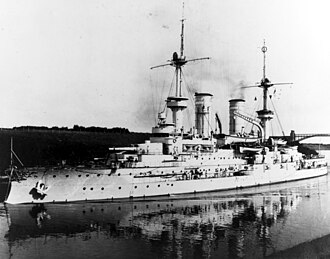
SMS Wettin: The German Pre-Dreadnought Battleship of the Imperial Navy
SMS Wettin was a German pre-dreadnought battleship of the Wittelsbach class and one of the earliest capital ships constructed under the ambitious German Naval Law of 1898. Named after the House of Wettin, the historic dynasty that ruled Saxony and several other German territories, she represented the close relationship between the political traditions of Imperial Germany and the country’s rapidly expanding naval ambitions. Built by Schichau in Danzig, Wettin was laid down on 10 October 1899, launched on 6 June 1901, and commissioned on 1 October 1902. She displaced approximately 11,774 tonnes under normal conditions and more than 12,700 tonnes at full load, while three triple-expansion steam engines gave her a top speed of roughly 18 knots. Her principal armament consisted of four 24 cm guns supported by eighteen 15 cm weapons, twelve 8.8 cm guns, and six 45 cm torpedo tubes.
Although Wettin never became famous for a major naval victory, her career is particularly valuable for understanding how the Imperial German Navy developed before the First World War. She spent most of her early service with the active fleet, participating in demanding annual maneuvers and long training cruises that helped establish the operational experience necessary for Germany’s later High Seas Fleet. By the time the First World War began in 1914, however, the arrival of dreadnought battleships had made her generation of warships obsolete for the principal battle line. She was nevertheless reactivated and assigned to the IV Battle Squadron, operating mainly in the Baltic Sea. Her wartime service included participation in the 1915 Battle of the Gulf of Riga operation, although she did not engage Russian ships directly. Later, shortages of trained personnel and the growing danger from modern weapons led to her withdrawal from frontline duties. She ended the war as a training and depot vessel and was eventually struck from the naval register in 1920 before being sold for scrap in 1921.
The Wittelsbach Class
Germany’s New Naval Construction Program
The Wittelsbach class was significant because it was the first class of German battleships constructed under the Naval Law of 1898. This legislation represented a major change in German naval policy, providing the framework for the systematic construction of a permanent battle fleet. The class consisted of five ships: Wittelsbach, Wettin, Zähringen, Schwaben, and Mecklenburg. Their construction demonstrated that Germany was no longer treating large warships as isolated projects but was developing a standardized fleet structure intended to support sustained naval operations.
The new battleships were evolutionary rather than revolutionary. German designers retained the basic arrangement used by the preceding Kaiser Friedrich III class, including four heavy guns mounted in two twin turrets, one forward and one aft. They also retained a remarkably large secondary battery of eighteen 15 cm guns. This combination reflected the pre-dreadnought theory of naval combat, in which battleships were expected to engage opponents with several different categories of weapons. Heavy guns were intended to penetrate the principal armor of enemy capital ships, while rapid-firing medium-caliber weapons could damage superstructures, secondary batteries, exposed personnel, and other vulnerable areas.
One of the most important changes involved the positioning of the secondary artillery. Instead of distributing the 15 cm guns relatively evenly along the length of the ship, the Wittelsbach class concentrated most of them around the central part of the hull. Seven of the nine guns on each side were positioned in this central area. This arrangement created a concentrated armored battery and reflected the increasing importance German designers placed on protecting the ship’s most important systems within a central citadel.
A Symbolic Name
The name Wettin was drawn from the House of Wettin, one of the most influential dynasties in German history. The dynasty had ruled Saxony and other territories for centuries, and its members occupied important political positions throughout central Europe. Naming a modern battleship after the house connected the technological power of the Imperial Navy with the historical traditions of the German states.
This was more than ceremonial symbolism. The Imperial German Navy frequently used the names of German rulers, dynasties, regions, and historical figures for its capital ships. These names helped present the rapidly expanding fleet as part of a broader national and historical identity. Wettin therefore represented both the industrial transformation of Germany and the country’s desire to establish itself as a major European and global power.
Construction of SMS Wettin
Built at Schichau in Danzig
The keel of Wettin was laid at the Schichau shipyard in Danzig on 10 October 1899 under construction number 676. She was launched on 6 June 1901, with the naming ceremony emphasizing her connection to the Saxon ruling dynasty, and entered commissioned service on 1 October 1902. Construction cost approximately 22.6 million marks, illustrating the considerable financial resources devoted to the creation of Germany’s new battle fleet.
The ship was 126.8 meters long overall and 22.8 meters wide. Her draft was approximately 7.95 meters, while displacement was around 11,774 tonnes under construction conditions and approximately 12,798 tonnes at maximum load. Her complement was roughly 683 officers and sailors, although the exact number could vary according to wartime requirements and the ship’s role. These dimensions gave Wettin a substantial hull capable of carrying heavy armor, large quantities of ammunition, coal, machinery, and crew accommodation while still providing a stable platform for her artillery.
The hull’s broad beam was particularly important for a battleship whose designers wanted to combine heavy protection with a large battery. Stability was essential because artillery accuracy depended upon the ship being able to maintain a relatively steady platform while maneuvering. At the same time, the broad hull contributed to the ship’s ability to withstand damage and remain afloat after sustaining hits.
Triple-Expansion Steam Power
Three vertical triple-expansion steam engines drove three propeller shafts. Steam was generated by six water-tube boilers and six cylindrical boilers, all using coal as fuel. The machinery was rated at approximately 14,000 PS and was designed to provide a maximum speed of about 18 knots. Her cruising range was approximately 5,000 nautical miles at 10 knots.
Triple-expansion engines were well-established technology at the time Wettin was constructed. Steam passed through successive cylinders of increasing size, allowing the machinery to extract energy efficiently before the steam was exhausted. Although these engines would eventually be replaced by steam turbines in the newest battleships, they offered a combination of reliability, efficiency, and engineering familiarity that made them suitable for a major fleet unit.
The three-shaft arrangement was also important. Separate engines and propellers provided a degree of redundancy and helped distribute machinery throughout the hull. For a battleship expected to operate under combat conditions, the ability to retain some propulsion after damage was a valuable design consideration. The arrangement would remain characteristic of many later German battleships.
The Armament of SMS Wettin
Four 24 cm Main Guns
The main battery consisted of four 24 cm SK L/40 guns mounted in two twin turrets. One turret was positioned at the bow and the other at the stern, both on the ship’s centerline. This arrangement allowed the main guns to fire effectively to either side and provided a conventional broadside configuration.
The 24 cm weapons were powerful by the standards of the late 1890s, but their relatively modest caliber would become one of the most obvious signs of the ship’s eventual obsolescence. German naval designers were attempting to balance the size and weight of the main guns with the enormous secondary battery. Larger guns required heavier turrets, ammunition hoists, barbettes, and structural reinforcement, all of which consumed displacement that could otherwise be used for armor, machinery, or secondary weapons.
The resulting design reflected the tactical assumptions of the pre-dreadnought era. Naval officers still believed that a battleship engagement could involve relatively short ranges at which rapid-firing medium artillery would be extremely important. Wettin was therefore not designed around the idea of a single standardized heavy battery. Instead, her weapons were intended to work together in layers.
Eighteen 15 cm Guns
The secondary battery was one of the ship’s most impressive characteristics. Wettin carried eighteen 15 cm SK L/40 guns, providing an enormous volume of medium-caliber fire. Most were concentrated in protected positions around the central part of the hull, with the arrangement intended to give the ship powerful broadside fire while protecting the guns and their crews.
The 15 cm guns had several potential uses. They could attack enemy battleships at closer range, damage lightly protected areas, engage cruisers, and provide additional firepower when the main battery was unavailable or reloading. Their rapid rate of fire was considered particularly valuable because a large number of medium-caliber shells could potentially overwhelm an enemy’s exposed upper works.
Twelve 8.8 cm SK L/30 quick-firing guns provided protection against torpedo boats, while twelve 3.7 cm machine cannon were also carried for close-range defense. Six 45 cm torpedo tubes completed the original armament. The torpedo tubes gave Wettin a weapon capable of inflicting potentially decisive damage against a large enemy vessel at short range, although using torpedoes effectively required closing the distance and accepting considerable tactical risk.
This mixture of calibers may look complicated from a modern perspective, but it was logical within the naval thinking of the period. Battleships faced a wide range of threats, from enemy capital ships to torpedo boats, and each category of weapon was intended to deal with a particular tactical problem.
Armor and Protection
A Heavy Armored Citadel
Protection was central to the design of Wettin. Her waterline armor belt varied from approximately 100 mm in less critical areas to 225 mm in the strongest sections. The main gun turrets were protected by armor up to 250 mm thick, while the armored deck was approximately 50 mm thick. The forward conning tower received particularly heavy protection, reaching around 250 mm.
The distribution of armor reflected the principle that a battleship did not need every square meter of its hull to be equally protected. Instead, designers concentrated the heaviest armor around machinery, magazines, gun positions, and command spaces. The central citadel was intended to preserve the ship’s essential functions even after the outer portions of the hull had suffered damage.
The use of substantial armor also imposed a significant cost in weight. Every additional millimeter of plate affected displacement and therefore influenced speed, draft, fuel capacity, and machinery requirements. Wettin represented a carefully calculated compromise: enough armor to remain a credible battle-line unit, enough machinery to achieve approximately 18 knots, and enough displacement remaining for her extensive artillery.
Peacetime Career
Service With the Active Fleet
After entering service in October 1902, Wettin joined the I Squadron of the German fleet. Her peacetime career was dominated by annual fleet exercises, maneuvers, gunnery practice, and goodwill visits to foreign countries. These activities were central to the development of the Imperial German Navy because the fleet needed not only modern ships but also officers and crews capable of operating those ships together.
Fleet maneuvers were complicated affairs. Battleships had to maintain formation, respond to signals, change course without collisions, coordinate artillery fire, and operate under simulated combat conditions. Officers needed experience in navigation, signaling, gunnery, engineering, and command. Sailors likewise needed to become familiar with the enormous machinery and complicated weapons systems aboard their ships.
For this reason, Wettin‘s years of seemingly uneventful peacetime service were actually important preparation for the future High Seas Fleet. Germany’s battle fleet was being built at the same time that its personnel were learning how to use it. The annual exercises provided an institutional foundation for the operations that would take place after 1914.
The Arrival of the Dreadnought
The technological position of Wettin changed dramatically after the appearance of HMS Dreadnought in 1906. The British battleship introduced an all-big-gun concept combined with turbine propulsion, establishing a new standard for capital ships. Germany responded with its own dreadnought construction program, but this meant that the relatively young pre-dreadnoughts were quickly relegated to secondary status.
By 1911, Wettin was decommissioned as the new generation of German battleships entered service. She was not obsolete because of any sudden mechanical failure or loss of fighting capability; instead, the entire standard of what constituted a first-rate battleship had changed. A ship armed with four 24 cm guns could still inflict serious damage, but it was at a major disadvantage against a modern battleship carrying a uniform battery of much larger weapons.
Rather than dispose of her immediately, the German Navy found another use for the vessel. From December 1911 until the outbreak of the First World War, Wettin served as a gunnery training ship, allowing the navy to exploit her extensive artillery facilities while newer vessels were reserved for the front-line battle fleet.
SMS Wettin During the First World War
Mobilization in 1914
The outbreak of war in August 1914 brought Wettin back into active service. She was assigned to the IV Battle Squadron of the High Seas Fleet alongside her sister ships. The squadron consisted of older pre-dreadnought battleships, which were still considered useful for defensive operations despite their technological disadvantages against modern dreadnoughts.
The Baltic Sea offered a particularly suitable theater for these older ships. Germany could employ substantial naval forces against Russia while reducing their exposure to the most powerful British capital ships. Wettin and her sisters therefore became part of German efforts to control or threaten Russian naval forces and support operations along the Baltic coast.
The ship’s wartime role was nevertheless cautious. Naval commanders understood that the older battleships could not safely challenge modern enemy capital ships under unfavorable circumstances. Their heavy armor and artillery remained useful, but their lower speed, smaller main guns, and outdated fire-control arrangements limited their tactical value.
The Gulf of Riga Operation
In August 1915, German forces launched a major operation in the Gulf of Riga. The objective was to force the entrance to the gulf, disrupt Russian naval forces, and support Germany’s broader military operations on the Eastern Front. Wettin participated as part of the reserve force rather than playing the central role in the fighting.
Her involvement illustrates the changing nature of pre-dreadnought usefulness during the war. Even when an older battleship was not expected to fight directly, its presence could contribute to a large naval operation by strengthening the available force and forcing the enemy to account for its artillery. Wettin could still deliver heavy fire if necessary, but commanders were reluctant to expose such an obsolete ship unnecessarily.
The operation also showed that naval warfare in the First World War was becoming increasingly complicated. Mines, submarines, torpedo boats, coastal artillery, and modern capital ships all posed threats. The old battleship’s original design assumptions had been developed for a very different tactical environment.
Withdrawal From Combat Service
Crew Shortages and Obsolescence
By late 1915 and into 1916, the German Navy increasingly recognized that keeping the Wittelsbach-class ships fully active was difficult to justify. Modern ships required trained crews, and Germany could not afford to devote large numbers of personnel to capital ships whose combat value was limited. The danger posed by British submarines added another reason for caution.
Wettin was consequently withdrawn from frontline service. Her guns and armor were no longer the most valuable aspects of the ship. Instead, her large hull, accommodation spaces, machinery, and training facilities could be used for secondary naval purposes.
She returned to roles associated with training and support. During the remainder of the war, she served as a training and depot ship, allowing the German Navy to continue making use of her even though she was no longer a battle-line unit. This transition was typical of many pre-dreadnoughts during the First World War.
The Final Years of SMS Wettin
From Capital Ship to Support Vessel
The transformation of Wettin from battleship to support ship reflected the rapid evolution of naval technology. Her original mission had been to fight in a battle line against enemy capital ships. By the end of the war, her value lay primarily in providing space and facilities for other naval personnel and vessels.
This was not an unusual fate for pre-dreadnoughts. The ships had been expensive, heavily armored, and mechanically complex, but their hulls remained useful even when their combat systems had become outdated. Training ships, accommodation ships, depot ships, and tenders could all exploit the physical resources that remained after their battle-line careers ended.
Following Germany’s defeat, the remaining Imperial Navy was drastically reduced. There was little reason to preserve Wettin as an operational warship, and she was struck from the naval register on 11 March 1920. She was eventually sold for scrap in November 1921 and dismantled at Rönnebeck, bringing her career to an end.
The Historical Importance of SMS Wettin
A Product of German Naval Expansion
The importance of Wettin lies partly in the circumstances of her construction. She belonged to the first generation of capital ships produced under the Naval Law of 1898, a program that gave the Imperial German Navy the resources and structure required to become a major battle fleet.
Her years of training were equally important. Before Germany could operate a modern High Seas Fleet, it needed officers and sailors who understood large-scale naval operations. Wettin and her sister ships provided years of practical experience in formation maneuvering, gunnery, navigation, engineering, and fleet command. Their contribution to German naval power therefore went far beyond their individual combat capabilities.
A Classic Pre-Dreadnought
Technically, Wettin is an excellent example of the mature pre-dreadnought battleship. Her design combined four 24 cm heavy guns with eighteen 15 cm weapons, substantial armor, three propeller shafts, and a respectable speed. The result was a balanced warship built around the assumptions of naval warfare at the end of the nineteenth century.
But those assumptions were quickly overturned. The dreadnought revolution demonstrated the importance of concentrated heavy-gun fire and improved propulsion, while advances in fire control and underwater warfare further changed the nature of naval combat. Wettin consequently went from front-line battleship to training vessel in less than a decade.
Her story is therefore a useful reminder that military technology can have a remarkably short period of dominance. When Wettin was commissioned in 1902, she was one of Germany’s newest capital ships. By the middle of the next decade, she was no longer considered suitable for frontline warfare.
Technical Specifications of SMS Wettin
The following figures primarily describe Wettin in her original configuration. Some published measurements vary slightly, particularly regarding draft, machinery output, and displacement terminology.
| Specification | SMS Wettin |
|---|---|
| Class | Wittelsbach class |
| Type | Pre-dreadnought battleship |
| Builder | Schichau, Danzig |
| Construction number | 676 |
| Laid down | 10 October 1899 |
| Launched | 6 June 1901 |
| Commissioned | 1 October 1902 |
| Length overall | 126.8 m |
| Beam | 22.8 m |
| Draft | Approximately 7.95–8.04 m |
| Normal displacement | Approximately 11,774 tonnes |
| Full-load displacement | Approximately 12,798 tonnes |
| Propulsion | 3 vertical triple-expansion steam engines |
| Propellers | 3 |
| Boilers | 6 water-tube + 6 cylindrical |
| Power | Approximately 14,000 PS |
| Maximum speed | Approximately 18 knots |
| Range | Approximately 5,000 nautical miles at 10 knots |
| Crew | Approximately 683 |
| Main armament | 4 × 24 cm SK L/40 guns |
| Main-gun arrangement | 2 × twin turrets |
| Secondary armament | 18 × 15 cm SK L/40 guns |
| Anti-torpedo-boat armament | 12 × 8.8 cm SK L/30 guns |
| Small-caliber weapons | 12 × 3.7 cm machine cannon |
| Torpedo armament | 6 × 45 cm torpedo tubes |
| Belt armor | Approximately 100–225 mm |
| Main turret armor | Up to 250 mm |
| Deck armor | Approximately 50 mm |
| Conning tower armor | Up to approximately 250 mm |
| Primary peacetime unit | I Squadron |
| World War I unit | IV Battle Squadron |
| Major wartime theater | Baltic Sea |
| Later wartime role | Training and depot ship |
| Struck from naval register | 11 March 1920 |
| Sold for scrap | 21 November 1921 |
| Final fate | Scrapped at Rönnebeck |
Conclusion
SMS Wettin was a representative but historically important member of the Imperial German Navy’s pre-dreadnought generation. Built at the beginning of Germany’s systematic naval expansion, she embodied the ideas of battleship design that dominated the closing years of the nineteenth century. Four 24 cm guns provided the principal striking power, while eighteen 15 cm weapons supplied an unusually formidable secondary battery. Heavy armor protected the most important parts of the hull, and three triple-expansion engines gave her a respectable speed of around 18 knots.
Her most important contribution, however, may have come during peacetime rather than combat. Years of fleet exercises and training cruises helped German sailors and officers develop the skills needed to operate large formations of battleships. Wettin was therefore part of the institutional foundation from which the later High Seas Fleet emerged.
The First World War provided one final opportunity for the ship to serve in an active military capacity. As a member of the IV Battle Squadron, she operated in the Baltic and participated in the 1915 Gulf of Riga operation, but she was never placed in the kind of decisive capital-ship engagement for which she had originally been designed. The emergence of dreadnoughts had already changed the balance of power, while submarines, mines, torpedoes, and crew shortages further reduced the value of older battleships.
By the later stages of the war, Wettin had become a training and depot vessel. Her transformation demonstrated that even an obsolete warship could retain practical value through her hull, machinery, accommodation, and support facilities. After the war, however, Germany had neither the strategic need nor the political freedom to maintain such a ship, and Wettin was eventually sold for scrap in 1921.
Today, SMS Wettin is best remembered as a symbol of the transitional era between the traditional battleship and the modern dreadnought. She was created at a moment when Germany was building the foundations of a powerful navy, served during the formative years of the Imperial fleet, and survived long enough to witness the technological revolution that made her own design obsolete. Her career captures the extraordinary speed of naval development in the early twentieth century and illustrates how a battleship could move from the cutting edge of technology to a secondary support role within little more than a decade.
