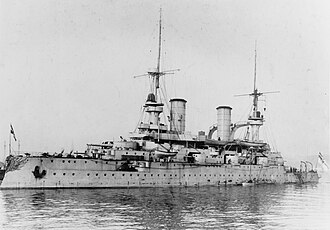
SMS Kaiser Karl der Grosse: The Charlemagne Battleship of Imperial Germany
SMS Kaiser Karl der Grosse was a German pre-dreadnought battleship that belonged to the Kaiser Friedrich III class, a group of five vessels that represented an important stage in the development of the Imperial German Navy. Named after Charlemagne, the medieval ruler whose German name was Karl der Grosse, the ship was built by Blohm & Voss in Hamburg during a period when Germany was transforming its navy from a relatively modest coastal force into a modern battle fleet. Her keel was laid on 17 September 1898, she was launched on 18 October 1899, and she was finally commissioned on 4 February 1902, making her the last member of her class to enter service. Delays caused by a shipyard strike and an accidental grounding during her trials contributed to her late completion. By the time she entered the fleet, however, she was a modern and heavily protected battleship, equipped with four 24 cm guns, an unusually powerful secondary battery of eighteen 15 cm guns, three propeller shafts, and armor up to 300 mm thick.
Although Kaiser Karl der Grosse never became famous for a dramatic fleet engagement, her career provides an excellent window into the evolution of German naval power before the First World War. She spent her first years conducting fleet exercises and training cruises, helping develop the skills required to operate large formations of battleships. In 1908 she was transferred to the reserve as newer vessels entered service, and a few years later the arrival of HMS Dreadnought rendered the entire pre-dreadnought generation fundamentally obsolete. Reactivated when the First World War began, Kaiser Karl der Grosse served with the V Battle Squadron and performed security duties in the German Bight, as well as participating in a Baltic operation in September 1914. From 1915 onward, her role became increasingly secondary: she was employed for training and engineering instruction at Wilhelmshaven before becoming accommodation for prisoners of war. She was struck from the naval register in December 1919 and broken up in 1920.
The Kaiser Friedrich III Class
A New Formula for German Battleships
The Kaiser Friedrich III class marked an important departure from the preceding Brandenburg-class battleships. The Brandenburgs had carried six 28 cm guns in three twin turrets, an unusual arrangement reflecting the experimental nature of battleship design in the early 1890s. German designers subsequently adopted a more conventional layout with two twin turrets, one forward and one aft, each carrying two 24 cm guns. At first glance, reducing the main battery from six heavy guns to four might appear to have represented a decline in firepower, but the change was part of a broader German theory of naval gunnery. The new battleships carried a much larger number of quick-firing medium-caliber guns, giving them an exceptionally powerful secondary battery intended to overwhelm enemy ships with a high volume of fire.
The Kaiser Friedrich III class also established several features that would become characteristic of German battleship design. Most notably, these were the first German battleships to employ three propeller shafts, an arrangement that would be retained by many later German capital ships. Their designers also emphasized seaworthiness and protection. Contemporary descriptions considered the class good sea boats, particularly in comparison with some earlier German vessels that could take considerable water in heavy weather. The ships were therefore intended not merely to defend Germany’s coastline but to operate effectively with an ocean-going battle fleet.
The choice of a large secondary battery was particularly significant. The Kaiser Friedrich III class originally carried eighteen 15 cm guns, more than twice the number of medium-caliber weapons carried by some earlier German battleships. The concept reflected the belief that rapid-firing guns could be devastating against the lightly protected portions of enemy battleships, while also giving the ship a powerful weapon against cruisers and other surface vessels. At the time Kaiser Karl der Grosse was designed, this was a serious and widely debated approach to naval warfare.
The Last Ship of the Class
Kaiser Karl der Grosse was ordered under the 1897 naval construction program and was built by Blohm & Voss in Hamburg. Construction began on 17 September 1898, and the ship was launched just over a year later. Her completion was delayed by industrial and operational problems, however, and she did not enter service until 4 February 1902. That made her the final member of the Kaiser Friedrich III class to become operational.
The delay was unfortunate from a technological perspective because battleship design was advancing at extraordinary speed. Even before Kaiser Karl der Grosse was commissioned, naval powers were experimenting with larger guns, improved armor, more efficient machinery, and better methods of fire control. Nevertheless, she remained a formidable ship by the standards of the early 1900s and embodied the best German thinking that had gone into her design.
The Design of SMS Kaiser Karl der Grosse
Hull and Propulsion
The ship was approximately 125.3 meters long and 20.4 meters wide, with a draft of roughly 7.9 meters. Her displacement was around 11,000 tonnes under normal loading, rising to approximately 11,600 tonnes or more when fully loaded depending on the reference and condition used. Three vertical triple-expansion steam engines drove three propeller shafts, while twelve boilers supplied the steam required to produce roughly 13,000 horsepower. Her maximum speed was approximately 17.5 knots, and her cruising range was about 3,420 nautical miles at 10 knots.
The three-shaft arrangement was one of the most significant aspects of the class. Propulsion technology was undergoing a major transition during these years, and naval engineers were looking for ways to combine power, reliability, and survivability. Three engines and three shafts offered redundancy while allowing the machinery to be distributed through the hull. Although triple-expansion engines would eventually be surpassed by steam turbines, they were well established and dependable technology when Kaiser Karl der Grosse was designed.
Her speed of around 17.5 knots was respectable for a battleship of the period. Speed was increasingly important because a battle fleet needed to maintain formation while retaining the ability to choose or break contact with an opponent. Yet Kaiser Karl der Grosse was never intended to be a fast battleship in the later sense of the term. Her designers prioritized protection and firepower over extreme speed, a trade-off that was typical of pre-dreadnought construction.
Heavy Armor Protection
Protection was one of the ship’s strongest characteristics. Her main belt armor reached approximately 300 mm amidships, tapering toward the ends, while the armored deck was about 65 mm thick. The conning tower and main battery turrets were protected by armor approximately 250 mm thick, while the secondary battery casemates received around 150 mm. Krupp-produced armor was used in the class, providing substantially improved resistance compared with older forms of armor plate.
The armor arrangement reveals the assumptions behind pre-dreadnought battleship warfare. The central portion of the hull, containing the machinery and other vital spaces, received the heaviest protection. The designers expected a ship in battle to absorb repeated shell impacts while continuing to operate its engines and guns. The conning tower was also heavily protected because maintaining command and steering functions was essential even when the rest of the ship was under fire.
Yet the class’s protection was not as comprehensive as that of some later German battleships. The armor belt was relatively narrow, a legacy of earlier battleship design practice. Later ships would make use of improved armor technology to distribute protection over a larger portion of the hull without creating an unacceptable increase in displacement. Kaiser Karl der Grosse therefore occupied an important intermediate position between the armored battleships of the nineteenth century and the more extensively protected dreadnoughts that followed.
A Powerful Pre-Dreadnought Armament
The Four 24 cm Guns
The main battery consisted of four 24 cm SK L/40 guns mounted in two twin turrets, one at the bow and one at the stern. The guns were quick-firing weapons by the standards of heavy naval artillery and represented an attempt to balance shell weight with rate of fire. The arrangement allowed both turrets to contribute to a full broadside, while the centerline positioning avoided the inefficient firing arcs associated with some earlier battleship designs.
The choice of 24 cm artillery was controversial even when the class was being designed. Foreign navies were increasingly experimenting with larger-caliber weapons, and some German naval thinkers also considered adopting guns comparable to those carried by foreign battleships. Ultimately, the Kaiser Friedrich III design retained the 24 cm weapon because it was considered an effective balance between firepower, ammunition supply, rate of fire, and weight. This decision also allowed the ships to retain their unusually large secondary battery.
Eighteen 15 cm Guns
The most distinctive element of Kaiser Karl der Grosse‘s armament was her eighteen 15 cm SK L/40 guns. These weapons were distributed among armored turrets and casemates, providing a formidable broadside of medium-caliber fire. Their purpose was to engage enemy battleships at closer ranges, attack cruisers, suppress exposed portions of opposing ships, and provide additional offensive power if the main battery was damaged or unable to fire.
Twelve 8.8 cm quick-firing guns provided defense against torpedo boats, while twelve 3.7 cm machine cannon were initially carried for very close-range protection. The ship also had six 45 cm torpedo tubes, all carried in above-water mounts. Together, these weapons gave Kaiser Karl der Grosse a remarkably varied offensive and defensive arsenal.
From a modern perspective, the collection of several different calibers seems cumbersome, but it made sense in the tactical environment of the time. Torpedo boats were considered a serious threat to battleships, particularly during nighttime or close-range attacks. A capital ship therefore needed numerous rapid-firing weapons capable of creating a defensive wall of shellfire. The Kaiser Karl der Grosse design attempted to address every major threat simultaneously.
Service With the Imperial German Navy
Peacetime Fleet Service
After commissioning in February 1902, Kaiser Karl der Grosse joined the active fleet and became part of the I Squadron. Her early career consisted largely of fleet maneuvers, training exercises, and cruises in the North and Baltic Seas. These activities were fundamental to the development of the Imperial German Navy because the country was still building the organizational experience needed to operate a large modern battle fleet.
Fleet exercises were much more than ceremonial displays. Battleships had to maintain formation while steaming at speed, respond rapidly to signals, coordinate their gunfire, and execute complicated turns without colliding with neighboring vessels. The increasing size of naval formations made these skills progressively more demanding. Ships such as Kaiser Karl der Grosse served as practical classrooms in which officers and sailors developed the habits that would later be required by the High Seas Fleet.
The ship’s service also coincided with the rapid expansion of the Imperial German Navy under Admiral Alfred von Tirpitz. Germany’s naval laws authorized increasingly ambitious construction programs, while tensions with Britain and other naval powers gave battleship development a strategic significance far beyond individual ships. Kaiser Karl der Grosse was therefore part of a broader political project: the creation of a German battle fleet capable of defending the empire’s maritime interests and challenging established naval powers.
Transfer to the Reserve
By 1908, the rapid arrival of newer German battleships had begun to push the Kaiser Friedrich III class away from the front line. Kaiser Karl der Grosse was transferred to the reserve that year, a sign that her once-modern design was already losing its strategic value.
The change was not caused by any fundamental defect in the ship. Rather, battleship technology had advanced so rapidly that vessels only a few years old could be overtaken by newer designs. Larger guns, better armor arrangements, improved fire control, and more powerful machinery were continually changing the standards by which capital ships were judged.
The arrival of HMS Dreadnought in 1906 accelerated this process dramatically. Her all-big-gun arrangement and turbine propulsion created a new category of battleship. Pre-dreadnoughts such as Kaiser Karl der Grosse could remain useful for training, coastal defense, and secondary duties, but they could no longer be regarded as equal opponents to modern dreadnoughts.
The First World War
Reactivation in 1914
The outbreak of the First World War brought Kaiser Karl der Grosse back into active service. She was reactivated in August 1914 and assigned to the V Battle Squadron of the High Seas Fleet. Her principal role was to perform security and defensive duties in the German Bight, protecting German coastal waters from enemy incursions.
In September 1914, the ship also participated in a German advance into the Baltic. Such operations demonstrated the limited but still useful strategic roles available to older battleships. Although Kaiser Karl der Grosse was not suitable for a confrontation with modern enemy dreadnoughts, her heavy armor and artillery could still provide useful support for defensive or limited offensive operations.
There was no major battle to define her wartime career. This absence of combat was not unusual among older capital ships. Naval commanders were reluctant to risk obsolete battleships in situations where modern enemy vessels might overwhelm them. The principal naval struggle was increasingly centered on the newest dreadnoughts and battlecruisers, while older ships were assigned to less dangerous duties.
Training and Prison Ship
By 1915, Kaiser Karl der Grosse had become effectively obsolete as a combat vessel. She was transferred to training duties at Wilhelmshaven, serving as an exercise and engineering training ship. On 19 November 1915 she was decommissioned and subsequently converted into accommodation for prisoners of war.
The transition from battleship to training ship was typical of the fate that awaited many pre-dreadnoughts. Their hulls remained valuable even after their combat capabilities had declined. A large battleship provided classrooms, workshops, accommodation, storage, and machinery that could be used to train sailors and engineers. Later, the same spaces could serve as barracks or prison accommodation.
For Kaiser Karl der Grosse, this represented a remarkable transformation. When she entered service in 1902, she was one of Germany’s newest capital ships. Thirteen years later, she was no longer considered suitable for the battle fleet and had become essentially a stationary naval facility.
The Final Years of SMS Kaiser Karl der Grosse
The End of an Era
The end of the First World War brought an end to any remaining possibility of restoring Kaiser Karl der Grosse to combat service. Germany’s naval forces were drastically restricted after the war, and there was little reason to preserve an obsolete pre-dreadnought. She was struck from the naval register on 6 December 1919.
In 1920 she was sold for demolition and broken up at Rönnebeck. Her dismantling marked the physical disappearance of one of the battleships that had helped establish the Imperial German Navy as a major European naval power.
Her fate was shared by the other members of her class. All five had been important fleet units during the first decade of the twentieth century, but all were overtaken by the rapid development of naval technology and eventually found secondary roles during the First World War. Their short period of usefulness demonstrates just how quickly capital-ship technology could evolve.
Why SMS Kaiser Karl der Grosse Matters
A Transitional Design
The historical significance of Kaiser Karl der Grosse lies in her transitional nature. She was neither an old-fashioned ironclad nor a modern dreadnought. Instead, she represented the mature pre-dreadnought concept at a moment when naval designers were still trying to determine the ideal balance between main battery size, secondary firepower, armor, and speed.
The class introduced the three-shaft arrangement that became characteristic of later German battleships and established the basic two-turret, four-heavy-gun layout that would be used repeatedly in subsequent German designs. Its heavy secondary battery also reflected a distinctly German interpretation of contemporary naval warfare.
A Symbol of German Naval Ambition
The name itself adds another layer of historical significance. Charlemagne had ruled a vast European empire centuries before the creation of modern Germany, and his memory occupied an important place in German historical culture. Naming a battleship after him associated the modern German Empire with one of Europe’s most famous medieval rulers.
The ship therefore represented both technological and political ambition. She was an enormous industrial product requiring advanced steelmaking, engineering, shipbuilding, and naval organization. Her construction demonstrated that Germany possessed the industrial resources necessary to compete with the established naval powers.
Yet her rapid obsolescence also serves as a reminder that industrial strength alone could not stop technological change. The battleship that represented modernity in 1902 was already a secondary asset by 1915.
Technical Specifications of SMS Kaiser Karl der Grosse
The figures below primarily describe Kaiser Karl der Grosse in her original configuration. Some published specifications vary according to loading condition and whether the original or later wartime armament is being described. The class-level figures are particularly useful because the five ships were broadly similar in dimensions, machinery, protection, and armament.
| Specification | SMS Kaiser Karl der Grosse |
|---|---|
| Class | Kaiser Friedrich III class |
| Type | Pre-dreadnought battleship |
| Builder | Blohm & Voss, Hamburg |
| Laid down | 17 September 1898 |
| Launched | 18 October 1899 |
| Commissioned | 4 February 1902 |
| Length overall | 125.3 m |
| Beam | 20.4 m |
| Draft | Approximately 7.89 m |
| Normal displacement | Approximately 11,100–11,600 tonnes |
| Full-load displacement | Approximately 11,600–11,800 tonnes |
| Propulsion | 3 vertical triple-expansion steam engines |
| Shafts | 3 |
| Boilers | 12 |
| Power | Approximately 13,000 PS |
| Maximum speed | Approximately 17.5 knots |
| Range | Approximately 3,420 nautical miles at 10 knots |
| Crew | Approximately 651 personnel |
| Main armament | 4 × 24 cm SK L/40 guns |
| Main-gun arrangement | 2 × twin turrets |
| Secondary armament | 18 × 15 cm SK L/40 guns |
| Anti-torpedo-boat armament | 12 × 8.8 cm SK L/30 guns |
| Small-caliber armament | 12 × 3.7 cm machine cannon |
| Torpedo armament | 6 × 45 cm torpedo tubes |
| Main belt armor | Up to approximately 300 mm |
| Armored deck | Approximately 65 mm |
| Main turret armor | Approximately 250 mm |
| Conning tower armor | Approximately 250 mm |
| Secondary casemate armor | Approximately 150 mm |
| Active fleet service | 1902–1908; reactivated 1914 |
| First World War role | Coastal and security duties |
| Later role | Training and engineering school ship; prison accommodation |
| Struck from naval register | 6 December 1919 |
| Final fate | Scrapped in 1920 |
Conclusion
SMS Kaiser Karl der Grosse was a product of an extraordinary period in naval history, when the battleship was evolving from the ironclad ships of the nineteenth century into the standardized steel giants that would dominate the seas during the First World War. Her four 24 cm guns, eighteen 15 cm secondary weapons, heavy Krupp armor, three-shaft propulsion system, and respectable 17.5-knot speed made her a formidable pre-dreadnought when she entered German service in 1902.
Her career, however, demonstrates that even the most advanced battleship could have a remarkably short technological lifespan. Delayed construction meant that she entered service as the last member of her class, and only a few years later newer German battleships began pushing her into reserve. The appearance of Dreadnought accelerated the process, turning the Kaiser Friedrich III class from front-line capital ships into obsolete survivors of an earlier naval philosophy.
When Germany went to war in 1914, Kaiser Karl der Grosse could still contribute to coastal security and limited Baltic operations. Her heavy armor and substantial guns had not suddenly ceased to exist, but the strategic environment had changed. Modern dreadnoughts and battlecruisers now represented the true core of the German battle fleet, while the older pre-dreadnoughts were increasingly useful for defensive, training, and support duties.
By 1915, Kaiser Karl der Grosse had become a training and engineering ship and then accommodation for prisoners. Her career ended when she was struck from the naval register in December 1919 and dismantled in 1920.
Ultimately, the story of Kaiser Karl der Grosse is not one of dramatic naval victories but of transformation. She embodied German naval ambition at the beginning of the twentieth century, demonstrated the strengths and limitations of the pre-dreadnought battleship, and witnessed the technological revolution that made her own design obsolete. As the battleship named for Charlemagne passed from powerful fleet unit to reserve ship, training vessel, prison accommodation, and finally scrap, her career traced the extraordinary rise and disappearance of an entire generation of naval technology.
