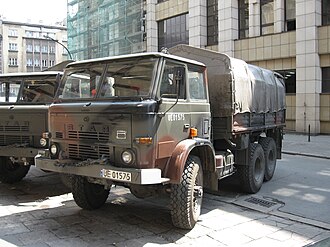
Star 266: The Polish 6×6 Truck That Became an Off-Road Legend
The Star 266 is one of the most important and recognizable trucks in the history of Polish automotive engineering. Built by Fabryka Samochodów Ciężarowych “Star” in Starachowice, the rugged 6×6 was designed primarily as a military transport vehicle, but its abilities made it useful in almost every environment where a dependable all-terrain truck was required. Serial production began in 1973 and continued until 2000, giving the Star 266 an extraordinary working life of more than a quarter of a century. During that period it became the standard medium-capacity off-road truck of the Polish armed forces and was adapted into dozens of specialist vehicles, including fuel tankers, workshops, command vehicles, radio stations, cranes, excavators and fire engines. It was also exported to several countries and eventually gained an unexpected place in motorsport history when specially prepared examples competed in the Paris-Dakar Rally.
The Star 266 succeeded the Star 660 and represented a major step forward in Polish off-road truck design. Although it retained the fundamental idea of a three-axle, all-wheel-drive military truck, it was developed as a new vehicle rather than simply being a modernization of its predecessor. Engineers at FSC Star, the Automotive Industry Design Office in Warsaw and the Military Institute of Armored and Automotive Technology worked together on the project from 1968. The first prototype appeared in 1969, followed by several years of testing and preparation before series production began. The result was a truck combining a 150-hp six-cylinder diesel, 6×6 drive, a two-speed reduction gearbox, high ground clearance and a chassis capable of carrying a remarkable variety of bodies.
The Origins of the Star 266
Replacing the Star 660
By the late 1960s, the Star 660 had become an established military workhorse, but Polish engineers were already looking for a more capable successor. The 660 had demonstrated the value of a relatively simple 6×6 truck, yet advances in vehicle engineering and changing military requirements demanded something more versatile. The new truck needed to transport cargo and personnel over paved roads and difficult terrain, tow trailers and specialized equipment, negotiate water obstacles and operate reliably in harsh climatic conditions.
Development began in 1968, with cooperation between FSC Star’s research and development organization, the Automotive Industry Design Office in Warsaw and the military technical institute in Sulejówek. The first prototype was completed in 1969, after which prototypes underwent extensive road and off-road testing. Engineers spent the period from 1970 to 1973 refining the vehicle and preparing the Starachowice factory for production.
The result was considerably more than a replacement model. The Star 266 was designed around a new frame and running gear, although it shared the general philosophy and some mechanical concepts of the Star 200 and Star 244 families. Its three driven axles gave it a major advantage over conventional trucks, while its dimensions and payload kept it within the medium-duty category. This balance was central to its success: the truck was large enough to perform serious military logistics work but compact enough to operate on narrow tracks and difficult terrain.
The Six-Cylinder Diesel Engine
The S359 and S359M
The Star 266 was powered initially by the Polish S359 diesel engine, later replaced by the improved S359M. This six-cylinder, inline diesel had a displacement of approximately 6.84 litres and produced 150 hp, or about 110 kW. Maximum torque was approximately 432 Nm. The engine used direct fuel injection and was designed with durability and ease of maintenance in mind rather than high specific output.
A 150-hp engine may seem modest for a truck weighing more than seven tonnes, but the Star 266 was not designed to travel quickly with a large payload. Its purpose was to maintain steady progress over difficult ground. The engine worked together with a five-speed manual transmission and a two-speed reduction gearbox, allowing the available torque to be multiplied when the vehicle encountered mud, steep slopes or other obstacles.
Fuel consumption was correspondingly substantial. Museum documentation gives an average figure of approximately 27 litres per 100 km, although actual consumption could vary considerably with terrain, payload, tire pressures and driving conditions. The truck was equipped with two fuel tanks, each holding approximately 150 litres, giving it a substantial fuel reserve for long-distance military operations away from conventional fuel infrastructure.
The Star 266’s 6×6 Drivetrain
Three Driven Axles
The defining feature of the Star 266 was its 6×6 drivetrain. Unlike the Star 200, which was primarily a rear-wheel-drive road truck, the Star 266 delivered engine power to all three axles. This arrangement provided the traction necessary to move through mud, sand, snow and rough terrain while carrying a useful military payload.
The five-speed S5-45 manual gearbox was connected to an SR-380M two-speed reduction gearbox. The reduction unit allowed the driver to select a lower range for particularly difficult terrain. This was a crucial feature because the truck’s off-road performance depended not only on having three driven axles but also on being able to generate sufficient wheel torque at very low speeds.
The driven axles incorporated pneumatically controlled differential locks. These allowed the driver to reduce wheel spin when traction became uneven, particularly when one side of an axle was on slippery ground. Combined with the 6×6 layout and low-range gearing, the system gave the Star 266 impressive mobility without the need for modern electronic traction-control systems.
The mechanical approach also had an important military advantage. A vehicle deployed far from a workshop needed systems that could be understood and repaired by trained mechanics using conventional tools. The Star 266 was complex enough to provide serious off-road capability but remained fundamentally a mechanical machine.
Suspension and Chassis
Built to Carry Heavy Loads
The Star 266 was constructed around a welded longitudinal frame made from pressed steel sections. The chassis had to be strong enough to support not only the standard cargo body but also cranes, tankers, workshops, communications equipment and numerous other specialist installations.
The suspension was equally important. The front driven axle was mounted on semi-elliptical leaf springs and supported by hydraulic telescopic shock absorbers. The middle and rear driven axles used inverted semi-elliptical leaf springs combined with reaction rods. This arrangement provided a robust solution for a vehicle that could experience substantial suspension loads when traveling over rough ground.
Leaf springs were hardly revolutionary technology, but they were exceptionally appropriate for the Star 266. They could carry substantial loads, were comparatively easy to maintain and could withstand the repeated impacts associated with military off-road operation. The suspension’s flexibility also helped keep the driven wheels in contact with uneven ground, an important factor in maintaining traction.
The result was a truck that could work at low speeds over terrain that would be extremely difficult for a conventional commercial vehicle. Its purpose was not to make rough roads feel smooth but to make rough roads passable.
Off-Road Capability
Crossing Water and Difficult Terrain
The Star 266’s off-road specifications were impressive for a medium-capacity truck. It could negotiate water obstacles without preparation to a depth of approximately 1.2 metres, while with additional preparation it could reach around 1.8 metres. Some configurations could even be prepared for movement along the bottom of a water obstacle.
Such capabilities were directly related to its military role. Rivers, flooded roads, mud and damaged infrastructure could all become obstacles during military operations. A truck that depended entirely on paved roads could quickly become useless, while a vehicle such as the Star 266 could continue to transport supplies and personnel.
The truck was also designed to function in difficult climatic conditions. Museum documentation notes that it could operate at very high humidity, while its mechanical systems were intended to tolerate the demanding conditions associated with military deployment. The two large fuel tanks further increased its usefulness in areas where regular refueling was difficult.
The Star 266’s ability to move off-road was therefore not an optional feature. It was the central purpose of the entire vehicle. Every major mechanical decision, from the three driven axles to the low-range gearbox and flexible suspension, contributed to that objective.
The Basic Military Transport Truck
The Workhorse of the Polish Army
The Star 266 became the basic medium-duty off-road transport truck of the Polish armed forces. Its standard cargo configuration could carry up to approximately 5,000 kg on roads and around 3,500 kg in difficult terrain. It could also tow trailers weighing up to approximately four tonnes.
This made the truck suitable for a huge range of logistical tasks. Soldiers, ammunition, fuel, food, engineering equipment and spare parts all had to be moved between bases, field positions and supply points. The Star 266 provided a common platform capable of handling many of these requirements.
The standard cargo body was usually covered by a removable canvas arrangement supported by bows. This allowed the truck to transport personnel as well as cargo while providing basic protection from weather. The cab accommodated two people, with the driver and commander or assistant seated at the front.
Military standardization also contributed to the Star 266’s longevity. Once mechanics and drivers had become familiar with the vehicle, maintaining a large fleet became considerably easier than operating many unrelated truck types. Spare parts, training and workshop procedures could be organized around a common platform.
A Platform for Specialist Vehicles
More Than a Cargo Truck
One of the greatest strengths of the Star 266 was its adaptability. The chassis became the basis for an enormous variety of specialist vehicles. Closed bodies were used for radio stations, command posts, workshops and technical equipment. Tank bodies turned the truck into a mobile fuel carrier, while cranes and excavators transformed it into a mobile engineering machine.
Among the military applications were CD-5 tanker trucks, GD-2 smoke-screen vehicles, ADK-11 command vehicles and specialist decontamination and chemical-reconnaissance machines. The truck was also used to carry elements of the AP-64 and BP-64 components of the PP-64 Wstęga pontoon bridge system. These applications demonstrate how a common 6×6 chassis could become part of an entire military logistics ecosystem.
The Star 266 was even incorporated into the Hibernyt self-propelled anti-aircraft system, carrying a ZU-23-2 gun. This was a striking example of the truck’s ability to provide a mobile platform for military equipment rather than merely transporting supplies.
Civilian users also recognized the value of the chassis. Fire brigades, energy companies, construction organizations and other services needed vehicles capable of reaching locations inaccessible to conventional trucks. The Star 266 offered them an established and proven solution.
The Firefighting Star 266
A Familiar Sight in Rural Poland
Firefighting became one of the Star 266’s most recognizable civilian roles. A 6×6 truck was especially valuable to rural and volunteer fire brigades because emergencies frequently occurred away from paved roads. Forest fires, agricultural incidents and inaccessible rural locations could require a vehicle capable of crossing mud, fields and poor tracks.
The basic chassis could support a range of firefighting bodies and equipment. The combination of a large water supply, pump equipment, crew capacity and four or six-wheel traction depending on the specific vehicle made Star-based fire engines extremely versatile.
For many Polish communities, these vehicles were part of everyday life for decades. A Star 266 fire engine was not merely a piece of municipal equipment; it was often one of the most important emergency vehicles available to a local volunteer brigade.
International Service
Exporting Polish Off-Road Engineering
The Star 266 was not limited to Poland. A total of 4,659 examples were exported to countries including the Soviet Union, Hungary, Angola, Yemen, Libya and Burma. These export contracts demonstrated that the vehicle’s combination of simplicity, payload and off-road mobility had value beyond the Polish market.
Exporting a military-oriented truck was also a useful way for Poland to develop its industrial relationships with other countries within and outside the Eastern Bloc. The vehicle could be supplied in basic cargo form or adapted for specialist applications.
Its ability to function in different climates was particularly valuable. A truck designed for Central European conditions also had to cope with heat, dust, humidity and poor infrastructure in overseas markets. The Star 266’s straightforward mechanical architecture made it comparatively well suited to such environments.
The Star 266 in the Paris-Dakar Rally
An Extraordinary Test of Durability
Perhaps the most surprising chapter in the Star 266’s history came in 1988, when two specially modified examples entered the Paris-Dakar Rally. The rally was one of the world’s toughest motorsport events, combining enormous distances with desert terrain, extreme temperatures and punishing mechanical conditions.
The Star 266s were not purpose-built racing trucks in the modern sense. They remained closely related to the heavy-duty machines developed for military service, although the competition vehicles were specially prepared for the event. Both Polish crews completed the route and reached the finish in Senegal, although they were officially disqualified because they exceeded the event’s time limit.
The result nevertheless demonstrated something important about the underlying design. A truck created primarily to move military cargo across difficult terrain was capable of surviving one of the world’s most demanding endurance rallies. The achievement helped turn the Star 266 from a respected military vehicle into something of an automotive legend.
One of the Dakar trucks is preserved at the Nature and Technology Museum in Starachowice, giving visitors a direct connection with this unusual chapter of Polish motorsport history.
Modernization and the Star 266M
Extending the Life of a Classic Design
By the 1990s, the Star 266 was no longer a young design, but replacing such a large military fleet was neither simple nor inexpensive. Instead, modernization programs were developed to extend its useful life. The Polish Army eventually introduced upgraded versions known as the Star 266M and later more extensive modernization programs.
One significant modernization path eventually produced the 266M2, incorporating a new powertrain and a tilting cab. According to Starachowice historical sources, more than 1,600 vehicles were modernized by AutoBox Innovation over a ten-year period.
This approach is a testament to the strength of the original chassis. Rather than discarding thousands of proven 6×6 vehicles, operators could retain the basic platform while replacing outdated components. A modernized engine, cabin and other systems could make an old Star significantly more useful without losing the rugged chassis and off-road geometry that made it valuable in the first place.
The End of Production
Twenty-Seven Years at Starachowice
Serial production of the Star 266 is generally documented as running from 1973 to 2000, although some sources give 2001 for the final production period. The model therefore remained in production for roughly 27 years, an extraordinary achievement for a truck whose engineering originated in the late 1960s.
The eventual successor was the Star 1466, which represented a more modern generation of heavy all-terrain trucks. By the end of the twentieth century, however, the Star 266 had already established a remarkable legacy.
Its longevity resulted from a combination of proven engineering, large numbers in military service and the availability of specialist bodies. It was not necessary for every customer to buy a new design because the Star 266 continued to perform its essential tasks effectively.
The Star 266 Today
From Military Workhorse to Classic
Today, surviving Star 266s occupy several different worlds. Some remain in military or specialist service, some have been preserved by museums and collectors, and others have been converted into expedition vehicles and recreational campers. The basic 6×6 chassis is particularly attractive to overland enthusiasts because it offers enormous ground clearance, robust axles and the ability to carry a substantial living or expedition body.
The truck’s restoration potential is also enhanced by its mechanical character. Unlike a modern commercial vehicle dominated by electronic control units, sensors and proprietary diagnostic equipment, the Star 266 remains a largely understandable mechanical machine. That makes it attractive to enthusiasts who enjoy maintaining their own vehicles.
Its historical value is equally important. A preserved Star 266 can represent Polish military history, Cold War industrial production, emergency services, international exports and motorsport simultaneously. Few Polish trucks have such a wide historical footprint.
Technical Specifications of the Star 266
The following figures describe a representative standard Star 266. Specialist bodies and later modernization programs could significantly change dimensions, weight and operating characteristics, so these values should be understood as general factory specifications rather than universal figures for every surviving vehicle.
| Specification | Star 266 |
|---|---|
| Manufacturer | FSC Star, Starachowice, Poland |
| Production period | 1973–2000 |
| Vehicle class | Medium-duty all-terrain truck |
| Primary role | Military transport and logistics |
| Predecessor | Star 660 |
| Successor | Star 1466 |
| Drive configuration | 6×6 |
| Engine | S359 / S359M diesel |
| Engine configuration | Inline 6-cylinder |
| Displacement | 6,842 cm³ |
| Maximum power | 150 hp / 110 kW |
| Maximum torque | Approximately 432 Nm |
| Transmission | S5-45, 5-speed manual |
| Reduction gearbox | SR-380M, 2-speed |
| Differential locks | Pneumatically controlled |
| Length | Approximately 6.82 m |
| Width | Approximately 2.50 m |
| Height | Approximately 2.66–3.15 m, depending on body |
| Wheelbase | 2.99 m + 1.25 m |
| Kerb weight | Approximately 7,350 kg |
| Road payload | Approximately 5,000 kg |
| Off-road payload | Approximately 3,500 kg |
| Trailer capacity | Up to approximately 4,000 kg |
| Maximum speed | Approximately 90 km/h |
| Average fuel consumption | Approximately 27 l/100 km |
| Fuel capacity | Approximately 300 litres (2 × 150 l) |
| Standard crew | 2 |
| Water-fording capability | Approximately 1.2 m without preparation; up to 1.8 m with preparation |
| Main body types | Cargo, tanker, workshop, command, communications, crane, fire engine |
| Notable specialist systems | Hibernyt, pontoon transport, ADK-11, GD-2, CD-5 |
Conclusion
The Star 266 deserves its reputation as one of Poland’s great automotive legends. Designed in the late 1960s as the successor to the Star 660, it entered production in 1973 and remained a central part of Polish military logistics for decades. Its combination of a 150-hp six-cylinder diesel, 6×6 drive, two-speed reduction gearbox, locking differentials and strong leaf-spring suspension created a truck that could operate in places where ordinary commercial vehicles simply could not go.
Its versatility was perhaps even more important than its basic off-road performance. The same chassis could become a cargo truck, tanker, workshop, command vehicle, communications platform, crane, excavator or fire engine. It could serve in Poland, be exported overseas or be transformed into an unusual competition truck for the Paris-Dakar Rally. Few commercial vehicles have demonstrated such a broad range of applications.
The Star 266 also illustrates an important principle of durable engineering. Its success did not depend on sophisticated electronics or cutting-edge materials. Instead, it relied on a strong frame, a proven diesel engine, mechanical four-wheel-drive technology, robust suspension and systems that could be repaired and understood by trained mechanics. Those qualities allowed the design to remain relevant long after newer trucks had appeared.
More than two decades after production ended, the Star 266 continues to attract attention from collectors, military historians, off-road enthusiasts and overland travelers. Its distinctive silhouette is instantly recognizable, while its reputation for toughness remains remarkably strong. From Polish military bases to rural fire stations and from African export markets to the sands of the Dakar Rally, the Star 266 proved that a well-designed working truck could become much more than a piece of transport equipment. It became a symbol of Polish engineering, endurance and practical ingenuity.
