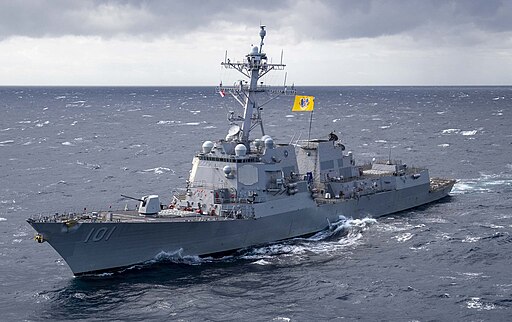
USS Gridley (DDG-101)
The USS Gridley (DDG-101) stands as a testament to modern naval engineering and technological prowess within the United States Navy. As an Arleigh Burke-class guided missile destroyer, this warship is designed to operate in a variety of environments and execute a wide range of missions, from air defense and anti-submarine warfare to strike operations and surface combat. Named in honor of a distinguished naval officer, USS Gridley blends advanced combat systems with robust design features, making it a crucial asset in maintaining maritime superiority.
Historical Background and Naming
Legacy of Admiral Charles Gridley
USS Gridley carries forward the proud legacy of Admiral Charles Gridley, a celebrated figure in naval history known for his decisive leadership and valor during pivotal moments in maritime conflicts. His actions continue to inspire the ship’s crew and serve as a reminder of the Navy’s storied past and commitment to excellence.
Evolution of the Arleigh Burke Class
The Arleigh Burke-class destroyers represent decades of iterative design improvements and strategic innovation. From the first ships commissioned in the 1990s, the class has evolved to incorporate the latest in propulsion, sensor, and weapons technologies. USS Gridley (DDG-101) benefits from these advancements, ensuring that it remains at the cutting edge of modern naval warfare.
Design and Construction
Construction Timeline and Process
The construction of USS Gridley followed a rigorous process combining traditional shipbuilding techniques with state-of-the-art modern practices. Commissioned as part of a continuous production line within the Arleigh Burke program, the ship was built in a modular fashion to expedite assembly while ensuring the highest standards of quality and reliability.
Design Innovations
Innovative design elements in USS Gridley ensure operational flexibility and resilience. The integration of advanced materials and construction techniques contributes not only to the ship’s performance but also to its ability to withstand the harsh conditions of maritime operations.
Hull and Superstructure
The ship’s hull is engineered for optimal hydrodynamics and durability, featuring a streamlined design that minimizes drag and enhances fuel efficiency. The superstructure is designed to house an array of sensors and communications equipment while maintaining a low radar cross-section, contributing to the ship’s stealth characteristics.
Propulsion System
USS Gridley is powered by a combined gas turbine and diesel system that delivers both high-speed capability and fuel efficiency. This propulsion system allows the ship to quickly maneuver in combat scenarios and maintain extended operations at sea.
Technical Specifications
Dimensions and Displacement
USS Gridley has the characteristic dimensions typical of the Arleigh Burke class:
- Length: Approximately 505 feet (154 meters)
- Beam: Roughly 66 feet (20 meters)
- Draft: Close to 30 feet (9 meters)
- Displacement: Typically around 9,200 to 9,700 tons at full load
These dimensions provide a balance between maneuverability and the space required for an extensive array of weapon systems and advanced electronics.
Propulsion and Performance
Gas Turbines and Engine Specifications
The ship is equipped with four General Electric LM2500 gas turbines that deliver a combined power output exceeding 100,000 shaft horsepower. This configuration allows USS Gridley to achieve high speeds while maintaining the agility necessary for complex naval maneuvers.
Speed and Range
With a top speed in excess of 30 knots, USS Gridley can rapidly deploy to areas of strategic interest. Its fuel-efficient design enables an operational range of over 4,400 nautical miles, making it well-suited for long-duration missions in various theaters of operation.
Armament and Combat Systems
The armament suite of USS Gridley is designed for multi-mission capability, integrating offensive and defensive weapons systems to counter a variety of threats.
Vertical Launch System and Missile Types
A key component of the ship’s offensive capability is the Mark 41 Vertical Launch System (VLS). This system can house a mix of missiles, including:
- Standard Missiles (SM-2/SM-3): For anti-air warfare and ballistic missile defense.
- Tomahawk Land Attack Missiles (TLAM): For precision strike capabilities.
- Anti-Submarine Rockets: Enhancing the ship’s ability to engage underwater threats.
The flexible VLS configuration allows commanders to tailor the missile loadout based on the mission at hand.
Naval Gun, CIWS, and Anti-Submarine Warfare Systems
In addition to its missile armament, USS Gridley is equipped with:
- A 5-inch (127 mm) Naval Gun: Providing both surface engagement and shore bombardment capabilities.
- Close-In Weapon Systems (CIWS): For last-resort defense against incoming missiles and aircraft.
- Anti-Submarine Warfare (ASW) Systems: Including torpedo tubes and advanced sonar suites to detect and counter underwater threats.
Sensor Suite and Combat Management
Aegis Combat System
At the heart of USS Gridley’s operational capability is the Aegis Combat System. This integrated system processes vast amounts of sensor data to track and engage multiple targets simultaneously. The Aegis system is central to the ship’s ability to conduct coordinated defensive and offensive operations in a network-centric warfare environment.
Radar and Sonar Systems
USS Gridley is equipped with the AN/SPY-1D(V) radar system, renowned for its ability to detect, track, and classify a wide range of airborne and surface threats. Complementing this is an advanced sonar system designed to enhance the ship’s anti-submarine warfare capabilities, providing a comprehensive situational awareness picture both above and below the waterline.
Operational Capabilities and Missions
Multi-Mission Role
USS Gridley is built for versatility. It can transition seamlessly between various roles, including:
- Air Defense: Providing fleet protection against enemy aircraft and missiles.
- Surface Warfare: Engaging enemy ships and land targets with precision missile strikes.
- Anti-Submarine Warfare: Detecting and neutralizing underwater threats using its sophisticated sonar and torpedo systems.
- Ballistic Missile Defense: Contributing to layered missile defense strategies as part of a broader networked force.
Integration with Carrier Strike Groups
Operating as a key component of Carrier Strike Groups, USS Gridley plays an integral role in modern naval strategy. Its advanced communication systems ensure it remains connected with other vessels and command centers, enabling coordinated operations across vast oceanic theaters.
Modernization and Upgrades
Recent Technological Enhancements
To maintain its cutting-edge status, USS Gridley undergoes regular upgrades and modernizations. Recent enhancements include:
- Software Upgrades to the Aegis System: Improving threat detection and response times.
- Enhanced Cybersecurity Measures: Protecting the ship’s systems against emerging digital threats.
- Integration of New Sensor Technologies: Allowing for more precise tracking of low-observable targets.
These upgrades ensure that the destroyer remains capable of addressing contemporary and future challenges on the modern battlefield.
Conclusion
The USS Gridley (DDG-101) exemplifies the advanced engineering, tactical versatility, and technological integration that define modern naval warfare. With its robust construction, sophisticated armament, and state-of-the-art sensor and combat systems, USS Gridley is a formidable presence on the high seas. It not only fulfills a critical role in the defense strategy of the United States Navy but also stands as a symbol of ongoing innovation and commitment to excellence in maritime operations.
_transits_the_Atlantic_Ocean._(48636129871)_(cropped).jpg)