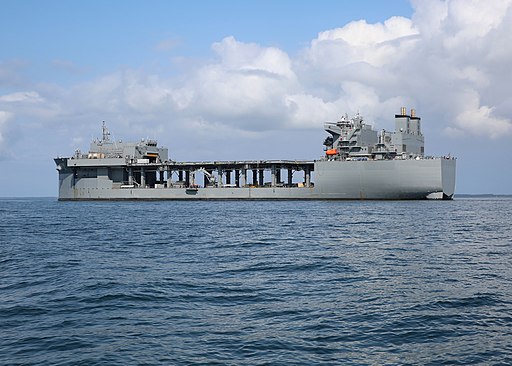
USS Hershel „Woody“ Williams (ESB-4)
The USS Hershel “Woody” Williams (ESB-4) stands as a groundbreaking asset in the U.S. Navy’s evolving expeditionary warfare portfolio. As an Expeditionary Sea Base, she is designed to serve as a flexible, multi-mission platform—capable of supporting operations ranging from amphibious assaults and mine countermeasures to special operations and humanitarian assistance. Named in honor of Medal of Honor recipient Hershel “Woody” Williams, the vessel not only commemorates a legacy of valor but also exemplifies modern naval innovation and modular design.
Concept and Mission
The primary role of the USS Hershel “Woody” Williams is to act as a floating base that extends the reach of the fleet into austere and contested maritime environments. Her design emphasizes rapid reconfiguration, allowing commanders to tailor the vessel’s mission modules to the operational needs at hand. Whether serving as a command and control hub, a logistics support center, or a launch platform for unmanned systems and helicopters, ESB-4 is engineered for versatility and endurance. This multi-role capability is essential in today’s distributed maritime operations, where flexibility and rapid adaptability can be the keys to success.
Hull Design and Dimensions
Built on a robust commercial hull design that has been heavily modified to meet military requirements, the USS Hershel “Woody” Williams offers a unique blend of seakeeping ability and operational functionality. Key technical dimensions include:
- Length and Beam:
The vessel measures approximately 300 feet in length with a beam of around 60 feet. This generous size provides ample deck space for mission modules, aircraft operations, and logistical support while maintaining a form factor suitable for littoral operations. - Draft and Displacement:
With a draft of roughly 15 feet, ESB-4 is optimized for operations in relatively shallow waters, ensuring access to forward operating areas. Her displacement is estimated to be in the range of 3,500 to 4,000 tons, reflecting her robust construction and extensive onboard systems. - Structural Integrity:
The hull is constructed from high-strength steel alloys and incorporates advanced structural reinforcements. This design enables the vessel to withstand the rigors of prolonged operations at sea, including the challenging conditions often encountered in coastal and near-shore theaters.
Propulsion and Power
To support extended deployments and maintain operational mobility, the USS Hershel “Woody” Williams employs a reliable propulsion system:
- Diesel-Electric Propulsion:
The vessel is powered by a state-of-the-art diesel-electric propulsion system. This configuration not only offers an economical cruising mode for sustained operations but also provides the burst power necessary for tactical repositioning. - Speed and Endurance:
Capable of reaching speeds up to 18 knots, the ESB-4 balances maneuverability with fuel efficiency. Its fuel capacity and efficient engines enable it to operate for up to 45 days at sea without the need for resupply, ensuring a persistent forward presence during extended missions.
Mission Modules and Operational Capabilities
One of the defining features of the USS Hershel “Woody” Williams is her modular design. This flexibility allows the vessel to be quickly reconfigured to support a wide range of missions:
- Flight Deck and Aviation Support:
The ship is equipped with a dedicated flight deck capable of handling two medium-sized helicopters. This capability facilitates vertical replenishment, personnel transport, and aerial reconnaissance. A modest hangar area and maintenance facilities further enhance her aviation support role. - Command and Control Center:
At the heart of the vessel is an advanced command and control center. Outfitted with integrated communications, secure satellite links, and state-of-the-art C4ISR (Command, Control, Communications, Computers, Intelligence, Surveillance, and Reconnaissance) systems, this center can serve as the nerve center for joint and combined operations in contested environments. - Mission Bays and Modular Spaces:
Internally, the ship features configurable mission bays that can be tailored for different operational requirements. These spaces can be outfitted as workshops, medical facilities, logistics hubs, or even temporary berthing areas for embarked forces. The modular design ensures that the vessel remains relevant across multiple mission types, from combat support to disaster relief. - Defensive Systems:
Although not designed as a front-line combatant, the USS Hershel “Woody” Williams is equipped with defensive measures to safeguard herself and embarked assets. Close-in weapon systems (CIWS) and integrated countermeasure suites provide protection against aerial threats and small-boat attacks, enhancing her survivability in hostile environments.
Sensor, Communication, and Navigation Systems
A modern expeditionary sea base must maintain seamless situational awareness and secure communication in complex operational theaters. The USS Hershel “Woody” Williams is outfitted with an array of advanced systems:
- Integrated Sensor Suite:
The vessel incorporates both radar and sonar systems tailored for navigation and threat detection in congested littoral zones. These sensors provide 360-degree situational awareness and are supported by advanced signal processing algorithms that differentiate between background noise and potential hazards. - Communications Infrastructure:
High-speed, secure satellite communications ensure that the ship remains connected with command centers and allied forces. Additionally, redundant communication channels guarantee continuous operational links even in electronic warfare environments. - Navigation and C4ISR Capabilities:
Advanced navigational aids and integrated C4ISR systems enable real-time data sharing and rapid decision-making. These capabilities are critical for coordinating multi-domain operations, ensuring that the vessel can act as a floating command post during complex missions.
Crew Accommodations and Support Facilities
The effectiveness of the USS Hershel “Woody” Williams is closely tied to the well-being and readiness of her crew. The design of the vessel places a strong emphasis on operational efficiency and crew comfort:
- Crew Complement:
The ship is designed to support a core crew of approximately 60 personnel. In addition, she has the capacity to accommodate embarked forces and specialist teams, providing the flexibility required for varied mission sets. - Living and Working Spaces:
Crew accommodations include modern, ergonomically designed berthing areas, mess facilities, and recreational spaces. These features help maintain high morale during long deployments. Additionally, dedicated training and briefing areas ensure that the crew remains prepared to respond to any situation. - Operational Support:
Onboard workshops, medical facilities, and logistical support areas contribute to the vessel’s self-sufficiency. This ensures that critical repairs, maintenance, and medical care can be administered without immediate reliance on shore-based support.
Strategic Impact and Future Prospects
The USS Hershel “Woody” Williams (ESB-4) represents a significant evolution in the Navy’s ability to project power and support distributed operations across the globe. Her design reflects the growing need for flexible, mobile platforms that can operate in a wide array of environments, from contested maritime regions to disaster-stricken areas requiring humanitarian aid. As the U.S. Navy continues to embrace distributed maritime operations and networked warfare, vessels like ESB-4 will play a pivotal role in enhancing strategic reach and operational resilience.
Conclusion
With her robust hull design, advanced propulsion system, and modular mission capabilities, the USS Hershel “Woody” Williams (ESB-4) is a testament to modern naval innovation. Her blend of endurance, versatility, and integrated command and control systems makes her a vital asset in the U.S. Navy’s expeditionary operations. As maritime threats evolve and operational demands become increasingly complex, the ESB-4 stands ready to support a wide range of missions, ensuring that U.S. naval forces remain agile, resilient, and effective in safeguarding national interests around the world.
_at_anchor_in_the_Chesapeake_Bay_on_15_September_2019_(190915-N-OH262-0709).JPG)