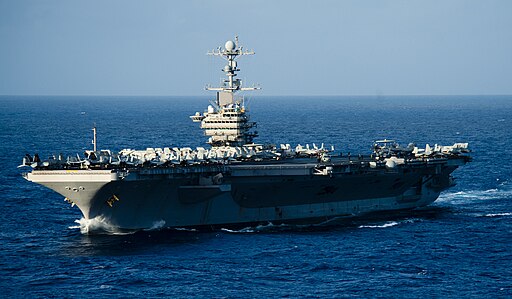
USS John C. Stennis (CVN-74)
USS John C. Stennis (CVN-74): Backbone of American Naval Power
The USS John C. Stennis (CVN-74) stands as one of the United States Navy’s most formidable and strategic maritime assets. As the seventh Nimitz-class nuclear-powered aircraft carrier, the John C. Stennis has played a central role in power projection, maritime security, and forward presence operations around the globe since its commissioning in 1995.
Named after Senator John Cornelius Stennis, a key advocate for a strong U.S. Navy and chairman of the Senate Armed Services Committee for over a decade, CVN-74 embodies the spirit of persistence, national defense, and technological innovation. From launching combat sorties in the Middle East to participating in joint multinational exercises, the USS John C. Stennis represents the steel backbone of U.S. naval air power.
Construction and Background
The keel of CVN-74 was laid on March 13, 1991, at Newport News Shipbuilding, now a division of Huntington Ingalls Industries in Virginia. The carrier was launched on November 13, 1993, and formally commissioned on December 9, 1995. Designed for a 50-year service life, the vessel is slated for a Refueling and Complex Overhaul (RCOH), a critical mid-life upgrade that involves refueling the nuclear reactors and modernizing systems.
General Characteristics
- Type: Nuclear-powered aircraft carrier
- Class: Nimitz-class
- Hull Number: CVN-74
- Builder: Newport News Shipbuilding
- Commissioned: December 9, 1995
- Homeport: Currently under maintenance; previously stationed at Naval Base Kitsap, Bremerton, Washington
Physical Specifications
- Displacement:
- Full Load: Approximately 97,000 long tons (98,500 metric tons)
- Length:
- Overall: 1,092 feet (332.8 meters)
- Waterline: 1,040 feet (317 meters)
- Beam:
- Overall: 252 feet (76.8 meters)
- Waterline: 134 feet (40.8 meters)
- Draft: 37 feet (11.3 meters)
Propulsion and Power Plant
- Propulsion System:
- 2 × Westinghouse A4W nuclear reactors
- 4 × steam turbines driving 4 shafts
- Total Output: 260,000 shaft horsepower (194 MW)
- Speed:
- In excess of 30 knots (56 km/h; 35 mph)
- Endurance:
- Essentially unlimited operational range (20–25 years per refueling cycle)
The nuclear reactors onboard generate enough electricity not just to power propulsion, but also to run an entire floating city, complete with radar systems, air operations, elevators, and life-support systems.
Air Wing and Flight Operations
The USS John C. Stennis supports Carrier Air Wing 9 (CVW-9) in most of its recent operational deployments, although the air wing is modular and may vary depending on mission requirements.
Flight Deck and Launch Capabilities
- Flight Deck Area: 4.5 acres (about 18,210 m²)
- Catapults: 4 × C-13 steam catapults
- Arresting Gear: 4 cables for aircraft recovery
- Aircraft Elevators: 4 deck-edge elevators
Air Wing Composition (Typical)
- Approximately 60 to 75 aircraft, including:
- F/A-18E/F Super Hornet – multirole strike fighter
- EA-18G Growler – electronic warfare aircraft
- E-2D Advanced Hawkeye – airborne early warning and control
- MH-60R/S Seahawk – anti-submarine and search & rescue
- CMV-22B Osprey – carrier onboard delivery (COD)
Armament and Defensive Systems
Although not primarily a warfighting platform in the traditional sense, the carrier is equipped with several layers of defensive weapons to counter threats from missiles, aircraft, and surface craft.
- Missile Defense:
- 2 × RIM-7 Sea Sparrow or ESSM surface-to-air missile launchers
- 2 × RIM-116 Rolling Airframe Missile (RAM) launchers
- Close-In Weapon Systems (CIWS):
- 3 × 20 mm Phalanx CIWS gun mounts for last-ditch defense
- Decoys and Countermeasures:
- SLQ-25 Nixie torpedo decoys
- Electronic countermeasure systems for radar and missile spoofing
Radar, Sensors, and Communication
- AN/SPS-48E: 3D air search radar
- AN/SPS-49(V)5: Long-range air search radar
- AN/SPQ-9B: Surface search and fire control radar
- AN/SLQ-32(V)4: Electronic warfare suite
- Navigation Radars: AN/SPN-46 for landing assistance and AN/URN-25 TACAN
These systems provide situational awareness, target tracking, navigation aid, and precise coordination for carrier-based aviation operations in contested environments.
Crew and Accommodation
- Ship’s Company: Approximately 3,200
- Air Wing Personnel: Approximately 2,480
- Total Complement: Over 5,600 personnel during full operational status
The carrier functions as a floating city with its own:
- Hospital and dental clinic
- Post office
- Cafeterias and bakeries
- Gyms and recreation areas
- Network operations centers
Living conditions have improved over the years, with modern upgrades to berthing spaces, connectivity, and quality-of-life amenities.
Operational History and Achievements
Over nearly three decades of service, USS John C. Stennis has participated in multiple operations, including:
- Operation Southern Watch and Operation Enduring Freedom: Deployed multiple times to the Persian Gulf and Arabian Sea for enforcement of no-fly zones and airstrikes.
- Operation Iraqi Freedom: Provided sustained combat air support during the 2003 Iraq invasion.
- Rim of the Pacific (RIMPAC) Exercises: A frequent participant in multinational naval drills.
- Freedom of Navigation Operations (FONOPs): Conducted strategic presence patrols in the South China Sea to reinforce maritime rights and international law.
The ship’s most recent major deployment concluded in 2019. It then began preparation for Refueling and Complex Overhaul, the most extensive maintenance period in a carrier’s service life, lasting up to four years.
Strategic Importance in the Modern Navy
In an era of near-peer competition and rising global tensions, particularly in the Indo-Pacific and Arctic regions, the USS John C. Stennis continues to symbolize sea-based air dominance and strategic mobility. Its nuclear propulsion allows the U.S. to project power and respond quickly to crises anywhere on the planet without reliance on foreign basing rights.
The upcoming RCOH will upgrade its flight deck for F-35C Lightning II operations, overhaul its nuclear reactors, modernize its electronics, and enhance defensive and cyber capabilities—ensuring the ship remains lethal and relevant into the 2050s.
Conclusion
The USS John C. Stennis (CVN-74) is more than a floating airfield—it is a strategic instrument of American diplomacy, deterrence, and warfighting capability. With nearly 30 years of operations across the globe and a significant modernization overhaul underway, the Stennis is poised to remain a cornerstone of U.S. maritime superiority for decades to come.
As newer Ford-class carriers begin to enter service, CVN-74 will serve as a critical transitional force, bridging the legacy systems of the Cold War era with the cutting-edge capabilities of 21st-century naval warfare.
.jpg)