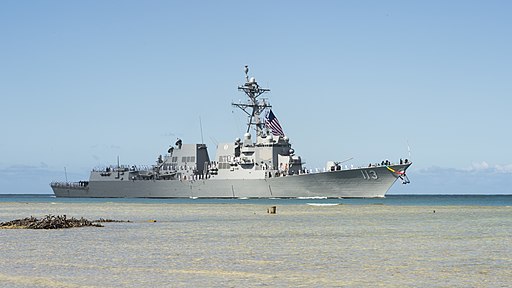
USS John Finn (DDG-113)
USS John Finn (DDG-113): A Legacy of Valor and Modern Naval Power
The USS John Finn (DDG-113) is one of the most advanced and capable destroyers in the United States Navy, embodying both the rich heritage of naval service and cutting-edge military technology. Named in honor of Chief Aviation Ordnanceman John William Finn, a Medal of Honor recipient for his heroic actions during the attack on Pearl Harbor, DDG-113 stands as a testament to bravery, innovation, and maritime dominance.
Commissioned on July 15, 2017, the USS John Finn is the 63rd Arleigh Burke-class destroyer and represents the Flight IIA configuration of the class. Built by Huntington Ingalls Industries at Ingalls Shipbuilding in Pascagoula, Mississippi, the vessel continues to serve as a critical component of the U.S. Navy’s surface warfare capabilities.
Design and Specifications
The Arleigh Burke-class destroyers are widely regarded as among the most powerful and versatile surface combatants in the world. The USS John Finn incorporates enhancements over earlier variants, particularly in its sensor suite, weapon systems, and survivability.
General Characteristics
- Class and Type: Arleigh Burke-class guided missile destroyer (Flight IIA)
- Displacement: Approx. 9,200 tons (full load)
- Length: 509.5 feet (155.3 meters)
- Beam: 66 feet (20 meters)
- Draft: 31 feet (9.4 meters)
- Propulsion:
- 4 × General Electric LM2500-30 gas turbines
- 2 shafts
- Total power output: 100,000 shaft horsepower (75 MW)
- Speed: 30+ knots (56+ km/h; 35+ mph)
- Range: 4,400 nautical miles (8,100 km) at 20 knots
- Complement: Approx. 320 personnel (officers and enlisted)
Sensors and Processing Systems
- Radar:
- AN/SPY-1D(V) multi-function radar (part of Aegis Combat System)
- AN/SPQ-9B surface search and fire control radar
- Sonar:
- AN/SQS-53C hull-mounted sonar
- AN/SQR-19 Tactical Towed Array Sonar
- Electronic Warfare:
- AN/SLQ-32(V)6 SEWIP (Surface Electronic Warfare Improvement Program)
- Advanced decoy and countermeasure systems
Armament
The USS John Finn is equipped for a wide range of missions, from anti-air and anti-submarine warfare to land attack and ballistic missile defense.
- Missiles:
- 96-cell Mk 41 Vertical Launch System (VLS)
- RIM-66M SM-2MR Block IIIB
- RIM-174 SM-6 ERAM
- RIM-161 SM-3 (for ballistic missile defense)
- RIM-162 ESSM (quad-packed)
- BGM-109 Tomahawk cruise missiles
- ASROC (Anti-Submarine Rocket)
- 96-cell Mk 41 Vertical Launch System (VLS)
- Guns:
- 1 × 5-inch (127 mm)/62 caliber Mk 45 Mod 4 naval gun
- 2 × Mk 38 25 mm machine gun systems
- Multiple .50 caliber and M240 machine guns
- Close-In Weapons Systems (CIWS):
- 1 × Phalanx CIWS (Block 1B)
- Torpedoes:
- 2 × Mk 32 triple torpedo tubes (Mk 46 or Mk 54 torpedoes)
Aircraft
- Flight Deck and Hangars: Accommodates up to 2 × MH-60R Seahawk helicopters
- Aviation Capabilities:
- Anti-submarine warfare (ASW)
- Surface surveillance
- Search and rescue (SAR)
- Naval gunfire spotting
- Logistics and personnel transport
Advanced Combat Systems
Aegis Combat System
The core of USS John Finn’s warfighting capability lies in the Aegis Combat System, an integrated naval weapons system that uses powerful computers and radar to track and guide weapons to destroy enemy targets. This system allows the ship to simultaneously engage numerous air, surface, and sub-surface threats.
Baseline 9C and Ballistic Missile Defense (BMD)
USS John Finn features the Aegis Baseline 9C configuration, providing simultaneous air and ballistic missile defense. It integrates the SM-3 for exo-atmospheric missile interception, making it one of the few ships equipped for BMD missions. This capability is critical for defending not only carrier strike groups but also forward-deployed assets and allied nations.
Operational History
Since her commissioning in 2017, USS John Finn has taken part in a variety of exercises, deployments, and strategic operations.
Initial Deployments
Shortly after joining the Pacific Fleet, DDG-113 was assigned to the Destroyer Squadron 1 (DESRON-1), operating out of Naval Base San Diego. The destroyer quickly became a regular participant in RIMPAC (Rim of the Pacific Exercise), Joint Task Force exercises, and freedom of navigation operations (FONOPs) in contested maritime regions such as the South China Sea.
Real-World Engagements
In 2020, the ship was involved in forward operations in the Indo-Pacific, projecting American naval power in a region increasingly marked by strategic rivalry and the assertive maritime posture of regional actors.
In 2021, the USS John Finn gained recognition for a live-fire intercept of a ballistic missile target using the SM-3 Block IIA interceptor — a milestone in the Navy’s BMD program and a powerful demonstration of the ship’s advanced combat systems.
Humanitarian and Escort Missions
The ship has also played a role in humanitarian assistance missions and has provided escort for carrier strike groups, amphibious ready groups, and logistics convoys. Its versatility makes it an ideal platform for diverse missions from deterrence to disaster response.
Namesake: Chief John William Finn
The ship is named after Chief Aviation Ordnanceman John William Finn, who received the Medal of Honor for his actions during the Japanese attack on Pearl Harbor on December 7, 1941. Despite being wounded multiple times, Finn manned a machine gun in the open against strafing enemy aircraft for over two hours. His bravery and self-sacrifice became emblematic of the courage displayed by countless service members that day.
Chief Finn lived to the age of 100 and passed away in 2010, leaving behind a legacy that now sails forward in the form of DDG-113.
Conclusion
The USS John Finn (DDG-113) stands at the intersection of honor and innovation — named for a hero of the past and equipped to face the threats of the future. As part of the Arleigh Burke class, she remains at the forefront of modern naval warfare, with the capability to defend, deter, and dominate in any operational environment. In both form and function, the John Finn continues to honor its namesake by serving as a steadfast guardian of the seas.
_arrives_at_Pearl_Harbor_on_10_July_2017.JPG)