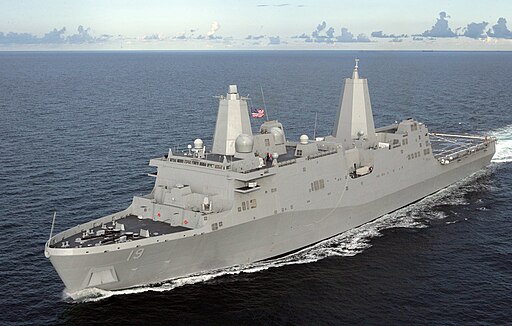
USS Mesa Verde (LPD-19)
USS Mesa Verde (LPD-19) is a San Antonio‑class amphibious transport dock that represents a significant evolution in the U.S. Navy’s ability to project power ashore. Named for Mesa Verde National Park in Colorado—a land known for its ancient cliff dwellings and rich Native American heritage—this vessel embodies the Navy’s commitment to combining operational versatility with technological innovation. Since her commissioning, USS Mesa Verde has played a crucial role in transporting Marines, landing craft, and equipment, serving as a flexible platform capable of executing a variety of missions from amphibious assaults to humanitarian assistance.
Design and Construction
Historical Context and Naming
USS Mesa Verde carries both a symbolic and functional legacy. Being the first U.S. Navy warship to bear the name of Mesa Verde National Park, she honors the history and spirit of a region that is a testament to resilience and ingenuity. Her name reflects a broader commitment to preserving cultural history while advancing modern military capability.
Hull Design and Structural Integrity
Constructed by Northrop Grumman Ship Systems in Pascagoula, Mississippi, USS Mesa Verde’s design is a blend of modern naval architecture and operational practicality. As a member of the third unit in the San Antonio‑class, her construction was marked by robust engineering techniques that ensure outstanding seakeeping in varied and hostile environments. Her hull is designed not only for stability during high-sea operations but also for rapid maneuverability during amphibious assaults. The integration of advanced automation and a streamlined superstructure contributes to reduced crew workload while enhancing overall efficiency.
Construction Milestones
The journey from design to delivery was marked by key milestones. The contract was awarded in February 2000, her keel was laid on 25 February 2003, and she was subsequently launched on 19 November 2004. Following a careful christening and outfitting, USS Mesa Verde was commissioned on 15 December 2007. Each of these phases reflects the Naval Vessel’s evolution into a frontline asset designed for the demands of 21st‑century warfare.
Technical Specifications
The technical attributes of USS Mesa Verde (LPD-19) provide the foundation for her role as a versatile amphibious platform. These specifications highlight the integration of advanced propulsion, significant displacement, and a design that supports both amphibious operations and maritime security.
Dimensions and Displacement
- Overall Length: Approximately 208.4 meters (684 feet)
- Waterline Length: Approximately 201.4 meters (661 feet)
- Beam: About 32 meters (105 feet) at its extreme, with a waterline beam near 29.5 meters (97 feet)
- Draft: Roughly 7 meters (23 feet)
- Full Load Displacement: Approximately 24,433 tons
The dimensions of USS Mesa Verde are optimized for long-range operations and for hosting a wide array of embarked forces and equipment. Her substantial displacement provides the necessary volume to house advanced command and control systems, troop accommodations, and an expansive well deck for landing craft operations.
Propulsion and Performance
- Propulsion System: 4 × Colt-Pielstick diesel engines
- Shafts: 2 fixed shafts
- Combined Power: Around 40,000 horsepower (approximately 30 MW)
- Maximum Speed: Approximately 22 knots (41 km/h or 25 mph)
- Operational Range: Capable of exceeding 7,000 nautical miles at a cruising speed of roughly 18 knots
These propulsion specifications ensure USS Mesa Verde can undertake extended deployments while offering the speed and reliability required for rapid force projection. The robust diesel-powered system also contributes to operational efficiency and lower fuel consumption compared to older steam-powered counterparts.
Armament and Landing Systems
While USS Mesa Verde is primarily designed to support amphibious operations rather than engage directly in front-line surface combat, she is equipped with a suite of defensive and self-protection systems.
Self-Defense Armament
- RIM-116 Rolling Airframe Missiles (RAM): Dual launchers provide point-defense capability against incoming aerial threats such as anti-ship missiles and drones.
- 30 mm Bushmaster II Cannons: Two cannons are installed for close-range surface defense to counter small craft and fast attack boats.
- Machine Guns: Two 0.50-inch (12.7 mm) machine guns offer further close-in protection against asymmetric threats.
These systems ensure that USS Mesa Verde maintains a protective envelope, capable of deterring and neutralizing immediate adversary actions during amphibious operations or while operating in contested waters.
Amphibious and Aviation Capabilities
A defining characteristic of USS Mesa Verde is her multifunctional design, which enables simultaneous transport, embarkation, and deployment of diverse forces:
Landing Craft and Well Deck
- Well Deck Operations: USS Mesa Verde features an expansive well deck that can accommodate up to two LCACs (Landing Craft Air Cushion) or a single conventional LCU (Landing Craft Utility). This capability is critical for offloading Marines, vehicles, and equipment onto hostile shores during amphibious assaults.
- Vehicle and Equipment Transport: The ship is designed to carry a broad array of amphibious vehicles—from armored assault vehicles to amphibious assault vehicles (AAVs), as well as additional support vehicles and even modular logistic units.
Aviation Support
- Flight Deck and Hangar: Integrated into the ship’s superstructure is a flight deck and hangar facility designed to support rotary‑wing and tilt‑rotor operations.
- Aircraft Carried: USS Mesa Verde can embark and recover two CH-53E Super Stallion heavy-lift helicopters or support the operation of MV-22 Osprey tiltrotors.
- Multirole Flexibility: The aviation facilities ensure enhanced situational awareness, rapid casualty evacuation, and the ability to conduct reconnaissance or assault operations.
These integrated landing and aviation capabilities propel USS Mesa Verde to the forefront of modern amphibious warfare, making her a multipurpose platform that seamlessly transitions between transport, assault, and support roles.
Sensor, Communications, and Command Systems
Advanced Sensor Suite
To maintain operational superiority in complex maritime environments, USS Mesa Verde is equipped with an array of state-of-the-art sensors:
- Radar Systems: Modern navigation and surface search radars facilitate safe operations in diverse weather and sea conditions.
- Electronic Support Measures: These systems detect and analyze potential threats, providing early warning of enemy missile launches or electronic interference.
Communications and Command Capabilities
- Secure Communication Networks: Integrated SATCOM, Link 16, and other tactical networking systems allow USS Mesa Verde to remain connected with fleet command and allied units.
- Command and Control Centers: The ship features advanced command spaces that integrate sensor data, facilitate decision‑making, and enable coordinated operations with embarked Marine Expeditionary Units (MEUs).
These systems collectively ensure that USS Mesa Verde can function as a modern command post at sea, coordinating multi‑domain operations and responding quickly to emerging threats.
Crew Accommodations and Operational Facilities
Crew Composition and Habitability
USS Mesa Verde is designed not just for technical excellence but also for the effective deployment and well‑being of her crew and embarked forces:
- Complement: Typically, the ship carries a total complement of around 699 personnel—this includes approximately 66 officers and 633 enlisted sailors, with an additional surge capacity bringing total personnel up to 800.
- Living Quarters: The ship’s design emphasizes modern, comfortable berthing spaces, dining areas, and recreational facilities, which are vital during extended deployments.
Embarked Marines and Expeditionary Operations
A unique feature of amphibious transport docks is their dual role as both warships and temporary landing bases:
- Marines Onboard: USS Mesa Verde can embark a Marine Expeditionary Unit (MEU) of roughly 550 Marines.
- Integrated Operations: Facilities for medical support, logistics, and command make the ship a self‑sufficient base during assault operations or humanitarian relief efforts.
These accommodations ensure that both the ship’s crew and the embarked Marines are well‑supported, capable of sustained operations away from traditional shore bases.
Operational History and Strategic Role
Since her commissioning, USS Mesa Verde has been an essential asset in U.S. Navy expeditionary operations. Her unique blend of transport, command, and landing capabilities enables rapid force projection in contested regions.
Key Deployments and Missions
USS Mesa Verde has participated in numerous maritime exercises and real‑world operations, ranging from high‑intensity amphibious assaults to humanitarian assistance missions in regions affected by natural disasters. Her ability to operate alongside other elements of the U.S. Navy and Marine Corps underscores a strategic commitment to flexibility and rapid response.
Strategic Significance
As global security dynamics evolve, platforms like USS Mesa Verde continue to prove indispensable. Her design facilitates seamless integration of air, sea, and land operations, ensuring that the U.S. maintains a forward‑deployed deterrent capable of responding to both conventional military challenges and non‑traditional threats.
Future Prospects and Upgrades
Looking ahead, USS Mesa Verde is poised for further modernization. Potential future enhancements may include:
- Upgraded Sensor and Radar Systems: Integration of next‑generation radar and electronic warfare capabilities to enhance early threat detection and situational awareness.
- Enhanced Communications: Further improvements to secure networking technologies ensuring faster, more robust connectivity across multi‑domain operations.
- Integration of Unmanned Systems: The ability to control and deploy unmanned aerial and underwater vehicles can further extend the Ship’s operational reach, creating a more comprehensive maritime battlespace network.
These prospective upgrades demonstrate the Navy’s commitment to continual innovation, ensuring that ships like USS Mesa Verde remain at the cutting edge of modern amphibious warfare.
Conclusion
USS Mesa Verde (LPD-19) stands as a testament to the evolving nature of naval warfare—a vessel that merges advanced engineering with the flexibility needed for today’s multi‑role operations. With a robust hull design, powerful diesel propulsion, versatile landing capabilities, and a suite of modern sensors and communication systems, Mesa Verde not only transports troops and equipment but also serves as an integrated command and control hub. As strategic challenges grow more complex, her continued evolution and upgrade will be critical in maintaining U.S. maritime power and ensuring rapid deployment of forces around the globe.
Whether engaging in high‑intensity amphibious assaults or supporting humanitarian relief efforts, USS Mesa Verde remains a quintessential asset—a platform where technology, heritage, and operational adaptability merge for the greater security of the nation.
