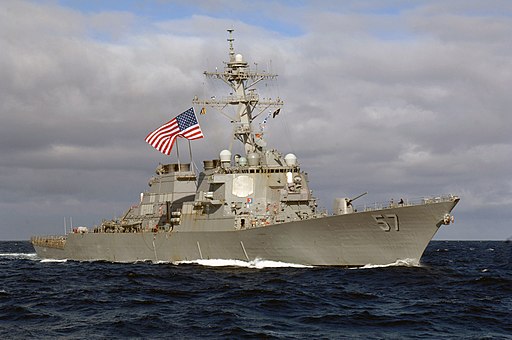
USS Mitscher (DDG-57)
Introduction to USS Mitscher (DDG‑57)
USS Mitscher (DDG‑57) is a Flight I Arleigh Burke‑class destroyer, built with the renowned Aegis Combat System that enables rapid detection, evaluation, and engagement of threats. Commissioned on December 10, 1994, this warship has steadily served as a multi‑mission platform, excelling in air defense, anti‑submarine warfare, and surface combat. Her design reflects a perfect blend of powerful weaponry, advanced sensor arrays, and streamlined propulsion—qualities that make her a linchpin in modern maritime operations .
Mission and Role
As an Aegis‑equipped guided missile destroyer, USS Mitscher is built to anticipate and neutralize threats before they manifest. Her primary missions include protecting carrier battle groups, performing ballistic missile defense, and conducting maritime interdiction operations. With an operational philosophy centered on flexibility and readiness, she is capable of rapid adaptation to emerging threats in both high‑intensity conflict and peacetime presence operations.
Historical Background
Namesake Legacy
USS Mitscher carries the proud name of Admiral Marc A. Mitscher—a distinguished naval aviator and World War II task force commander whose leadership and tactical acumen left an indelible mark on naval aviation history. By bearing his name, the ship honors his legacy and embodies the spirit of innovative maritime strategy and operational courage that defined his career .
Construction and Commissioning
Ordered in December 1988 and constructed at Ingalls Shipbuilding in Pascagoula, Mississippi, her keel was laid down in February 1992. Following a series of meticulous construction phases that underscored advancements in automated assembly and quality control, she was launched on May 7, 1993, and formally commissioned on December 10, 1994. Since then, USS Mitscher has participated in multiple deployments—ranging from Mediterranean exercises to operations in the Caribbean—proving her adaptability and combat readiness under diverse conditions.
Technical Specifications
Dimensions and Displacement
The physical dimensions of USS Mitscher are finely tuned to balance seakeeping, payload capacity, and stealth. Key characteristics include:
- Length: 505 feet (154 meters)
- Beam: 59 feet (18 meters)
- Draft: Approximately 31 feet (9.4 meters)
- Displacement:
- Light: ~6,800 long tons
- Full: ~8,900 long tons
These measurements help create a platform that is both agile in high seas and robust enough to endure the rigors of modern naval warfare .
Propulsion and Performance
Engine and Drive Systems
USS Mitscher is powered by a combination of four General Electric LM2500 gas turbines, which drive two shafts via advanced reduction gearing and pump‑jet propulsors. This configuration not only ensures rapid acceleration and high top speeds but also supports efficient fuel consumption over long patrols.
- Speed: In excess of 30 knots
- Range: Approximately 4,400 nautical miles at 20 knots
The design of the propulsion system makes possible quick tactical maneuvers, crucial for evading sophisticated enemy detection systems and engaging fast‑moving targets.
Crew and Habitability
USS Mitscher maintains a highly trained complement that usually consists of around 33 commissioned officers, 38 chief petty officers, and approximately 210 enlisted personnel. Despite the space constraints inherent to naval vessels, every effort has been made in the design to maximize crew comfort and operational efficiency:
- Bridge and Combat Information Centers: Ergonomically designed for rapid decision-making and seamless coordination.
- Living Quarters: Modern berthing and recreational spaces promote high morale during extended deployments.
- Support Systems: Advanced environmental controls and redundant life-support systems ensure crew well‑being even under strenuous operational conditions.
Armament and Combat Systems
Missile Systems and Vertical Launch Capabilities
One of the standout features of the USS Mitscher is her comprehensive missile suite. The ship is armed with a versatile Mk 41 Vertical Launch System (VLS) that typically includes two configurations (29‑cell and 61‑cell modules for a total of 90 cells). This VLS empowers Mitscher to launch a wide variety of missiles, such as:
- RIM‑66M and RIM‑156 Surface‑to‑Air Missiles (SAM): For air defense against high‑speed aerial threats.
- RIM‑161 Standard Missile 3 (SM‑3): Often utilized for anti‑ballistic missile missions.
- BGM‑109 Tomahawk Cruise Missiles: Providing precise long‑range land‑attack capabilities.
- RUM‑139 Vertical Launch ASROC: Enhancing anti‑submarine warfare (ASW) capabilities.
The flexibility of the VLS makes it possible for Mitscher to engage multiple target types simultaneously, thus providing a layered defensive and offensive shield.
Guns and Close‑In Defense
In addition to her missile arsenal, USS Mitscher carries several key gun systems to provide close‑in defense:
- 5‑inch/54 Mk 45 Lightweight Gun: A primary naval gun used for surface combat and shore bombardment.
- Phalanx Close‑In Weapon System (CIWS): Two 20‑mm systems designed to automatically detect and engage incoming anti‑ship missiles and aircraft.
- 25‑mm Mk 38 Machine Gun Systems: Complementing the CIWS for added security in short‑range engagements.
- 0.50‑inch Caliber Machine Guns: Additional armament to counter low‑flying threats and provide situational defense during complex operations.
Torpedo Tubes and Additional Offensive Armaments
USS Mitscher further enhances her multi‑mission capability with two Mark 32 triple torpedo tubes. These launchers are used to deploy lightweight torpedoes—such as the Mark 46, Mark 50, and Mark 54—designed to counter both enemy submarines and surface vessels. The integration of these torpedo systems allows Mitscher to transition from long‑range missile engagements to close‑in antisubmarine actions seamlessly.
Sensors, Electronics, and Combat Systems
Aegis Combat System and Radar Suites
At the heart of USS Mitscher’s operational capability is the integrated Aegis Combat System. This sophisticated platform fuses data from multiple sensor arrays into a single, coherent picture of the battlespace. Key sensor and radar systems include:
- AN/SPY‑1D Phased Array Radar: A cornerstone of the Aegis system, enabling three‑dimensional tracking of airborne targets and surface contacts.
- Optical and Electro‑Optical Sight Systems: Such as the Mk 46 and Mk 20 systems, which provide additional situational awareness in varying environmental conditions.
- Electronic Data Links and Networking: Allowing real-time communication between USS Mitscher and other elements within a carrier battle group or joint force integration.
Electronic Warfare and Countermeasures
The survivability of a modern warship often depends on its ability to counter and deceive enemy sensors. Mitscher is equipped with a suite of electronic warfare (EW) and decoy systems designed to neutralize hostile radar and missile guidance systems:
- AN/SLQ‑32 Electronic Warfare Suite: Provides radar jamming and threat detection capabilities.
- Decoy Launching Systems: Including Mk 36 Mod 12, Mk 53 Nulka, and Mk 59 systems to confuse and misdirect incoming missiles.
- Integrated Combat Processing: Rapidly analyzes sensor data to adjust defensive postures and deploy countermeasures as necessary.
These systems work in concert to form an advanced defensive barrier against modern anti‑ship weaponry, making USS Mitscher remarkably resilient in contested environments.
Operational Capabilities and Strategic Role
Multi‑Mission Versatility
USS Mitscher exemplifies the versatility needed in today’s complex maritime landscape. Her design enables her to transition smoothly between multiple mission sets:
- Air Defense: Utilizing the Aegis system and surface-to-air missiles to create an impenetrable shield for carrier groups.
- Anti‑Submarine Warfare: Employing both torpedoes and advanced sensor systems to detect and neutralize underwater threats.
- Surface Warfare and Land Attack: Leveraging her vertical launch capabilities and precision-guided missiles to strike high-value targets from long ranges.
This multi‑mission flexibility makes USS Mitscher an invaluable asset, capable of addressing a spectrum of challenges across the battlespace.
Global Deployment and Tactical Impact
Throughout her operational history, USS Mitscher has made significant contributions to naval operations worldwide—from routine patrols and fleet exercises in the Atlantic to deployments in the Mediterranean Sea. Her ability to integrate seamlessly with allied forces and adapt to rapidly changing tactical environments underscores her strategic importance. With every mission, she not only provides a formidable force projection but also reinforces the U.S. Navy’s deterrent posture in vital maritime regions.
Future Upgrades and Modernization
Embracing Technological Innovation
The evolution of modern naval warfare necessitates continuous improvements. USS Mitscher is positioned to benefit from future upgrades that will further enhance her capabilities. Planned systems enhancements include:
- Sensor and Radar Upgrades: Integration of next-generation radars and improved signal processing algorithms to sustain an edge in threat detection.
- Enhanced Electronic Warfare Suites: Incorporating state‑of‑the‑art countermeasure technologies that will further solidify her defensive posture.
- Software and Combat System Enhancements: Modular software updates designed to refine combat data fusion and improve real‑time decision-making processes.
These forward‑compatible upgrades will ensure that USS Mitscher remains a cutting‑edge platform well into the future, ready to counter emerging threats and integrate with evolving naval assets.
Conclusion
USS Mitscher (DDG‑57) stands as a beacon of modern naval engineering and operational excellence. From her storied namesake and robust construction to her sophisticated suite of weapons, sensors, and electronic warfare systems, Mitscher embodies the U.S. Navy’s commitment to innovation and multi‑mission versatility. Whether defending carrier groups, neutralizing undersea threats, or delivering long‑range precision strikes, her design and technology enable her to ‘seize the day’ in every engagement.
For enthusiasts and professionals alike, exploring the continuous evolution of platforms like USS Mitscher offers invaluable insights into the future of maritime warfare—a future where agility, precision, and integrated systems will define the battlespace of tomorrow.
_operates_in_the_Pacific_Ocean_in_support_of_UNITAS_Pacific_2007_which_supports_Partnership_of_the_Americas_(POA)_2007.jpg)