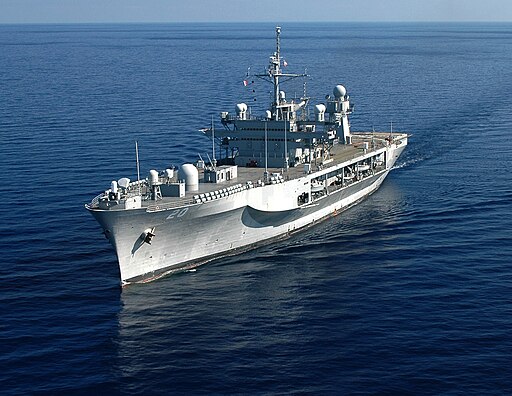
USS Mount Whitney (LCC/JCC 20): A Comprehensive Technical Profile
USS Mount Whitney (LCC/JCC 20) serves as the U.S. Navy’s afloat command-and-control platform for Sixth Fleet operations in Europe. Commissioned in January 1971, she integrates advanced communications, data processing, and intelligence systems to coordinate complex joint and coalition missions. As one of two Blue Ridge-class command ships, Mount Whitney remains at the forefront of modern naval strategy, providing a secure node for strategic decision-making at sea.
Class and Design
Blue Ridge-class command ships were developed in the late 1960s to support fleet commanders with unparalleled C4ISR (command, control, communications, computers, intelligence, surveillance, and reconnaissance) capabilities. Unlike traditional combatants, these ships emphasize electronic suites over heavy armament. Key design features include:
- A broad, uncluttered deckhouse to minimize electromagnetic interference.
- Automated patch panels and digital switching matrices for rapid reconfiguration of communications links.
- Redundant power and environmental-control systems to sustain prolonged high-load operations ashore or at sea.
Construction and Commissioning
- Ordered: 10 August 1966
- Keel laid: 8 January 1969, Newport News Shipbuilding & Drydock Co.
- Launched: 8 January 1970
- Commissioned: 16 January 1971, Norfolk, Virginia, under Captain Robert H. Langmaid.
From the outset, Mount Whitney’s electronics suite was touted as 30 percent larger than that aboard contemporary carriers, reflecting her mission as “The Voice of the Sea.”
Technical Specifications
Dimensions and Displacement
- Length overall: 189 m (620 ft 1 in)
- Beam: 33 m (108 ft 3 in)
- Draft (full load): 9.07 m (29 ft 9 in)
- Displacement (full load): 18,400 t
- Displacement (lightship): approx. 11,700 t.
Mount Whitney’s generous beam supports expansive antenna arrays and ensures platform stability during high-tempo communication operations.
Propulsion and Performance
- Propulsion: 2 × steam boilers powering 1 × geared steam turbine, single shaft
- Power output: approx. 35,000 shp
- Speed: 23 knots (max)
- Range/endurance: unlimited nuclear-style endurance; limited by food and maintenance cycles.
Her conventional steam plant delivers reliable transit speeds while freeing deck space for mission systems.
Communications and Electronic Suites
- Automated Patch Panel: Enables any combination of radio, satellite, and teletype circuits under software control.
- Satellite Communications: Multiple stabilized dish antennas for UHF, SHF, and EHF links to shore, air, and space nodes.
- Signal Processing: AN/USQ-69(V) data terminals and AN/WSC-3E cryptographic devices.
- Electronic Support Measures: ESM sensors for detection and geolocation of adversary emissions.
Continuous modernization has kept Mount Whitney’s network-centric capabilities on par with shore-based command centers.
Defensive Armament
- 2 × Phalanx CIWS (20 mm) for close-in missile defense
- 2 × 25 mm Bushmaster guns
- 4 × .50 cal M2HB machine guns
- 4 × Mark 36 SRBOC chaff/flare launchers for missile countermeasures[3].
Although lightly armed, her self-defense suite protects critical C2 assets in forward areas.
Aviation and Command Facilities
- Flight Deck: Unobstructed helicopter landing area accommodating one MH-60S Seahawk for logistics, MEDEVAC, and liaison duties.
- Command Spaces: Multiple Combat Information Centers (CICs), planning rooms, and secure briefing suites capable of hosting up to 930 personnel in surge conditions.
- Flag Bridge: Reinforced for strategic staff with high-bandwidth video-teleconference (VTC) terminals and map-display systems.
Crew and Accommodations
- Core complement: 170 officers and enlisted sailors
- Military Sealift Command civilians: ~155 technicians and communications specialists
- Surge capacity: Up to 930 embarked staff, including joint/coalition commanders and support personnel[3]. Habitability features include air-conditioned berthing, a medical/dental clinic, galley and mess decks, and satellite TV in recreation areas.
Operational Role and History
Mount Whitney has supported a wide range of missions:
- Flagship, U.S. Sixth Fleet: Hosting European theater commanders in operations across the Mediterranean.
- Operation Uphold Democracy (Haiti, 1994–95): Coordination of multinational humanitarian and security forces.
- Operation Enduring Freedom (Afghanistan, 2002–03): Launch platform for joint planning and precision strikes.
- Humanitarian and Crisis Response: Relief coordination during the 2008 Georgian conflict and 2011 Libya operations.
Her persistent presence underwrites alliance interoperability and rapid crisis management.
Modernization and Upgrades
To maintain her edge, Mount Whitney has undergone multiple refits:
- 1978–79 Overhaul: Upgraded communications hardware and improved habitability.
- 1990s Electronic Refresh: Installation of fiber-optic data networks and satellite uplink enhancements.
- 2015–17 Combat Systems Upgrade: Integration of next-generation EHF terminals and cyber-hardened networks.
These upgrades ensure that LCC/JCC 20 continues as a resilient afloat command node into the 2030s.
Conclusion
USS Mount Whitney (LCC/JCC 20) exemplifies the evolution of naval command-and-control vessels. Her blend of comprehensive communications suites, self-defense systems, and surge capacity makes her indispensable for modern joint and coalition maritime operations. As strategic environments grow more complex, Mount Whitney’s ability to serve as a staging ground for decision-makers underscores the enduring importance of afloat headquarters in U.S. naval doctrine.
,_is_underway_with_Sailors_and_Marines_from_the_newly_combined_staff_for_commander_Naval_Forces_Europe_and_commander_6th_Fleet_(CNE-C6f).jpg)