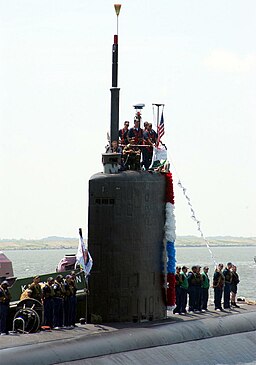
USS Montpelier (SSN-765): Technical Deep Dive on a Los Angeles-Class Attack Submarine
USS Montpelier (SSN-765) is a Los Angeles-class nuclear-powered attack submarine commissioned into the U.S. Navy on 13 March 1993. As the third vessel named for Vermont’s capital city, Montpelier brings high-speed, deep-diving capability and multi-mission flexibility to undersea warfare. Over more than three decades of service she has demonstrated prowess in surveillance, special-operations support, anti-submarine and anti-surface warfare, and precision strike.
Design and Development
The Los Angeles class was conceived in the late 1960s to succeed the Sturgeon-class and challenge evolving Soviet undersea threats. Montpelier belongs to the “688i” (improved) subclass, which introduced quieting enhancements, deeper test depths, and advanced sensors.
Key design goals for SSN-765 included: • Acoustic stealth through anechoic tiles and raft-mounted machinery. • High sustained submerged speed for rapid theater transit. • A large sensor suite to detect quiet diesel-electric submarines. • Vertical launch capability for Tomahawk land-attack cruise missiles.
Construction and Commissioning
- Contract Awarded: 6 February 1987 to Newport News Shipbuilding, Virginia
- Keel Laid: 19 May 1989, marking the start of modular hull assembly
- Launched: 23 August 1991, christened by Mrs. Nancy Hayes Sununu
- Commissioned: 13 March 1993 at Norfolk, Virginia, under Commander Victor Fiebig
Montpelier entered service equipped with the latest sonar, combat system and fire-control software of its time. Early on she underwent crew training and sea trials to validate her performance envelope.
Technical Specifications
Dimensions and Displacement
- Length Overall: 110.3 m (361 ft 11 in)
- Beam: 10 m (32 ft 10 in)
- Draft: 9.4 m (30 ft 10 in)
- Light Displacement: ≈6,000 long tons (6,096 t)
- Full-Load (Surfaced) Displacement: ≈6,927 long tons (7,038 t)
- Submerged Displacement: ≈7,092 long tons (7,204 t)
The hull’s teardrop shape and robust framing allow Montpelier to operate quietly at speeds exceeding 25 knots and to withstand depths beyond 650 ft (test depth).
Propulsion and Performance
- Reactor: 1 × S6G pressurized-water reactor (165 MW thermal)
- Turbines: 2 × steam turbines delivering 33,500 shp
- Shafts: Single shaft with one fixed-pitch propeller
- Auxiliary Propulsion: 1 × 325 hp secondary motor for slow-speed maneuvering
- Speed: > 25 knots submerged
- Range: Essentially unlimited endurance provided by nuclear fuel; limited chiefly by food and maintenance cycles
- Endurance: Months at sea between depot overhauls
This CODAG-style (nuclear-gas turbine) arrangement gives Montpelier sprint-and-dash capability for force projection, yet silent-running options during covert operations.
Weapons and Combat Systems
- Torpedo Tubes: 4 × 533 mm bow tubes, capable of launching Mk 48 heavyweight torpedoes
- Tomahawk Missiles: 12 × vertical-launch TLAMs for land-attack strikes
- Mines: Carrying capacity to deploy sea mines in strategic choke points
- Countermeasures: Banks of decoys and towed acoustic jammers to defeat incoming torpedoes
Montpelier uses the AN/BYG-1 combat control system to fuse sonar tracks, periscope information, and fire-control solutions for weapons employment.
Sensors and Electronic Warfare
- Hull-Mounted Sonar: AN/BQQ-5 suite for active/passive search and attack
- Towed Array: AN/BQQ-10 passive flank array to detect distant contacts
- Mine-Hunting: High-frequency sonar attachments when configured for mine-countermeasure roles
- Combat System Display: AN/UYK-43/44 computers with WLR-8 ESM for signals intelligence
- Periscopes: Photonics masts with infrared and low-light sensors
Montpelier’s sensor mix allows multi-axis undersea detection and tracking, particularly important against quiet modern diesel submarines.
Crew and Accommodation
- Complement: 12 officers and 98 enlisted sailors
- Habitability: Bunks for rotating 18-hour watches, medical bay, galley, recreation area
- Special-Operations Support: Lock-in/lock-out chamber for up to a dozen combat divers or SEALs
Automation in machinery spaces and digital control systems reduces watchstanding manning requirements, enabling a smaller core crew than earlier attack-sub designs.
Operational History
Early Deployments
Following shakedown and initial certification, Montpelier deployed to the Atlantic and Mediterranean, conducting anti-submarine and intelligence-gathering missions under NATO command.
Operation Iraqi Freedom
In March 2003, Montpelier became the first submarine in her class to launch Tomahawk cruise missiles during U.S. strikes on Iraq. She fired all 20 of her embarked TLAMs, earning a “clean sweep” commendation for precision engagement without misfire.
Modernization Periods
- 2004 Depot Modernization Period: An 18-month availability at Portsmouth Naval Shipyard upgraded sonar processors, combat system software and hull coatings—completed three months ahead of schedule.
- 2010 NSY Overhaul: A $35 million refit in Norfolk Naval Shipyard focused on buoyancy adjustments, sonar enhancements and life-extension measures; returned to service eight days early.
Collision Incident
On 13 October 2012, Montpelier collided with USS San Jacinto (CG-56) during a joint exercise off Florida’s Atlantic coast. No casualties occurred, but Montpelier underwent $70 million in repairs and her commanding officer was relieved.
Modernization and Upgrades
Post-2012 repairs integrated hull-mounted sonar upgrades and quieter machinery mounts. Current modernization plans include:
- Radio Room Refresh: Upgrading satellite communications and cyber-secure networks
- Weapon System Refresh: Integrating updated Mk 48 MOD 7 torpedoes and Block IV Tomahawks
- Acoustic Coatings: New anechoic tiles to further reduce detectability
These work packages ensure SSN-765 remains tactically relevant into the 2040s.
Awards and Commendations
Montpelier’s crew has earned multiple Battle Efficiency “Battle E” awards, Meritorious Unit Commendations, and individual service medals for excellence in operations ranging from counter-narcotics patrols to global strike missions.
Conclusion
USS Montpelier (SSN-765) exemplifies the enduring value of the improved Los Angeles-class attack submarine. With robust nuclear propulsion, a potent weapons suite, and a finely tuned sensor array, Montpelier continues to project undersea power, support special-operations forces, and deliver precision missile strikes. Ongoing upgrades and modernization will sustain her role as a stealthy, long-range asset of the U.S. Navy’s submarine force well into the 21st century.
