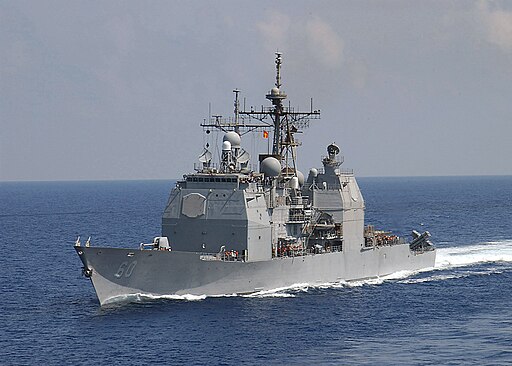
USS Normandy (CG-60): Shield of the Seas
USS Normandy (CG-60) glides through oceans as a Ticonderoga-class guided-missile cruiser, blending air defense, strike capability and command functions. Commissioned in May 1990 and named for the World War II Normandy landings, she carries forward a legacy of protection and projection. This article dissects her technical parameters, systems and mission sets.
Design and Construction
Hull Form and Signature Management
Normandy sports a flared bow and tumblehome hull sections designed for seakeeping at high speeds. Vertical superstructure facets and sloped mast faces work together to reduce radar cross-section. Underwater, anechoic coatings and carefully faired appendages lower acoustic and flow noise, enhancing stealth in anti-submarine and littoral environments.
Modular Assembly at Ingalls Shipbuilding
Built in Pascagoula, Mississippi, Normandy was assembled from pre-outfitted blocks containing piping, electronics racks and machinery skids. This modular approach cut construction time by nearly 25 percent compared to earlier cruisers. Factory acceptance tests of combat suites and power systems ensured seamless integration once the hull was afloat.
Quick Reference Technical Summary
| Parameter | Value |
|---|---|
| Displacement (full load) | 9,600 tons |
| Length overall | 567 ft (173 m) |
| Beam | 55 ft (17 m) |
| Draft | 31 ft (9.4 m) |
| Propulsion | 4 × LM2500 gas turbines, 93,420 shp total |
| Shafts | 2 |
| Maximum Speed | 30+ knots |
| Range | 4,500 nm at 20 knots |
| Crew Complement | ~30 officers, ~300 enlisted |
| Aviation Facilities | Flight deck plus hangar for 2 MH-60R Seahawks |
Propulsion and Electrical Plant
Combined Gas Turbine Arrangement
Two shafts receive power from four General Electric LM2500 gas turbines arranged in a Combined Gas And Gas configuration. With 93,420 shaft horsepower on tap, Normandy achieves dash speeds above 30 knots. Rapid turbine startup and remote-control clutches allow swift changes between economy cruising and high-speed sprint.
Electrical Generation and Distribution
Three 1 MW diesel generators supply hotel loads, combat systems and damage-control devices. An uninterruptible power system protects Aegis computers and AN/SPY-1 radar arrays against transients. Power-distribution switchboards feature automatic bus-tie breakers to isolate faults and maintain mission-critical functions under duress.
Combat Systems and Sensors
Aegis Weapon System
At the heart of Normandy’s combat capability is Aegis Baseline 7, featuring the AN/SPY-1D(V) phased-array radar. This multi-function radar continuously scans airspace and surface contacts out to hundreds of miles. Integrated computing consoles in the Combat Information Center fuse tracks, assign weapon types and manage salvo timing with sub-second precision.
Radar and Sonar Suites
• AN/SPY-1D(V) radar handles simultaneous air and surface tracking • AN/SPS-49(V)5 long-range air-search radar provides 2D coverage to 250 nm • AN/SQQ-89(V)15 antisubmarine warfare suite fuses hull and towed arrays • AN/SPQ-9B fire-control radar locks fast on small or high-speed targets
Electronic Warfare and Decoys
The AN/SLQ-32(V)3 electronic support system detects, classifies and jams hostile radar emissions. Mk 36 Super Rapid Bloom Offboard Chaff (SRBOC) launchers and Nulka active decoys create a layered defense against incoming anti-ship missiles.
Armament
Vertical Launch System
Normandy carries 122 Mk 41 VLS cells—61 forward and 61 aft—capable of firing a mix of:
- SM-2 and SM-6 missiles for fleet air defense
- Tomahawk Land Attack Missiles for deep-strike missions
- ASROC rocket-thrown torpedoes for anti-submarine warfare
- ESSM (Evolved Sea Sparrow Missile) for point defense
Flexible cell-loading allows commanders to tailor each deployment’s loadout for specific threat environments.
Gun and CIWS Batteries
A single 5-inch/54 Mk 45 Mod 2 naval gun on the forecastle delivers rapid-fire support against surface threats and shore targets. Two Phalanx Block 1B CIWS mounts automatically engage inbound missiles and aircraft at close range.
Torpedo Tubes
Twin Mk 32 triple-tube launchers amidships can fire Mk 46 or Mk 54 lightweight torpedoes. Automated fire-control routing ensures quick target handoff from ASROC launchers or shipboard sonar solutions.
Aviation Facilities
The aft flight deck and enclosed hangar support two MH-60R Seahawk helicopters. These helicopters extend Normandy’s reach for anti-submarine patrols, over-the-horizon targeting and search-and-rescue missions. Aviation fuel and weapons handling systems ensure rapid sortie generation.
Crew and Habitability
Normandy’s crew of roughly 330 divides into three watch sections, rotating through 8-hour cycles. Officers enjoy two-person staterooms, while enlisted sailors hot-rack in six-stack bunks. Shared spaces include a fiber-optic news network, fitness center and a modern galley serving three fresh hot meals daily.
Life-support systems distill up to 20,000 gal of freshwater daily and scrub CO₂ to maintain air quality. Advanced HVAC units regulate temperature and humidity, vital for both electronics cooling and crew comfort on extended patrols.
Mission Profiles
Area Air Defense
Operating at the core of carrier strike groups, Normandy provides shield-wall defense against aircraft, cruise missiles and heavy antiship salvos. Aegis’ mid-course guidance handoff to SM-6 interceptors enables engagements beyond 200 nm.
Surface Warfare
With Tomahawk and naval gunfire, Normandy can strike coastal batteries or shipping. Over-the-horizon targeting from Aegis radar boosts first-shot kill probability against enemy vessels.
Anti-Submarine Warfare
Combining hull-mounted sonar, towed arrays and embarked MH-60Rs armed with torpedoes, Normandy creates a multi-layered submarine hunt envelope. Rapid deployment of ASROC rockets further extends her reach below the surface.
Ballistic Missile Defense
Upgraded with Aegis BMD 3.6, Normandy can launch SM-3 interceptors to engage short- and medium-range ballistic missiles shortly after launch, contributing to regional missile defense architectures.
Command and Control
With extensive communications suites—SATCOM, Link 16 and HF/DF—Normandy can serve as a task-group flagship. Networked data sharing ensures joint operations from sea, air and land forces remain synchronized in real time.
Service History and Upgrades
From Atlantic crossings to Pacific patrols, Normandy has supported operations in Kosovo, Enduring Freedom and Inherent Resolve. Mid-life modernizations included:
- Upgrade to Aegis Baseline 9 Combat System for integrated air/missile defense
- Installation of SPQ-9B radar and updated electronic-warfare decoys
- Habitability improvements with new berthing modules and expanded gym spaces
Recent deployments have emphasized ballistic missile defense patrols in the Mediterranean and carrier escort in the Western Pacific.
Conclusion
USS Normandy (CG-60) epitomizes multi-mission flexibility. Her blend of Aegis-directed air defense, strike firepower, antisubmarine tools and command facilities allow her to pivot between high-end warfare and humanitarian response. With upgrades keeping pace with emerging threats, Normandy will continue forging ahead as a cornerstone of naval power projection.
_CTF-58.jpg)