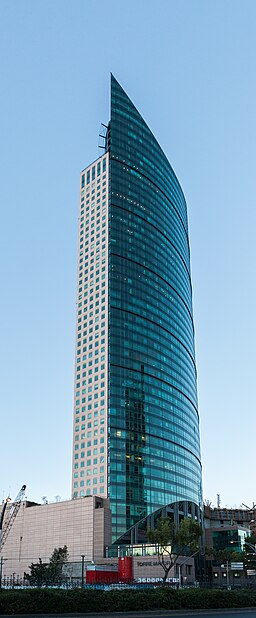
Torre Mayor
Torre Mayor stands as an engineering landmark on Mexico City’s Paseo de la Reforma. Completed in 2003, this 225-meter commercial tower was conceived to endure one of the world’s highest seismic risks while delivering premium office environments. It held the title of Mexico’s tallest building for over a decade and remains recognized for its sophisticated structural damping, high-performance envelope, and cutting-edge building systems.
Site and Urban Context
Torre Mayor occupies a prominent corner at Paseo de la Reforma 505, directly opposite Chapultepec Park. Its slender footprint of roughly 1 200 m² rises above a four‐level basement podium, creating a vertical gateway between the city’s financial district and historic core. The tower’s location ensures direct access to bus rapid transit, metro lines, and major arterial roads, anchoring it as both a corporate icon and an urban catalyst.
Architectural Design
The architectural concept marries functional clarity with tectonic expression. A central reinforced‐concrete core anchors 55 office floors, while perimeter steel columns and outrigger trusses remain exposed behind a fully glazed façade. The result is a rhythmic interplay of light and shadow that animates Reforma’s skyline and underscores the building’s structural honesty.
Technical Specifications
| Parameter | Specification |
|---|---|
| Architectural height | 225.4 m |
| Roof height | 213.0 m |
| Floors above ground | 55 |
| Basement levels | 4 |
| Gross floor area | 84 135 m² |
| Footprint at base | ~1 200 m² |
| Structural system | Composite core, perimeter steel frame |
| Foundation | Bored piles to 60 m, raft slab |
| Seismic dampers | 96 viscous fluid dampers |
| Elevators | 29 high-speed units (up to 6.6 m/s) |
| Parking capacity | ~290 stalls in 4 basement levels |
| Completion year | 2003 |
Structural System
Core and Frame
A massive, steel‐reinforced concrete core houses elevators, stairwells, and mechanical shafts. Eight perimeter mega-columns connect to the core via steel outrigger trusses at mechanical floors, distributing wind and seismic forces efficiently. Flat slab floor plates span between the core and outer frame, delivering column-free interiors and flexible leasing options.
Foundation and Seismic Strategy
Deep‐bored piles descend roughly 60 meters into competent strata, linked by a reinforced concrete raft slab. Ninety-six viscous fluid dampers are strategically located at beam-to-column connections, absorbing and dissipating seismic energy. This damping network reduces peak accelerations by up to 40 percent, ensuring both occupant comfort and structural integrity during major tremors.
Façade and Envelope
Torre Mayor’s curtain wall combines low-iron tempered glass with thermally broken aluminum mullions. Full-height glazing on each floor maximizes daylight, while external sun-shades set at alternating angles moderate solar gain. The façade assembly achieves a U-value below 1.8 W/(m²·K) and an STC rating above 40 dB, balancing energy performance with acoustic comfort along the busy boulevard.
Building Systems and Services
HVAC and Climate Control
The central plant features high-efficiency chillers feeding variable-air-volume (VAV) air terminals on every floor. Heat-recovery wheels reclaim energy from exhaust streams, cutting chiller loads by nearly 20 percent. Automated controls adjust airflow and temperature according to occupancy sensors and outdoor conditions, optimizing comfort and efficiency.
Electrical and Lighting
An on-site substation delivers power to LED fixtures equipped with daylight and presence sensors, reducing lighting energy by over 50 percent compared to traditional systems. A building management system (BMS) monitors consumption in real time, triggering demand-response sequences during peak grid periods.
Vertical Transportation
Twenty-nine high-speed passenger elevators operate in four shuttle zones, limiting travel distances and wait times. Destination control dispatching groups passengers by floor, improving handling capacity during morning and evening peaks. Two service elevators and one freight lift support logistics and emergency operations.
Water and Waste Management
Rainwater retention tanks collect rooftop runoff for irrigation and cooling-tower make-up. Low-flow fixtures, dual-flush toilets, and leak-detection sensors cut potable water use by 35 percent. A dedicated waste-sorting room in the basement streamlines recycling and reduces landfill contributions.
Sustainability and Certifications
Originally conceived without green certification, Torre Mayor later achieved LEED Gold O+M status. Key measures include:
- Envelope upgrades with high-performance glazing
- Solar panels on the mechanical penthouse roof
- Greywater harvesting for non-potable needs
- Energy metering at major mechanical and electrical loads
These enhancements lowered annual energy use intensity by an estimated 30 percent and bolstered the building’s environmental profile.
Occupancy and Program
Primarily delivering Class AAA office space, Torre Mayor accommodates over 4 000 employees across flexible floor plates of roughly 1 400 m². The ground floor lobby features a double-height reception, concierge desk, and exhibition alcoves. Upper mechanical floors house tenant amenity lounges, fitness areas, and panoramic terraces overlooking Chapultepec Park.
Office Layouts
Open-plan configurations flank the central core on each floor, supported by modular partitions and integrated underfloor trunking for power and data. Column-free zones allow adaptable workstation layouts, while perimeter setback offices benefit from uninterrupted city views.
Tenant Amenities
A sky lobby on the 32nd floor provides a breakout lounge, meeting pods, and café service. Mechanical floors on levels 16, 32, and 48 incorporate chilled ceiling panels for auxiliary cooling, enhancing thermal comfort in shared amenity spaces.
Conclusion
Torre Mayor remains a testament to the marriage of architectural clarity and seismic engineering innovation. Its pioneering viscous damper network, high-performance envelope, and comprehensive building systems have enabled it to endure major earthquakes unscathed while delivering enduring value to tenants. As a defining feature of Mexico City’s skyline, it exemplifies how rigorous technical design can coexist with refined urban presence.
