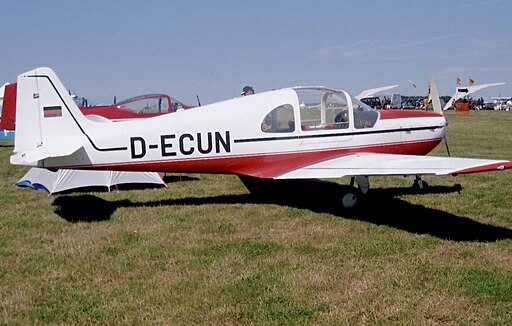
Ambrosini Rondone
The Ambrosini Rondone is a lightweight Italian touring monoplane dating from the early 1950s. Designed by Stelio Frati and built by SAI Ambrosini in collaboration with Aeronautica Lombardi, it served private pilots and aero clubs seeking a modern, efficient aircraft with seating for two or three. The Rondone combined clean aerodynamics, retractable landing gear, and wood-and-ply monocoque construction to deliver performance and handling that outclassed many contemporaries.
Design and Development
Origins
In the post-war years, demand grew for affordable, high-performance civilian aircraft. Stelio Frati responded with a sleek low-wing design featuring a plywood-skinned fuselage and a one-piece wooden wing spar. The prototype F.4 Rondone I flew in 1951, proving the concept of a retractable-gear, two-seat tourer with minimal structural weight.
Airframe and Aerodynamics
The Rondone employs a conventional wooden monocoque fuselage covered in birch plywood. Its one-piece wing uses a single spar and plywood covering to balance strength and lightness. Two-position flaps and full-span ailerons yield gentle stall behavior. The clean wing root fairings and retractable tricycle undercarriage reduce drag, while the cabin’s low-profile greenhouse canopy offers excellent visibility.
Variants
F.4 Rondone I
• Two-seat prototype powered by a 65 hp four-cylinder piston engine for initial trials • Production batch of ten fitted with 85–90 hp Continental engines to boost climb and cruise performance • Dual controls standard for club use
F.7 Rondone II
• Stretched cabin accommodating pilot plus two passengers in a triangular arrangement • Choices of 90 hp Continental or 135 hp Lycoming engines for enhanced speed and payload • Nine purpose-built production airframes and one conversion of an F.4 airframe • Additional side windows and minor aerodynamic refinements
Technical Specifications
General Characteristics
| Parameter | F.7 Rondone II |
|---|---|
| Crew | 1 pilot |
| Capacity | Up to 3 passengers |
| Length | 6.80 m |
| Wingspan | 9.30 m |
| Height | 2.26 m |
| Wing Area | 10.6 m² |
| Aspect Ratio | 6.6 |
| Empty Weight | 530 kg |
| Maximum Takeoff Weight | 900 kg |
| Fuel Capacity | 142 L (three fuselage tanks) |
| Powerplant | Lycoming O-290-D2, 135 hp (101 kW) |
Performance
| Metric | F.7 Rondone II |
|---|---|
| Maximum Speed | 265 km/h |
| Cruise Speed | 233 km/h |
| Stall Speed (flaps down) | 75 km/h |
| Range | 700 km |
| Service Ceiling | 4 500 m |
| Rate of Climb | 4.3 m/s (850 ft/min) |
| Takeoff Run | 130 m |
| Landing Run | 100 m |
| Wing Loading | 68 kg/m² |
| Power-to-Mass Ratio | 0.078 kW/kg |
Operational History
Following its 1951 debut, the two-seat Rondone I quickly found buyers among Italian aero clubs. Its combination of retractable gear and efficient structure delivered higher cruise speeds than fixed-gear rivals. In 1954 the three-seat Rondone II expanded usability for family or light charter flights. A handful of examples reached France and Germany, where several remained airworthy into the twenty-first century.
Legacy and Influence
Though only around 20 Rondones were built, their advanced wooden-wing design and retractable undercarriage foreshadowed later Frati aircraft. The Rondone’s balance of performance, economy, and pilot-friendly handling secured its reputation as an Italian post-war classic. Today surviving examples are prized by vintage-aircraft collectors and flown at historic rallies, preserving a milestone in light-aircraft innovation.
