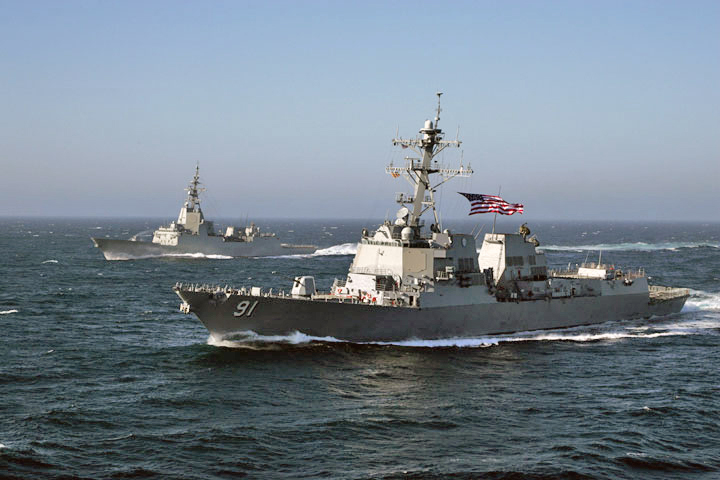
USS Pinckney (DDG-91)
USS Pinckney (DDG-91) is a Flight IIA Arleigh Burke–class guided-missile destroyer in service with the United States Navy. Commissioned in May 2004, she honors William Pinckney, a Navy Cook First Class who received the Navy Cross for heroic action during the Battle of Santa Cruz. Pinckney embodies multi-mission flexibility, combining advanced air and missile defense, anti-submarine warfare, and strike capabilities in a stealth-optimized hull.
Design and Construction
Namesake and Builder
Awarded on 6 March 1998, DDG-91 was built by Ingalls Shipbuilding in Pascagoula, Mississippi. Her keel was laid on 16 July 2001, she was launched on 26 June 2002, and formally commissioned on 29 May 2004 at Port Hueneme, California. As the first Flight IIA destroyer fitted with the Littoral Warfare Radar upgrade, Pinckney set a precedent for enhanced detection in coastal environments.
Hull and Stealth Features
Her steel hull employs angled surfaces and infrared-reduction coatings to minimize radar and heat signatures. Machinery is raft-mounted, and vibration-dampening materials line the compartments to reduce acoustic noise. A bulbous bow and hydrodynamic fairings streamline water flow, improving fuel efficiency and lowering cavitation during high-speed transits.
General Characteristics
The destroyer’s dimensions and displacement reflect a balance between endurance, payload, and maneuverability.
| Characteristic | Specification |
|---|---|
| Displacement (full load) | 9,200 long tons |
| Length overall | 509 ft 6 in (155.3 m) |
| Beam | 66 ft (20 m) |
| Draft | 31 ft (9.4 m) |
| Propulsion | 4 × GE LM2500-30 gas turbines, 2 shafts |
| Speed | > 30 knots (56 km/h) |
| Range | 4,400 nmi at 20 knots |
| Complement | ~ 380 officers and enlisted |
| Homeport | San Diego, California |
These figures enable sustained blue-water operations with robust weapons and sensor suites aboard.
Propulsion and Performance
Gas Turbine Plant
Power is provided by four General Electric LM2500-30 gas turbines, producing 100,000 shaft horsepower. Twin reduction gears drive two controllable-pitch propellers, delivering rapid acceleration and high reliability. An emergency diesel generator and auxiliary motors support low-noise station-keeping during anti-submarine missions.
Speed and Endurance
Pinckney can exceed 30 knots in surge operations. At a cruising speed of 20 knots, she can traverse roughly 4,400 nautical miles without refueling. The gas-turbine configuration permits swift readiness after cold starts, critical for surge deployments.
Combat Systems
Aegis Weapon System
Central to her combat capability is the Aegis Combat System with AN/SPY-1D(V) phased-array radar. This networked suite tracks hundreds of air and surface contacts simultaneously, cueing Standard Missiles (SM-2/SM-6) and ESSMs for layered air defense. Mk 99 fire-control radars and a Command and Decision system coordinate engagements against fast, maneuvering threats.
Littoral Warfare Radar Upgrade
As the first Arleigh Burke–class destroyer to receive the AN/SPY-1 D(V) Littoral Warfare Radar, Pinckney gains improved performance against low-altitude and sea-skimming targets in cluttered coastal zones. Enhanced signal processing filters out land and surface reflections, sharpening threat discrimination near shorelines.
Armament
Vertical Launch System
Pinckney is equipped with two Mk 41 VLS modules (32 cells forward, 64 aft) for up to 96 missiles. Typical load-outs include:
- RIM-66/156 Standard Missiles for medium-range air defense
- RIM-174A Standard ERAM for extended-range engagements
- RIM-161 SM-3 for ballistic missile defense
- RIM-162 ESSM (quad-packed) for close-in air threats
- BGM-109 Tomahawk for precision land-attack
- RUM-139 VL-ASROC for anti-submarine strike
Naval Gun and Close-In Defense
A 5-inch/62 Mk 45 Mod 4 lightweight gun provides naval gunfire support and surface-target engagement. Two 20 mm Phalanx CIWS units and two 25 mm Mk 38 remote-weapon stations guard against incoming missiles, aircraft, and small boats. Four .50 caliber machine guns offer additional close-range defense.
Torpedoes and ASW
For underwater threats, Pinckney carries two Mk 32 triple torpedo launchers deploying Mk 46, Mk 50, or Mk 54 lightweight torpedoes. The ship’s SQQ-89 ASW combat system integrates sonar data and processes to prosecute hostile submarines and protect high-value units.
Sensors and Electronics
Radar and Sonar
- AN/SPY-1D(V) multi-function radar for 3D air/surface tracking
- AN/SPS-67(V)3 surface-search navigation radar
- AN/SQS-53C hull-mounted sonar
- AN/SQR-19 towed passive array for long-range submarine detection
Electronic Warfare and Decoys
An AN/SLQ-32(V)7 SEWIP Block 3 suite delivers radar warning, jamming, and decoy direction. Mk 36 SRBOC chaff/flare launchers and Nulka active decoys enhance missile-countermeasure capabilities. The AN/SLQ-25 Nixie tow system lures incoming torpedoes away from the ship.
Aviation Capabilities
A flight deck and twin-hangar bay support two MH-60R Seahawks. Helicopters extend Pinckney’s reach for over-the-horizon targeting, ASW with dipping sonar and sonobuoys, search-and-rescue, and vertical replenishment. Hangar-integrated refueling and weapons-handling stations streamline flight operations.
Crew and Habitability
Pinckney carries approximately 380 crew, including aviators. Modern berthing features noise-insulated compartments, climate control, and personal storage. Galley and mess decks accommodate varied dietary needs, while a telemedicine-equipped medical bay sustains health during extended patrols.
Operational History
Maiden Deployment
Pinckney’s first deployment in 2005–2006 took her to the Western Pacific, where she participated in multinational exercises and interoperability drills with allied navies. She became the first DDG to refuel and embark an MK V special-operations boat alongside standard replenishment evolutions.
Key Missions
The destroyer earned the Battle “E” Award in 2006 and has supported counter-piracy patrols, freedom-of-navigation operations in the South China Sea, and ballistic-missile defense tests. In 2014 she assisted the search for Malaysia Airlines Flight 370 and in 2025 participated in hypersonic-tracking trials using the Aegis system’s upgraded processing suite.
Modernization and Future Upgrades
Undergoing DDG Mod 2.0 at NASSCO (2021–2023), Pinckney received:
- AN/SPY-6(V) air and missile defense radar
- Aegis Baseline 10 Combat System
- SEWIP Block 3 electronic warfare suite
Planned enhancements include integration of unmanned aerial and undersea vehicles for distributed sensing and strike, plus cyber-hardening of combat network architecture.
Strategic Significance
USS Pinckney exemplifies 21st-century destroyer design: stealth-shaped hull, potent multi-layered defenses, precision long-range strike, and advanced ASW. Forward-deployed with the Pacific Fleet, she reinforces deterrence, sea-control, and rapid response across contested littorals and open oceans alike.
