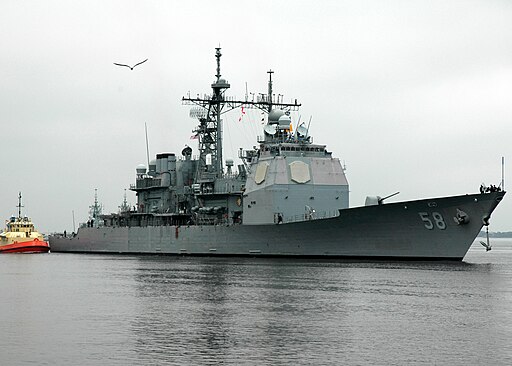
USS Philippine Sea (CG-58)
USS Philippine Sea (CG-58) is a Ticonderoga-class guided-missile cruiser commissioned in March 1989. Named for the pivotal World War II Battle of the Philippine Sea, she combines multi-mission air, surface and undersea warfare capabilities. Equipped with the Aegis Combat System, she provides fleet air defense, strike and sea control for carrier strike groups and expeditionary forces.
Design and Construction
Namesake and Builder
The ship honors the “Great Marianas Turkey Shoot” fought on 19–20 June 1944. Bath Iron Works in Bath, Maine laid her keel in April 1986, launched her in July 1987, and delivered her to the U.S. Navy after builder’s trials and combat system certification.
Hull Form and Stealth Features
Her steel hull and superstructure employ angled surfaces and reduced infrared signature materials. Longitudinal framing, raft-mounted machinery and acoustic dampeners minimize noise. Internal cross-connectivity of shock-isolated compartments enhances survivability against underwater explosions.
General Characteristics
| Characteristic | Specification |
|---|---|
| Class & Type | Ticonderoga-class guided-missile cruiser (Flight II) |
| Displacement (full) | 9,600 long tons |
| Length overall | 567 ft (173 m) |
| Beam | 55 ft (16.8 m) |
| Draft | 34 ft (10.4 m) |
| Speed | 32.5 knots (60 km/h) |
| Range | 6,000 nmi at 20 knots |
| Complement | 30 officers, 300 enlisted |
| Homeport | Naval Station Norfolk, Virginia |
Propulsion and Performance
Gas Turbine Plant
Four General Electric LM2500 gas turbines produce approximately 82,000 shaft horsepower. Power is transmitted through twin-reduction gears to two controllable-pitch propellers. Dual rudders and high-lift fins ensure tight maneuvering in confined seas.
Endurance and Maneuvering
Cruise speed of 20 knots delivers a range nearing 6,000 nautical miles. Maximum sprint speed exceeds 32 knots. Diesel-electric auxiliary motors enable low-noise station-keeping during undersea warfare operations.
Combat Systems
Aegis Weapon System
Central processing uses the AN/SPY-1 A/B phased-array radar for continuous 360° detection and tracking of air and surface threats. Mk 99 illuminators and the command-and-decision suite support simultaneous engagements against ballistic and anti-ship missiles.
Undersea Warfare Suite
AN/SQS-53 hull-mounted sonar and AN/SQR-19 towed array feed the SQQ-89 Anti-Submarine Warfare Combat System. Mk 32 triple torpedo tubes launch Mk 46/Mk 54 lightweight torpedoes. Hull-integrated degaussing coil reduces magnetic signature.
Armament
Vertical Launch System
Two Mk 41 VLS modules (61 cells forward, 61 aft) house a mixed load of:
- SM-2 MR and SM-6 for area air defense
- RIM-174 ERAM and ESSM for local air defense
- RIM-161 Standard SM-3 for ballistic missile defense
- BGM-109 Tomahawk for precision land-attack
- RUM-139 VL-ASROC for anti-submarine strike
Surface Strike and Close-In Defense
Eight Harpoon anti-ship missiles in Mk 141 launchers augment surface strike. A single 5-inch/62 Mk 45 Mod 4 gun provides naval gunfire support. Two Phalanx CIWS and two Mk 38 25 mm remote gun systems secure point defense against missiles and small boats.
Sensors and Electronics
Radar and Fire Control
- AN/SPY-1 A/B phased arrays
- AN/SPS-49(V)5 long-range air search radar
- AN/SPQ-9B gunfire control radar
- AN/SPS-73(V)3 surface search radar
Electronic Warfare
AN/SLQ-32(V)3 intercept and countermeasure suite detects radar emissions and launches Mk 36 SRBOC chaff/flare. NULKA decoy launchers create off-board electromagnetic signatures.
Aviation Facilities
A 2,500 sq ft flight deck and twin-bay hangar support two MH-60R Seahawk helicopters. Embarked aircraft conduct over-the-horizon targeting, anti-submarine patrols, search-and-rescue and vertical replenishment.
Operational History
Early Deployments
Upon commissioning, Philippine Sea joined Atlantic Fleet operations, deploying to the Mediterranean and Red Seas during Operations Desert Shield and Desert Storm to launch Tomahawk missiles and enforce sanctions.
Global Missions
She has rotated between U.S. Fifth, Sixth and Seventh Fleet areas, conducting ballistic missile defense patrols, counter-piracy operations, multinational exercises (RIMPAC, BALTOPS) and humanitarian assistance missions.
Recent Actions
In 2023–2024, she launched Tomahawk strikes against hostile actors in the Middle East and supported freedom-of-navigation transits in contested waters. Her adaptability has made her a linchpin for crisis response.
Crew and Habitability
Watch rotations divide the crew into operations, engineering, weapons and aviation departments. Living spaces feature modern noise suppression, improved ventilation, and telemedicine-capable medical facilities. A central galley and multiple berthing areas support sustained deployments.
Modernization and Future Upgrades
Planned enhancements include Aegis Baseline 10 integration, Cooperative Engagement Capability for networked fire control, and unmanned system interfaces for aerial and undersea drones. Electronic warfare suites are being upgraded for software-defined adaptability.
Strategic Significance
USS Philippine Sea remains a versatile surface combatant, projecting power from sea to land, defending allied forces against air and missile threats, and conducting undersea warfare. Her blend of stealth, speed and firepower underpins U.S. naval dominance in multiple theaters.
_departs_Mayport.jpg)