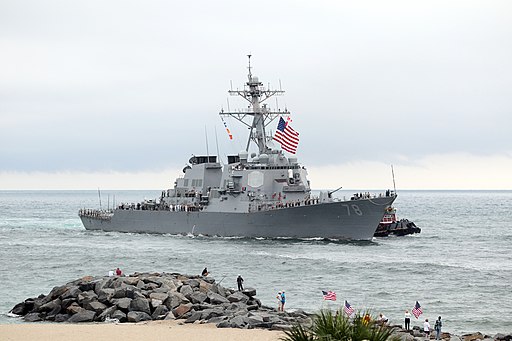
USS Porter (DDG-78)
The USS Porter (DDG-78) is an Arleigh Burke–class guided-missile destroyer in the United States Navy. Commissioned in March 1999, Porter has been a key asset in forward-deployed naval forces, combining advanced sensors, weapons, and propulsion to perform a broad spectrum of missions. From ballistic missile defense to anti-submarine warfare, Porter exemplifies modern multi-mission destroyer capabilities.
Porter proudly bears the name of Commodore David Porter and his son Admiral David Dixon Porter, both distinguished naval officers in American history. The ship’s motto, “Aweigh to Battle,” underscores its readiness to confront threats across any maritime domain.
Design and Development
Arleigh Burke–Class Evolution
Arleigh Burke–class destroyers represent a leap in naval architecture, integrating the Aegis Combat System on a survivable hull form. Porter is a Flight I variant, characterized by a versatile mk 41 Vertical Launching System (VLS) and a suite of sensors that provide unparalleled situational awareness.
As a Flight I ship, Porter laid the groundwork for later enhancements in sonar, close-in weapon systems, and electronic warfare. Each subsequent Flight introduced incremental improvements, but Flight I vessels like Porter remain vital to the fleet’s layered defense.
Hull and Survivability
The hull of USS Porter is built from high-strength steel, shaped to reduce radar cross-section and maximize stability at high speeds. Internal compartmentalization and redundant systems enhance survivability against battle damage. Porter’s hull form balances seakeeping, maneuverability, and stealth, enabling operations in littoral and open-ocean environments alike.
Survivability features include:
- Double-hulled fuel tanks to limit fire spread
- Automated damage-control systems to contain flooding
- Shock-hardened vital equipment for underwater explosion resilience
Propulsion and Powerplant
Combined Gas and Gas (COGAG) Configuration
Porter employs a Combined Gas and Gas configuration, utilizing four General Electric LM2500 gas turbines. Each turbine delivers 25,000 shaft horsepower, feeding two shafts for a combined 100,000 shp. The COGAG setup provides rapid acceleration, sustained high-speed transit, and reliable power for shipboard systems.
Performance and Range
Porter can achieve speeds in excess of 30 knots, crucial for fleet escort and rapid-response missions. With a fuel capacity of approximately 1,800 tons of diesel, the vessel can steam over 4,400 nautical miles at an economical cruising speed of 20 knots. Auxiliary diesel generators supply hotel power and can sustain essential systems during main-engine maintenance.
Weapons and Combat Systems
Vertical Launching System
Porter’s forward and aft mk 41 VLS arrays total 90 cells, offering flexible loadouts for:
- Standard Missile-6 (SM-6) for long-range air and ballistic missile defense
- Tomahawk Land Attack Missiles (TLAM) for precision strike
- SM-2 and SM-3 interceptors for regional and theater missile defense
- ASROC (Anti-Submarine Rocket) for deep-water submarine threats
The VLS’s modularity enables mission-specific missile mixes and rapid reconfiguration alongside logistical efficiencies.
Gun Systems
- One 5-inch (127 mm)/62 caliber Mk 45 Mod 4 naval gun, optimized for anti-surface fire and shore bombardment.
- Two Mk 38 Mod 2 25 mm machine gun systems for short-range engagements against small craft.
These guns complement missile defenses and offer precise fire support during amphibious operations.
Close-In Weapon System (CIWS)
Porter is equipped with a Phalanx Mk 15 Block 1B CIWS on the superstructure. The system provides a last line of defense against incoming anti-ship missiles and fast-attack craft, employing a rapid-firing 20 mm Gatling gun guided by radar and electro-optical sensors.
Sensors and Electronic Warfare
Aegis Combat System
At the heart of Porter’s combat capability is the Aegis Baseline 7 combat system. The SPY-1D(V) phased-array radar delivers simultaneous multi-target tracking and missile guidance. Integrated computing systems fuse data from all onboard sensors, providing a cohesive battlespace picture and enabling cooperative engagements with allied ships and aircraft.
Sonar and Anti-Submarine Warfare
Porter employs a multi-function towed array sonar (TACTAS) and hull-mounted sonar for submarine detection. The AN/SQS-53C system supports active and passive modes, allowing:
- Long-range acoustic tracking
- Classification of submerged contacts
- Fire-control solutions for ASROC and anti-submarine helicopter torpedoes
Electronic Warfare Suite
The ship’s AN/SLQ-32(V)4 suite provides electronic support measures (ESM) and electronic countermeasures (ECM). Complemented by decoy launchers and chaff/flare dispensers, Porter can detect, deceive, and defeat radar-guided and infrared-seeking threats.
Dimensions and Performance
Physical Characteristics
- Length overall: 509 feet (155 m)
- Beam: 66 feet (20 m)
- Draft: 31 feet (9.4 m)
Displacement and Stability
- Light displacement: approximately 7,800 tons
- Full load displacement: around 9,100 tons
Porter’s beam-to-length ratio and hull stabilization systems enable solid performance in both calm seas and high-wind conditions.
| Specification | Details |
|---|---|
| Class and Type | Arleigh Burke–class Guided Missile Destroyer |
| Hull Material | High-strength stealth steel |
| Propulsion | 4 × GE LM2500 Gas Turbines (COGAG) |
| Power Output | 100,000 shp |
| Speed | >30 knots |
| Range | 4,400 nmi at 20 knots |
| Complement | 28 officers, 254 enlisted |
| Vertical Launch Cells | 90 mk 41 VLS |
| Main Gun | 1 × 5 in/62 cal Mk 45 Mod 4 |
| CIWS | 1 × Phalanx Mk 15 Block 1B |
| ASW Systems | AN/SQS-53C hull sonar, TACTAS towed array |
| Radar | AN/SPY-1D(V) |
| Electronic Warfare | AN/SLQ-32(V)4 |
Crew and Habitability
Accommodations
Porter’s living quarters are arranged in modular berthing compartments, each equipped with noise-dampening and vibration isolation. The ship’s design prioritizes habitability for extended deployments, featuring a modern galley, a fitness area, and recreation rooms.
Training and Readiness
Routine drills, including missile engagements, damage control, and flight deck operations, maintain peak readiness. Porter regularly embarks sailors for advanced training in combat systems, engineering, and aviation operations to optimize cross-disciplinary teamwork.
Aviation Facilities
Flight Deck and Hangar
The aft flight deck supports one MH-60R Seahawk helicopter, which enhances anti-submarine warfare and search-and-rescue capabilities. The adjacent hangar offers maintenance space, spare parts storage, and loading facilities for torpedoes and sonobuoys.
UAV Integration
Porter is wired for future integration of unmanned aerial systems, with provisions for data links and push-button launch-and-recovery systems. This adaptation will extend surveillance horizons and provide real-time targeting data to the Aegis suite.
Operational History
Early Deployments
Following shakedown cruises in the Atlantic, Porter joined the U.S. Sixth Fleet in the Mediterranean, where it participated in maritime security operations and multinational exercises. The destroyer earned accolades for interoperability training with NATO forces.
Middle East and Global Missions
Porter has conducted board-and-search operations in the Arabian Gulf, enforced maritime embargoes, and provided ballistic missile defense coverage. The ship’s VLS cells have been loaded with SM-3 interceptors as part of the Aegis Ballistic Missile Defense program.
Notable Exercises
- Exercise Dynamic Mongoose (anti-submarine warfare)
- Exercise Formidable Shield (integrated air and missile defense)
- Rim of the Pacific (RIMPAC) multinational task groups
These events have tested Porter’s systems alongside partner navies, refining tactics and strengthening alliances.
Future Upgrades
Porter is slated for Aegis Baseline 9 upgrades, which will integrate Cooperative Engagement Capability (CEC) and enhanced ballistic missile defense software. Planned additions include:
- Laser-based close-in defense prototype
- Advanced hull-mounted sonar arrays
- Expanded data links for joint all-domain command and control (JADC2)
These enhancements will ensure Porter remains at the forefront of naval combat technology into the 2040s.
Conclusion
USS Porter (DDG-78) continues to embody versatility, firepower, and resilience. Its integration of the Aegis Combat System, multi-mission sensors, and robust weapons suite makes it a cornerstone of U.S. Navy strike groups. As Porter transitions through future upgrades, it will extend its legacy of readiness, deterrence, and maritime security across global waters.
_pulls_into_Port_Everglades,_Fla._for_Fleet_Week_Port_Everglades.jpg)