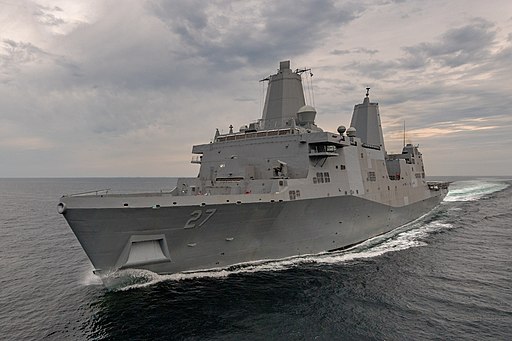
USS Portland (LPD-27)
The USS Portland (LPD-27) is the seventh San Antonio–class amphibious transport dock of the United States Navy. Commissioned in June 2017, Portland bridges the gap between high-speed deployments and sustained littoral operations. Designed to embark, transport, and land elements of an embarked Marine Expeditionary Unit by means of air cushion landing craft, conventional landing craft, and helicopters, she embodies flexibility, survivability, and lean crew requirements.
Design and Features
Hull Form and Survivability
Portland’s hull incorporates a tumblehome design that reduces radar cross-section and enhances stability during amphibious operations. Built with high-strength steel and blast-resistant bulkheads, her internal arrangement emphasizes compartmentalization and automated damage-control systems. She integrates the latest in fire suppression, flooding sensors, and redundant power routing to survive battle damage and maritime mishaps.
Propulsion and Powerplant
Portland uses a Combined Diesel and Diesel (CODAD) configuration:
- Two Colt-Pielstick PA6B STC diesel engines, each rated at 12,500 brake horsepower
- Two Colt-Pielstick PA6B STC diesel generators for hotel loads
- Two shafts driving controllable-pitch propellers
This arrangement yields a maximum speed of 22 knots and a cruising range exceeding 7,000 nautical miles at 15 knots. Electrical power is supplied by four 2,750 kW diesel generators, providing ample capacity for mission systems, aviation support, and habitability.
Amphibious Warfare Capabilities
Portland’s primary mission centers on supporting amphibious task forces and Marine Corps units. Key features include:
- A 1,200-square-foot well deck accommodating two Landing Craft Air Cushion (LCAC) vehicles or one Landing Craft Utility (LCU)
- Vehicle stowage for up to eight amphibious assault vehicles (AAV) or 38 standard Army trucks
- A 16,000-square-foot vehicle deck connected to the well deck via internal ramps
- Cargo handling facilities capable of moving 500 tons of supplies and equipment
Vehicle launch and recovery operations are fully automated, reducing manpower requirements and improving sortie generation rates.
Armament and Self-Defense Systems
Close-In Weapon Systems
- Two Rolling Airframe Missile (RAM) Mk 31 launchers, each with 21 missiles for point defense against anti-ship missiles
- Two Mk 38 Mod 2 25 mm gun mounts for defense against small boats and asymmetric surface threats
Surface and Air Defense
- A Mk 15 Phalanx Block 1B Close-In Weapon System (CIWS) provides an additional layer of defense against incoming missiles and aircraft
- AN/SLQ-32(V)2 electronic warfare suite for detection and jamming of hostile radars
These systems combine to create a layered defensive envelope around the ship when operating near contested shorelines.
Aviation Facilities
Flight Deck and Hangar
Portland supports a mixed air wing of up to six helicopters:
- The flight deck can handle simultaneous operations of two CH-53E Super Stallions or four MV-22B Ospreys
- A 10,000-square-foot hangar accommodates aircraft maintenance and storage
- Integrated aviation fuel storage of 60,000 gallons and three refueling points
Unmanned Aerial Systems
The hangar and flight deck are wired for Future Vertical Lift platforms and large unmanned tiltrotor systems, with space reserved for two medium-altitude long-endurance unmanned aerial vehicles (UAVs). Data links, mission planning consoles, and secure satellite communications ensure seamless integration of manned and unmanned aviation assets.
Command, Control, Communications, Computers, Intelligence, Surveillance, and Reconnaissance (C4ISR)
Combat Information Center
Portland’s Combat Information Center (CIC) features open-architecture consoles and modular mission bays. Core capabilities include:
- Link 16 tactical data exchange for real-time coordination with fleet and air assets
- AN/SPS-73(V)12 surface-search radar and navigation radar arrays
- Integrated command suite to plan and execute amphibious assault, humanitarian relief, or maritime security missions
Intelligence and Reconnaissance
A dedicated intelligence compartment hosts secure communications equipment, workstations for imagery analysis, and unmanned system control stations. Advanced sensor fusion tools process targeting data from embarked UAVs, long-range surveillance radar, and allied data networks.
Crew and Habitability
Complement and Automation
Portland operates with a core crew of 28 officers and 333 enlisted personnel, augmented by up to 700 embarked Marines. Automation in auxiliary systems, damage control, and machinery monitoring reduces workload and optimizes watch rotations.
Living Spaces
- Multi-functional berthing compartments with privacy curtains and personal storage
- A modern galley serving 1,000 meals per day, supported by automated food distribution systems
- Fitness center, chapel, and medical/dental treatment spaces to maintain crew health and morale
Living areas are designed for long deployments, with noise dampening, climate control, and vibration isolation.
Dimensions and Performance
Physical Characteristics
- Length overall: 684 feet (208.5 m)
- Beam: 105 feet (32 m)
- Draft: 24 feet (7.3 m)
Speed and Endurance
- Maximum speed: 22 knots
- Cruising speed: 15–18 knots
- Range: 7,000+ nautical miles at 15 knots
Displacement
- Light ship: 17,000 tons
- Full load: 25,000 tons
Technical Specifications
| Specification | Details |
|---|---|
| Class and Type | San Antonio–class Amphibious Transport Dock |
| Hull Material | High-strength steel, blast-resistant subdivisions |
| Propulsion | CODAD: 2 × Colt-Pielstick PA6B STC diesels; 2 shafts |
| Power Generation | 4 × 2,750 kW diesel generators |
| Speed | Max 22 knots; economical cruise at 15 knots |
| Range | 7,000+ nmi at 15 knots |
| Well Deck | 1,200 sq ft; supports 2 LCACs or 1 LCU |
| Vehicle Deck | 16,000 sq ft; stowage for amphibious assault vehicles |
| Aviation Fuel Capacity | 60,000 US gallons |
| Flight Deck | Supports 2 CH-53E or 4 MV-22B simultaneously |
| Armament | 2 × RAM Mk 31; 2 × Mk 38 Mod 2; 1 × Phalanx Block 1B |
| Electronic Warfare Suite | AN/SLQ-32(V)2 |
| Radar | AN/SPS-73(V)12 surface search; navigation radars |
| Crew | 28 officers, 333 enlisted; up to 700 embarked Marines |
Operational History
Since entering service in 2017, USS Portland has participated in major amphibious exercises and humanitarian missions. Highlights include:
- Joint amphibious landings with Marine Expeditionary Units in the Pacific
- Humanitarian assistance and disaster relief in Southeast Asia following typhoons
- Security cooperation operations in the Gulf of Aden, counter-piracy patrols alongside allied navies
Portland’s ability to rapidly transition between combat-ready posture and humanitarian support has made her a valued asset in global naval operations.
Future Upgrades
Planned enhancements to maintain Portland’s technological edge include:
- Installation of a hybrid-electric propulsion module to improve fuel efficiency and reduce acoustic signature
- Integration of directed-energy weapons for close-in defense against unmanned threats
- Expansion of onboard bandwidth and data-processing capability to support distributed maritime operations and network-centric warfare
These upgrades will extend her service life into the 2040s, ensuring continued relevance in evolving threats and mission sets.
Conclusion
USS Portland (LPD-27) stands at the forefront of modern amphibious warfare, blending robust survivability, advanced C4ISR systems, and flexible transport capabilities. Her design supports rapid force projection, humanitarian aid, and maritime security in any littoral environment. As she adopts future upgrades, Portland will remain a cornerstone of the Navy–Marine Corps team, delivering persistent presence and operational agility around the globe.
.jpg)