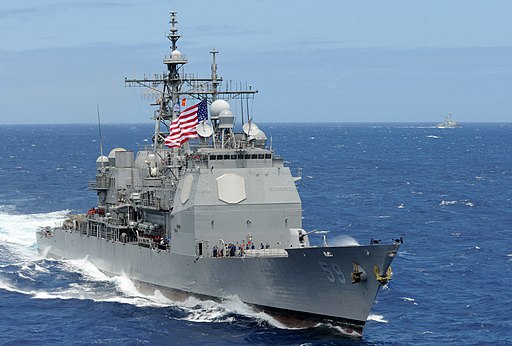
USS Princeton (CG-59)
USS Princeton (CG-59) is the ninth Ticonderoga-class guided-missile cruiser in the United States Navy. Commissioned in May 1989, Princeton has served across multiple theaters, protecting carrier strike groups, enforcing maritime security, and conducting ballistic missile defense patrols. With its powerful array of sensors, missiles, guns, and electronic systems, the ship remains a versatile force multiplier capable of countering threats in the air, on the surface, and underwater.
Design and Development
Hull and Superstructure
Princeton’s hull is constructed from high-strength steel, optimized for both survivability and seakeeping. The flared bow and large beam deliver stability during heavy seas, while the superstructure employs angled faceting to reduce radar cross-section. Key structural features include:
- Longitudinal and transverse framing for shock resistance
- Double-hull segments around vital engineering spaces
- Kevlar-lined magazines and ammunition handling rooms
Survivability Features
Survivability is built into every level of Princeton’s design. Flooding and fire-fighting systems operate with automated control, isolating damage zones and directing firefighting foam or water spray precisely where needed. Redundancies in power, communications, and propulsion allow the ship to remain mission-capable even after sustaining battle damage.
Propulsion and Powerplant
USS Princeton uses a twin-shaft, Combined Gas and Gas (COGAG) propulsion plant:
- Four General Electric LM2500 gas turbines, each delivering 25,000 shaft horsepower
- Two controllable-pitch propellers for agile maneuvering
- Two 2,000 kW ship service gas turbine generators
- Two 1,500 kW emergency diesel generators
This configuration yields a total of 100,000 shp, allowing speeds exceeding 30 knots and a range of roughly 6,000 nautical miles at 20 knots. The redundant electrical network ensures core systems remain powered despite multiple failures.
Combat Systems
Missile Systems
Princeton’s vertical launching system (VLS) comprises 122 Mark 41 cells, split evenly between fore and aft decks. Typical missile loadouts include:
- SM-2 Standard Missiles for air defense
- SM-3 interceptors for ballistic missile defense
- SM-6 for over-the-horizon engagements
- Tomahawk Land Attack Missiles for precision strike
- ASROC rockets for anti-submarine warfare
The ship can tailor its VLS inventory to specific mission sets, enabling rapid adaptation to evolving threats.
Gun Systems
- One 5-inch/54 caliber Mk 45 Mod 2 naval gun supports naval gunfire, surface engagements, and shell-based counter-airburst roles.
- Two Mk 38 Mod 2 25 mm machine gun systems provide close-in defense against small-boat and asymmetric threats.
These guns deliver rapid, accurate fire when missile systems are not required or available.
Anti-Air and Anti-Missile Defenses
USS Princeton employs layered defenses to intercept incoming threats:
- Aegis Combat System with SPY-1D(V) phased-array radar for multi-target detection and tracking
- Standard Missile batteries guided by Aegis for long-range interception
- Two Mk 15 Phalanx Block 1B Close-In Weapon Systems (CIWS) as a final layer against missiles and aircraft
The combination of long-range interceptors, medium-range missiles, and point-defense guns ensures multiple engagement opportunities against inbound threats.
Sensors and Electronic Warfare
Radar and Fire Control
At the core of Princeton’s situational awareness is the Aegis Baseline 9 combat system, integrating:
- AN/SPY-1D(V) multi-function radar arrays
- An upgraded signal processor for ballistic missile track and intercept
- Fire control radars AN/SPG-62 for SM-2 and SM-3 guidance
This networked architecture fuses data from allied assets via Cooperative Engagement Capability (CEC), enabling extended detection horizons and cooperative target engagement.
Sonar and ASW Suite
Princeton conducts anti-submarine warfare using:
- AN/SQS-53C hull-mounted sonar for active detection and fire-control solutions
- AN/SQR-19 Tactical Towed Array Sonar System for passive long-range tracking
- Two triple Mk 32 torpedo tube launchers with Mk 54 lightweight torpedoes
An embarked MH-60R Seahawk helicopter expands ASW reach with dipping sonar, sonobuoys, and torpedo delivery.
Electronic Warfare Suite
The AN/SLQ-32(V) electronic warfare suite offers radar warning, signal analysis, and active countermeasures. Complemented by Mk 36 Super Rapid Bloom Offboard Countermeasure (SRBOC) chaff/flare launchers and Nulka active decoy systems, Princeton can detect and defeat radar-guided and infrared threats.
Aviation Facilities
Flight Deck and Hangar
The ship’s aft deck features a reinforced flight deck and a two-spot protected hangar. It can support:
- Two MH-60R Seahawks for anti-submarine, anti-surface, and search-and-rescue missions
- Embarked UAVs as future enhancements for intelligence, surveillance, and reconnaissance
Aviation support includes JP-5 fuel storage, maintenance shops, and avionics consoles.
Crew and Habitability
Complement and Organization
USS Princeton operates with a crew of 33 officers and 312 enlisted personnel. Departments include operations, weapons, engineering, combat systems, supply, and medical. Cross-training enables personnel to manage multiple roles during high-tempo operations.
Living Spaces and Amenities
Berthing compartments feature noise-isolated racks, climate control, and storage lockers. Common facilities include a modern galley, fitness room, chapel, and medical clinic—supporting extended deployments with improved quality of life.
Dimensions and Performance
Physical Characteristics
- Length overall: 567 feet (173 m)
- Beam: 55 feet (17 m)
- Draft: 31 feet (9.4 m)
Displacement and Speed
- Light displacement: 9,600 tons
- Full load displacement: 9,800 tons
- Maximum speed: over 30 knots
- Range: 6,000 nautical miles at 20 knots
Operational History
Early Service
After commissioning, Princeton joined the Pacific Fleet, deploying routinely to the Western Pacific and Persian Gulf. She supported carrier strike group operations, maritime interception missions, and humanitarian relief following natural disasters.
Ballistic Missile Defense
Princeton was among the first Aegis cruisers upgraded for ballistic missile defense under the Aegis Ballistic Missile Defense program. She has conducted numerous patrols in the Western Pacific, providing regional missile defense coverage alongside allied navies.
Notable Exercises
- Exercise Valiant Shield: integrated air and missile defense drills
- Exercise RIMPAC: multinational maritime warfare training
- Maritime security operations in the Straits of Hormuz
These deployments have demonstrated Princeton’s flexibility, interoperability, and combat readiness.
Technical Specifications
| Specification | Details |
|---|---|
| Class and Type | Ticonderoga-class Guided-Missile Cruiser |
| Hull Material | High-strength steel |
| Propulsion | 4 × GE LM2500 gas turbines (COGAG), 2 shafts |
| Total Power | 100,000 shp |
| Speed | >30 knots |
| Range | 6,000 nmi at 20 knots |
| Displacement (Light/Full) | 9,600 / 9,800 tons |
| Complement | 33 officers, 312 enlisted |
| VLS Cells | 122 Mk 41 |
| Main Gun | 1 × 5 in/54 cal Mk 45 Mod 2 |
| Secondary Guns | 2 × Mk 38 Mod 2 25 mm |
| CIWS | 2 × Phalanx Mk 15 Block 1B |
| ASW Systems | AN/SQS-53C, AN/SQR-19 towed array, Mk 32 torpedoes |
| Radar | AN/SPY-1D(V) phased-array |
| Electronic Warfare | AN/SLQ-32(V), SRBOC, Nulka |
| Aviation Facilities | Flight deck, 2-spot hangar for MH-60R |
Conclusion
USS Princeton (CG-59) remains a cornerstone of the U.S. Navy’s surface combatant fleet, blending advanced Aegis capabilities, potent strike weapons, and robust defensive systems. Her adaptability—from sea-based ballistic missile defense to anti-submarine warfare, maritime security, and humanitarian assistance—underscores the enduring value of the Ticonderoga-class. As future upgrades to combat systems, electronic warfare, and unmanned integration take shape, Princeton will continue safeguarding global maritime interests well into the next decade.
