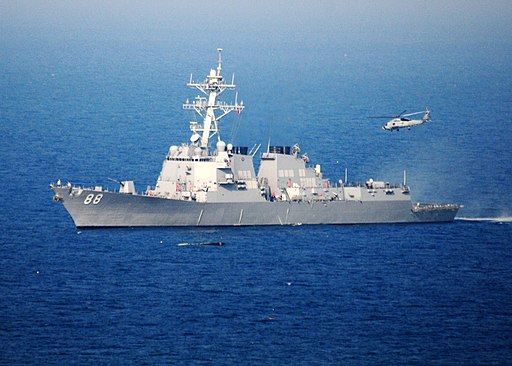
USS Preble (DDG-88)
USS Preble (DDG-88) is a Flight IIA Arleigh Burke–class guided missile destroyer commissioned in 2002. Built to perform air defense, surface warfare, anti-submarine operations, and strike missions, Preble embodies the multi-mission versatility of the Arleigh Burke design. The ship honors Commodore Edward Preble for his leadership in early U.S. naval history.
Preble serves as an integral part of carrier strike groups, amphibious ready groups, and ballistic missile defense deployments. Its mix of high-end sensors, advanced weapons, and robust survivability features ensures readiness across all threat spectrums.
Design and Development
Hull and Structural Features
The hull of Preble is fabricated from high-strength, radar-absorbent steel alloy. A pronounced tumblehome near the waterline reduces radar cross-section and enhances seakeeping in high sea states. Internally, longitudinal and transverse framing supports a shock-hardened superstructure designed to absorb combat damage.
Bulkheads are arranged in multiple watertight compartments, allowing the ship to withstand flooding in several damaged sections and maintain operational capability. Automated flood control valves isolate compromised zones rapidly.
Survivability
Preble’s survivability suite encompasses:
- Redundant power routing with dual switched main electrical buses
- Double-alkaseltzer fire suppression for engine rooms and combat system spaces
- Kevlar-lined magazines and blast-resistant doors
These systems work in concert to limit battle damage effects and preserve combat power.
Propulsion and Powerplant
Preble employs a Combined Gas and Gas (COGAG) propulsion arrangement. Four General Electric LM2500 gas turbines deliver a combined 100,000 shaft horsepower across two shafts. This configuration offers rapid acceleration, quick recovery from turbine failures, and sustained high-speed transits.
Electric power is provided by two 1,500 kW emergency diesel generators and three 2,000 kW ship service gas turbine generators. This redundancy supports full operational capability even under single-generator casualties.
Weapons and Combat Systems
Missile Systems
Vertical Launching System arrays comprise 96 Mark 41 VLS cells distributed fore and aft. Typical loadouts include:
- SM-2 Standard Missiles for regional air defense
- SM-3 interceptors for ballistic missile defense
- SM-6 for over-the-horizon engagement
- Tomahawk cruise missiles for long-range strike
- ASROC rockets for anti-submarine warfare
The modular cell design allows mission-specific missile mixes.
Gun Systems
A single 5-inch/62-caliber Mk 45 Mod 4 naval gun offers:
- Long-range precision fire against surface targets
- Naval gunfire support for amphibious operations
- Programmable ammunition for counter-airburst roles
Two Mk 38 Mod 2 25 mm remotely operated guns provide close-in defense against small boat threats.
Close-In Defense
Preble’s last line of defense includes:
- One Phalanx Mk 15 Block 1B Close-In Weapon System for missile defense
- Rolling Airframe Missile Mk 31 launcher for fast-reacquisition and high-angle intercepts
- Decoy launchers deploying chaff and infrared flares
Anti-Submarine Warfare
An SQS-53C hull-mounted sonar and SQR-19 multi-function towed array system deliver long-range passive and active detection. The ship carries:
- Two triple Mk 32 torpedo tubes loaded with Mk 54 lightweight torpedoes
- Capability to embark an MH-60R Seahawk for dipping sonar, sonobuoys, and torpedo delivery
Sensors and Electronics
Radar Systems
At the heart of Preble’s situational awareness is the AN/SPY-1D(V) phased-array radar. It tracks hundreds of air and surface contacts simultaneously and guides missile engagements. The SPY-1 integrates with Aegis Baseline 9 for cooperative engagement and ballistic missile defense.
Sonar and Acoustic Suite
The hull-mounted SQS-53C sonar provides active search and fire-control support. The SQR-19 Tactical Towed Array System extends passive undersea surveillance beyond 100 kilometers, feeding contact data to the combat information center.
Electronic Warfare and C4I
The AN/SLQ-32(V)4 electronic warfare suite detects, classifies, and counters hostile radar emissions. Link 16 and Cooperative Engagement Capability (CEC) datalinks enable real-time sensor sharing with other ships and aircraft, forming a distributed maritime defense network.
Aviation Facilities
Flight Deck and Hangar
Preble’s aft flight deck and hangar support one MH-60R Seahawk. Facilities include:
- Maintenance and storage for helicopter airframes
- Refueling points for JP-5 fuel
- Torque-tool stations and parts storage
These capabilities enhance anti-submarine, anti-surface, and search-and-rescue missions.
UAV Capabilities
Wiring and space allocations are in place for future unmanned aerial systems. Data links and launch-and-recovery provisions will allow integration of vertical-takeoff ISR drones when deployed.
Crew and Habitability
Complement and Roles
Typical ship’s company comprises 28 officers and 254 enlisted personnel. Key departments include operations, engineering, weapons, combat systems, and supply. Crew rotations and cross-training ensure 24/7 readiness across all mission areas.
Living Spaces and Amenities
Berthing compartments feature vibration-isolated racks and climate control. Common areas include:
- A modular galley feeding up to 300 sailors per watch
- Fitness center with cardiovascular and resistance equipment
- Medical and dental facilities for casualty care
These spaces support morale and endurance during extended deployments.
Dimensions and Performance
Physical Characteristics
- Length overall: 509 feet (155 m)
- Beam: 66 feet (20 m)
- Draft: 31 feet (9.4 m)
Displacement and Range
- Light displacement: 7,600 tons
- Full load displacement: 9,200 tons
- Maximum speed: over 30 knots
- Range: 4,400 nautical miles at 20 knots
Operational History
Early Deployments
After commissioning, Preble joined the Pacific Fleet and conducted exercises with carrier strike groups in the Western Pacific. The destroyer provided Aegis air defense cover during multinational drills with allied navies.
Recent Missions
Preble has rotated through ballistic missile defense patrols in the Western Pacific, conducted freedom of navigation operations in contested seas, and supported humanitarian assistance after regional typhoons. The ship’s VLS cells have also demonstrated Tomahawk strike capability during joint exercises.
Notable Exercises
- Exercise Keen Sword for combined U.S.–Japan readiness
- RIMPAC multinational maritime warfare training
- Valiant Shield integrated strike force operations
These events refine Preble’s tactics and enhance coalition interoperability.
| Specification | Detail |
|---|---|
| Class and Type | Arleigh Burke–class Guided Missile Destroyer |
| Hull Material | High-strength, radar-absorbent steel |
| Propulsion | 4 × GE LM2500 Gas Turbines (COGAG) |
| Power Output | 100,000 shp |
| Speed | >30 knots |
| Range | 4,400 nmi at 20 knots |
| Displacement (Light/Full) | 7,600 / 9,200 tons |
| Complement | 28 Officers, 254 Enlisted |
| VLS Cells | 96 Mk 41 |
| Main Gun | 1 × 5 in/62 cal Mk 45 Mod 4 |
| CIWS | 1 × Phalanx Mk 15 Block 1B |
| ASW Systems | AN/SQS-53C, SQR-19 towed array, Mk 32 Torpedo Tubes |
| Radar | AN/SPY-1D(V) |
| Electronic Warfare | AN/SLQ-32(V)4 |
USS Preble (DDG-88) continues to evolve with upgrades in missile defense software, electronic warfare enhancements, and integration of unmanned systems. As threats change, Preble remains a versatile and resilient asset in the U.S. Navy’s global fleet.
_after_refueling.jpg)