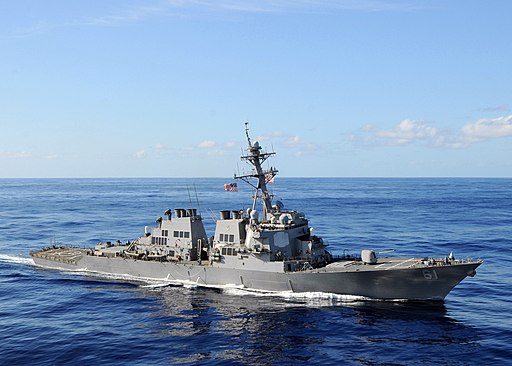
USS Ramage (DDG-61)
USS Ramage (DDG-61) is an Arleigh Burke–class guided-missile destroyer commissioned into the United States Navy in April 1995. Named in honor of Vice Admiral Lawson P. “Red” Ramage, a pioneering submariner and Medal of Honor recipient, Ramage combines potent Aegis combat capabilities, high-speed maneuverability, and robust survivability. As part of Destroyer Squadron 23, she routinely deploys in carrier strike groups, expeditionary strike groups, and ballistic missile defense task forces, projecting power across the globe.
Design and Development
Arleigh Burke–Class Heritage
The Arleigh Burke class represents the Navy’s transition to a single multi-mission destroyer design optimized around the Aegis Combat System. Ramage is a Flight I variant, the first production run of this class, featuring the AN/SPY-1A phased-array radar, 90-cell Mk 41 Vertical Launching System, and extensive electronic warfare suites. Lessons learned on early Burkes shaped her survivability features, habitability, and engineering arrangements.
Hull and Structural Features
Ramage’s hull is built from high-strength, low-observable steel with a rounded bow and flared hull sides to improve seakeeping and reduce radar signature. Longitudinal stringers and transverse frames create a shock-hardened structure capable of withstanding mine blasts and underwater detonations. The ship is subdivided into ten watertight compartments, each protected by automatic fire and flooding control valves.
Propulsion and Powerplant
Combined Gas and Gas (COGAG)
Ramage employs a COGAG arrangement with four General Electric LM2500-30 gas turbines delivering a total of 100,000 shaft horsepower. Two turbines drive each controllable-pitch propeller shaft, providing rapid acceleration for high-speed dashes, sustained operation above 30 knots, and single-engine cruising for fuel economy.
Electrical Generation and Distribution
Electric power is supplied by four 1,000 kW ship service gas turbine generators and two 600 kW emergency diesel generators. A dual main electrical bus system, with automatic cross-ties and load-shedding capability, ensures uninterrupted power to radars, combat systems, propulsion auxiliaries, and habitability loads even under battle damage conditions.
Combat Systems and Armament
Aegis Combat System
At the heart of Ramage’s combat capability is the Aegis Baseline 3 system integrated around the AN/SPY-1A radar. The system tracks over 100 simultaneous targets, provides fire-control quality tracks for SM-2 missiles, and fuses data from Link 11, Link 16, and the ship’s sonar arrays. Combat system consoles offer multi-function displays for weapons control, threat evaluation, and tactical decision aids.
Vertical Launching System
Ramage carries 90 Mk 41 Vertical Launch System cells—two 29-cell forward modules and one 32-cell aft module. Typical loadouts include:
- Standard Missile 2 (SM-2) for area air defense
- Harpoon anti-ship missiles
- ASROC anti-submarine rockets
- Tomahawk land-attack cruise missiles
Cells can be replenished at sea via underway replenishment, enabling continuous operations in littoral and open-ocean theaters.
Gun and Close-In Weapon Systems
- A single 5-inch/54-caliber Mk 45 naval gun on the forecastle provides naval gunfire support, anti-surface fire, and limited anti-airburst engagement.
- Two Mk 15 Phalanx Block 1B Close-In Weapon Systems (CIWS) mounted amidships and aft defend against anti-ship missiles and fast-attack craft.
- Two Mk 38 Mod 2 25 mm machine gun mounts offer additional protection against small boats and asymmetric threats.
Anti-Submarine Warfare Suite
Ramage’s ASW suite combines a hull-mounted AN/SQS-53 sonar with an SQR-19 Tactical Towed Array Sonar System. Two triple Mk 32 torpedo tubes allow rapid deployment of Mk 46 and Mk 50 lightweight torpedoes. The flight deck and hangar support one MH-60R Seahawk helicopter equipped with dipping sonar, sonobuoys, and torpedoes, extending detection and engagement ranges beyond the reach of shipboard sensors.
Sensors and Electronic Warfare
Radar and Fire-Control Arrays
- AN/SPY-1A four-face phased-array radar delivers continuous 360-degree search and track capability.
- AN/SPQ-9A/X surface-search and fire-control radar provides high-resolution targeting for surface and low-flying threats.
- AN/SPG-62 illumination radars guide semi-active homing missiles during terminal engagement.
Electronic Support and Countermeasures
The AN/SLQ-32(V)2 electronic support measures suite detects, classifies, and warns of hostile radar emissions. For countermeasures, Ramage carries the Mk 36 Super Rapid Bloom Offboard Countermeasures (SRBOC) launchers deploying chaff and infrared flares. In later upgrades, AN/SLQ-25 Nixie torpedo decoys have been added to protect against acoustic-homing torpedoes.
Communication and Networking
Link 11 and Link 16 tactical data links provide real-time exchange of track data with allied ships, aircraft, and shore stations. An onboard combat network combines inputs from satellites, airborne platforms, and underwater sensors, supporting cooperative engagement with other Aegis-equipped vessels. Secure satellite communications ensure continuous connectivity regardless of theater.
Aviation Facilities
Flight Deck and Hangar
Ramage’s aft hangar and flight deck support one MH-60R Seahawk. The hangar includes maintenance and refueling facilities, parts storage, and a helo-crane for handling large payloads like sonobuoy racks. The flight deck is equipped with deck-edge sensors and elemental wind sensors to ensure safe launch and recovery in high seas.
Unmanned Aerial System Integration
While not originally designed for UAVs, USS Ramage’s aviation control suites and electrical outlets have been adapted to launch and recover the MQ-8 Fire Scout unmanned helicopter. Ship’s boats have also been fitted for launch and retrieval of small unmanned surface vessels for harbor patrol and intelligence missions.
Survivability and Damage Control
Passive Defense
Ramage’s hull and superstructure incorporate degaussing coils to reduce magnetic signature, minimizing vulnerability to magnetic influence mines. Radar-absorbent coatings and angled surfaces suppress radar returns against anti-ship missiles.
Active Damage Control
An integrated Automated Fire and Flooding System continually monitors temperature, smoke, and water ingress. Should a compartment breach occur, electrically actuated dampers isolate the space while remotely controlled firefighting monitors flood fire zones with aqueous film-forming foam. Redundant fire pumps and power buses ensure continued operation under duress.
Crew and Habitability
Ship’s Company and Organization
USS Ramage typically sails with 28 officers and 254 enlisted personnel. Departments include operations, combat systems, engineering, weapons, supply, and medical. Cross-training among watch stations provides redundancy for critical roles, while automated machinery controls reduce watchstanding requirements in engineering spaces.
Living Quarters and Amenities
Ramage’s berthing areas feature vibration-isolated racks, individual reading lights, and personal storage. The ship includes a modern galley with plating rooms, beverage stations, and a protected mess hall. Morale and welfare facilities consist of a small library, a fitness room with cardio and resistance equipment, and an all-hands lounge equipped with video teleconferencing.
Dimensions and Performance
Physical Characteristics
- Length overall: 509 feet (155 meters)
- Beam: 66 feet (20 meters)
- Draft: 31 feet (9.4 meters)
Displacement and Endurance
- Light displacement: 7,300 long tons
- Full load displacement: 8,300 long tons
- Maximum speed: 31+ knots
- Range: 4,400 nautical miles at 20 knots
Operational History
Early Deployments
Following her 1995 commissioning, USS Ramage joined the Atlantic Fleet, conducting North Atlantic exercises and counter-narcotics patrols in the Caribbean. She supported Operation Allied Force in the Adriatic, providing Aegis air defense for carrier strike groups.
Global Missions
Over successive deployments, Ramage operated in the Mediterranean, Persian Gulf, and Western Pacific. She participated in Operation Enduring Freedom by launching Tomahawk strikes against high-value targets, enforced sanctions in the Gulf, and escorted humanitarian relief convoys following regional disasters.
Ballistic Missile Defense Upgrades
In the 2000s, Ramage received Aegis Ballistic Missile Defense upgrades, enabling her to carry SM-3 interceptors. She has since rotated through ballistic missile defense patrols in the Western Pacific, operating alongside allied vessels under the Cooperative Engagement Capability umbrella.
Technical Specifications
| Specification | Details |
|---|---|
| Class and Type | Arleigh Burke–class Guided-Missile Destroyer |
| Hull Material | Low-observable high-strength steel |
| Propulsion | 4 × GE LM2500-30 Gas Turbines (COGAG) |
| Total Power | 100,000 shaft horsepower |
| Electrical Generation | 4 × 1,000 kW GTGs; 2 × 600 kW Diesel Generators |
| Speed | Over 30 knots |
| Range | 4,400 nmi at 20 knots |
| Displacement (Light/Full) | 7,300 / 8,300 long tons |
| Complement | 28 officers, 254 enlisted |
| Vertical Launch Cells | 90 Mk 41 |
| Main Gun | 1 × 5″/54 cal Mk 45 |
| CIWS | 2 × Phalanx Mk 15 Block 1B |
| Secondary Guns | 2 × Mk 38 Mod 2 25 mm |
| ASW Systems | AN/SQS-53; AN/SQR-19 towed array; Mk 32 tubes |
| Radar | AN/SPY-1A; AN/SPQ-9A/X; AN/SPG-62 |
| Electronic Warfare | AN/SLQ-32(V)2; Mk 36 SRBOC; Nixie; Nulka |
| Aviation Facilities | Hangar and Flight Deck for 1 MH-60R Seahawk |
Conclusion
USS Ramage (DDG-61) remains a critical asset within the U.S. Navy’s surface fleet, blending proven Arleigh Burke flexibility with continuous technological upgrades. From Aegis air defense to precision strike, anti-submarine warfare, and ballistic missile defense, Ramage delivers a layered, integrated response to evolving threats. As unmanned systems and directed-energy weapons emerge, her open-architecture design and modular combat systems will allow her to remain at the forefront of naval combat power well into the 2040s.
_transits_the_Atlantic_Ocean.jpg)