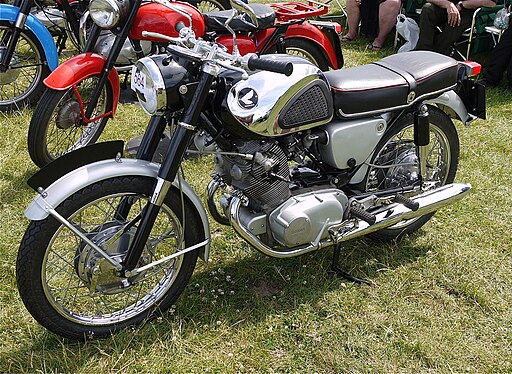
Honda CB77
The Honda CB77 Super Hawk emerged in the mid-1960s as a game-changer for the burgeoning sport-bike market. Marrying advanced twin-cylinder engineering with slim, café-inspired styling, it offered performance that outpaced many larger machines of the era. Its blend of spirited acceleration, nimble handling, and build-quality reliability cemented its place in motorcycle lore and laid the groundwork for Honda’s future CB series.
Design and Styling
Bodywork and Aesthetics
Honda’s designers sculpted the CB77 with clean, flowing lines that emphasize its narrow engine packaging and upright riding stance. A modestly faired headlamp nacelle blends into a teardrop fuel tank, while the sculpted side covers wrap the twin’s camshaft covers without excess bulk. Chrome fenders, polished tank knee indents, and finned engine casings add visual flair, balancing sporty presence with timeless elegance.
Rider Ergonomics
An elongated, dual-density seat offers room for two riders without sacrificing the machine’s café-style silhouette. Clip-on handlebars sit low enough for an engaged riding posture yet high enough to prevent fatigue on longer runs. Mid-mounted footpegs strike a compromise between comfortable cruising and lean-angle clearance, making the CB77 equally confident on winding roads or open highways.
Engine and Performance
Powerplant Specifications
| Specification | Detail |
|---|---|
| Engine Type | 305 cc air-cooled SOHC 4-valve parallel twin |
| Bore × Stroke | 60 mm × 54 mm |
| Compression Ratio | 9.3 : 1 |
| Carburation | Twin Keihin CV30 constant-velocity carburetors |
| Ignition | 6-volt points |
| Peak Power | 28 bhp at 9,500 rpm |
| Peak Torque | 26 N·m at 8,000 rpm |
Performance Characteristics
The CB77’s twin-cam design delivered a broad, linear power curve that surprised riders accustomed to single-cylinder thumpers. Strong midrange torque from 6,000–8,500 rpm ensured quick roll-on acceleration, while the high-revving nature rewarded riders chasing every rev up to the 10,000 rpm redline. A well-tuned exhaust note and smooth clutch action made spirited riding both engaging and accessible.
Chassis and Suspension
Frame Architecture
A tubular steel cradle frame underpins the Super Hawk, engineered to provide rigidity without excess weight. The engine functions as a semi-stressed member, contributing to torsional stiffness and precise handling. Strategic bracing around the steering head and swingarm pivot helps maintain stability at speed and in tight turns.
Front Suspension
Telescopic forks with 33 mm stanchions offer 120 mm of travel. Internally, dampers are valved for balanced compression and rebound control, minimizing fork dive under braking. Protective gaiters shield seals from dust and grit, preserving smooth operation over time.
Rear Suspension
Dual shock absorbers with adjustable preload deliver 100 mm of rear travel. Progressive spring rates soften minor bumps yet firm up under heavier loads—whether carving corners or carrying a passenger. Chrome-plated springs and polished bodies lend a classic look while resisting corrosion.
Brakes and Wheels
Stopping Power
Drum brakes dominate both ends: a 158 mm twin-leading-shoe drum at the front and a 150 mm single-leading-shoe drum out back. The front setup delivers commendable bite for the era, while the rear complements with predictable modulation. Regular adjustment and proper shoe lining condition are key to consistent performance.
Wheels and Tires
Wire-spoke rims measure 18 inches front and rear, balancing compliance with responsive feedback. Standard tire sizes—3.25–18 front and 3.50–18 rear—offer a mix of grip and longevity. Inner tubes remain the norm, reflecting period technology, but modern tubeless conversions are a popular restoration upgrade.
Electrical System and Instrumentation
Electrical Architecture
A 6-volt battery and generator system power the CB77’s lighting and ignition. A positive-ground circuit places the coil and regulator beneath the tank, while minimal wiring harness lengths reduce clutter. Dual rear fuse protection safeguards the ignition and lighting circuits independently.
Gauge Cluster
A centrally mounted speedometer sits alongside a tachometer, both featuring black faces with white numerals. Indicator lights for neutral, high-beam, and turn signals flank the gauges. Handlebar-mounted switches provide clear, tactile control over lights, horn, and ignition cut-off.
Dimensions, Weight, and Capacities
| Measurement | Value |
|---|---|
| Overall Length | 2,050 mm |
| Overall Width | 790 mm |
| Wheelbase | 1,350 mm |
| Seat Height | 790 mm |
| Ground Clearance | 130 mm |
| Dry Weight | 160 kg |
| Fuel Tank Capacity | 11 L (approx.) |
| Oil Capacity | 2.2 L |
Riding Experience and Legacy
Riders rave about the CB77’s effortless acceleration and nimble cornering, qualities that belied its humble displacement. Its lightweight chassis instilled confidence in changing lanes or tackling winding backroads. Beyond performance, the Super Hawk became a style icon—adopted by rockers and café racers who customized exhausts, paint schemes, and rider ergonomics to amplify its sporting character.
Maintenance and Restoration Tips
- Change engine oil every 1,000 km to preserve bearing life and valve-train longevity.
- Inspect and adjust valve clearance at 5,000 km intervals to maintain the twin-cam’s crisp performance.
- Clean and re-jet carburetors seasonally to ensure optimal fuel mixture across all altitudes.
- Re-chrome or polish fork stanchions and shock bodies to prevent seal lip wear.
- Upgrade to modern tube-type tires with period-correct tread patterns for improved grip and safety.
Conclusion
The Honda CB77 Super Hawk stands as a testament to Honda’s early mastery of multi-cylinder engineering and sport-bike design. Its spirited twin, agile chassis, and timeless styling continue to captivate collectors and enthusiasts decades after its debut. Whether restored to original glory or reimagined as a bespoke café racer, the CB77 remains a symbol of the golden age of motorcycling.
