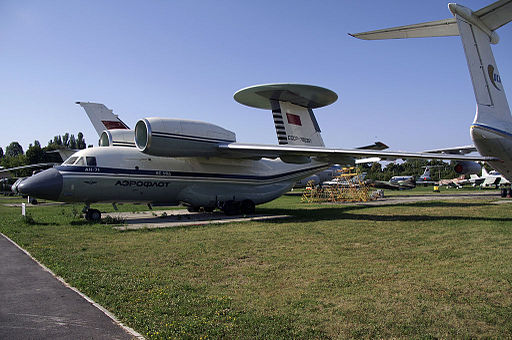
Antonov An-71
The Antonov An-71 was a Soviet-era airborne early warning and control aircraft conceived in the 1980s to provide radar surveillance and command coordination for front-line aviation units. Based on the proven An-72 transport platform, the An-71 incorporated an elevated radar pod above the tail to house a rotating phased-array antenna. Designed to operate from austere airstrips, it combined short-takeoff and landing performance with an advanced electronic suite intended to detect low-flying targets at extended ranges. Two prototypes flew between 1985 and 1991, but shifting military priorities and economic constraints ultimately halted the program before production could begin.
Design and Development
Origins and Rationale
The Soviet General Staff sought an AWACS platform capable of operating closer to contested airspace than longer-ranged Il-76-based aircraft. By adapting the An-72’s overwing engine layout and rugged landing gear, designers aimed to deliver an early warning asset able to disperse to secondary fields after front-line bases were threatened. The An-71’s elevated radar installation was intended to minimize ground clutter and maximize horizon visibility, while its turbofan powerplants promised fuel economy and reliability in harsh climates.
Prototype and Flight Testing
Construction of the first prototype began in Kyiv in 1983. Engineers replaced the An-72’s forward cargo hatch with avionics racks and extended the tail cone to mount a 9-meter diameter electronically steered array. The maiden flight in August 1985 validated basic handling and engine performance. A second prototype added full sensor suites, cockpit consoles for four operators, and refined aerodynamic fairings. By 1991 both airframes had completed over 500 hours of trials, demonstrating radar coverage out to 300 kilometers and crew coordination capabilities, but funding cuts prevented further development.
Airframe and Aerodynamics
Fuselage and Radar Pod
The An-71 shared the An-72’s semi-monocoque fuselage, 22.5 meters long and seven meters wide, fabricated from corrosion-resistant aluminum alloys. The rear fuselage extended into a distinctive canoe-shaped fairing supporting the radar array. That fairing housed the rotating phased-array dish, power supplies, and climate controls for the sensitive electronics. Internal racks accommodated up to seven operator consoles, mission computers, and data-link terminals.
Wing and Control Surfaces
Its high-mounted wing spanned 28.8 meters with a supercritical airfoil section optimized for low-speed lift during surveillance orbits. Automatic leading-edge slats and double-slotted flaps enabled a stall speed below 160 km/h when fully laden. Two Turbofan-duct engine pods sat atop each wing root, shielding foreign object debris intake and reducing infrared signature from below. Wide chord ailerons and spoiler panels provided precise roll authority when flying slow, prolonged patterns.
Landing Gear
A rugged tricycle undercarriage featured twin-wheel nose gear and four-wheel main bogies, each unit equipped with oleo-pneumatic struts and low-pressure tires. Designed for unpaved strips, the gear retracted into streamlined fairings beneath the fuselage. Ground clearance remained sufficient for rapid turnarounds in primitive conditions, while reversing prop-pitch on landing shortened roll-out distances.
Avionics and Radar Systems
Phased-Array Surveillance Radar
Central to the An-71 was its electronically steered, rotating phased-array radar capable of concurrent air and surface search modes. Azimuth coverage reached 360 degrees with elevation up to 60 degrees. Pulse-Doppler processing filtered ground returns for low-level target detection, while track-while-scan algorithms could manage over 150 simultaneous contacts. Mission data could be relayed in real time to ground or airborne command posts via secure data links.
Electronic Warfare Suite
Supplementing the surveillance radar, the An-71 carried an integrated electronic support measures system to detect and classify enemy emitters. Infrared missile warning sensors externally mounted on the fuselage linked to chaff and flare dispensers. A communications intelligence sub-system could intercept tactical radios within a 200-kilometer radius, feeding direction-finding data into the onboard tactical display.
Powerplant and Performance
Engine Configuration
Power came from a pair of Lotarev D-36 turbofan engines, each rated at 61 kN thrust. These high-bypass fans featured wide-chord blades and FADEC-style governors to maintain stable operation across long surveillance legs. Integral accessory gearboxes drove hydraulic pumps, electrical generators, and environmental compressors. Fire detection and suppression systems were installed in each nacelle.
Flight Performance
- Maximum cruise speed at altitude 700 km/h
- Typical survey speed 450 km/h
- Service ceiling 11,000 m
- Range with full fuel and mission load 3,200 km
- Endurance on station 6 hours without aerial refueling
- Takeoff distance to 15 m obstacle 1,050 m
- Landing distance from 15 m obstacle 900 m
Superior high-lift aerodynamics and efficient turbofans gave the An-71 the ability to hold station at low speeds while retaining the capability to transit between bases rapidly.
Crew and Mission Profile
Crew Composition
A typical An-71 flight crew consisted of two pilots, one flight engineer, a navigator/communications officer, and three radar system operators. Each operator station featured a multifunction display for track management, identification friend or foe system control, and data-link oversight. The flight deck employed conventional analog gauges augmented by CRT-based mission displays in the prototype series.
Mission Scenarios
Operational profiles envisioned the An-71 deploying to forward airstrips, establishing surveillance orbits at 6,000 to 8,000 meters. The aircraft could vector fighter interceptors against incoming threats or relay maritime domain data to naval task forces. Secondary missions included battlefield area surveillance, search-and-rescue coordination, and overwatch during airborne assault operations.
Variants and Potential Upgrades
Although only prototypes were built, planners drafted several variants:
- An-71R long-range version with additional fuel pods under the wings
- An-71EW electronic warfare converter with jamming pods and signal intelligence racks
- An-71T troop transport retrofitted with paratroop doors and reduced electronics payload
Upgrades studied in the early 1990s included digital cockpit modernization, active electronically scanned array radar, and improved data-link architecture compatible with Western NATO standards.
Operational History and Fate
After Soviet dissolution, both An-71 prototypes were flown to Ukraine for further evaluation. Limited budgets and the emergence of cheaper Western AWACS platforms led to the program’s cancellation in 1991. The aircraft served as testbeds for radar development and hot-and-high performance studies. One airframe remains preserved at an aviation museum near Kyiv, symbolizing an ambitious but unrealized chapter in Soviet airborne surveillance.
Technical Specifications
| Parameter | Specification |
|---|---|
| Crew | 8 (2 pilots, flight engineer, navigator, 4 operators) |
| Length | 22.5 m |
| Wingspan | 28.8 m |
| Height | 8.9 m |
| Wing area | 70.4 m² |
| Empty weight | 23,000 kg |
| Maximum takeoff weight | 34,500 kg |
| Powerplant | 2 × Lotarev D-36 turbofans, 61 kN each |
| Maximum speed | 700 km/h |
| Cruise speed | 650 km/h |
| Surveillance speed | 450 km/h |
| Service ceiling | 11,000 m |
| Range | 3,200 km |
| Endurance | 6 hours |
| Takeoff distance (15 m obstacle) | 1,050 m |
| Landing distance (15 m obstacle) | 900 m |
Legacy and Lessons Learned
The An-71’s innovative radar placement and STOL capabilities influenced later designs in airborne surveillance. Its development highlighted challenges of integrating large phased-array systems onto smaller airframes and underscored the importance of funding stability for advanced programs. Though the An-71 never entered service, its prototypes contributed to radar technology maturation and remain a testament to the Antonov bureau’s willingness to explore unconventional airborne command platforms.
