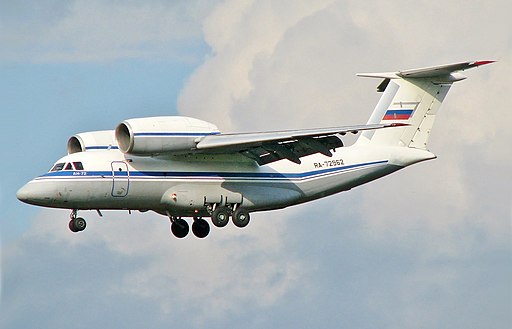
Antonov An-72
The Antonov An-72 is a twin-engine, high-wing tactical transport aircraft renowned for its exceptional short takeoff and landing capabilities. Developed by the Ukrainian Antonov Design Bureau in the late 1970s, its unique over-wing engine placement exploits the Coandă effect to generate additional lift at low speeds. This design enables operations from unprepared runways, ice fields, and compact mountain airstrips, making the An-72 a versatile asset for military, humanitarian, and commercial missions.
Its maiden flight took place in December 1977, and following extensive testing, the An-72 entered service in 1983. Over 150 units have been built, with operators spanning cold-weather nations in the Arctic, tropical carriers in Africa, and military units across Eastern Europe and Asia. Its ability to combine jet-propulsion speed with turboprop-like field performance has sustained interest in several upgrade programs that extend its operational life well into the 21st century.
Design and Development
Origins and Concept
The concept for the An-72 emerged from a Soviet requirement for a rear-loading transport capable of operating closer to front-line areas than the larger Il-76 could manage. By mounting two Lotarev D-36 turbofan engines above a supercritical wing, Antonov engineers harnessed the Coandă effect—where high-velocity exhaust hugs the wing’s upper surface, boosting lift during takeoff and landing. This innovation reduced takeoff runs to under 500 meters even at maximum weight.
Prototype and Testing
Construction of the first An-72 prototype began in Kyiv in 1976. Engineers conducted wind-tunnel trials on scale models to refine flap and slat deployment sequences that would maximize the Coandă-induced lift. The prototype’s initial sorties in 1977 confirmed handling stability at low speeds. Two subsequent prototypes incorporated reinforced landing gear and improved environmental control systems before the design was frozen for production in 1981.
Airframe and Structure
Fuselage
The An-72’s semi-monocoque fuselage is built from riveted aluminum alloys with steel reinforcements at high-stress zones around wing roots and cargo doors. The rear cargo ramp measures 2.4 meters wide by 1.7 meters high, facilitating rapid loading of vehicles, pallets, or rescue stretchers. Internally, roller-floor tracks and tie-down rings allow conversion between troop transport (up to 52 soldiers) and palletized cargo configurations within minutes.
Wing and Aerodynamics
The high-mounted wing spans 28.4 meters and features a supercritical airfoil to maintain laminar flow at cruise speeds near 820 km/h. Automatic leading-edge slats deploy below 200 km/h, and double-slotted Fowler flaps extend up to 35 degrees for steep approaches. Wing fences prevent spanwise flow during high-angle operations, ensuring predictable stall characteristics even with asymmetric loading.
Landing Gear
A rugged tricycle undercarriage comprises twin-wheel nose gear and dual four-wheel bogies under the wings. Oleo-pneumatic struts absorb rough-field impacts, and low-pressure tires distribute weight over soft ground. The gear retracts into sealed fairings to preserve fuselage aerodynamics and reduce foreign object ingestion during takeoff.
Propulsion and Performance
Engines
Power is provided by two Lotarev D-36 turbofan engines mounted above the wing roots. Each engine produces 61 kilonewtons of thrust and incorporates full-authority digital engine controls for optimized fuel flow and synchronized spool-up. Exhaust mixers and nacelle fairings channel jet flow over the wing surface, boosting lift while reducing infrared and acoustic signatures.
Flight Characteristics
The An-72 combines high-subsonic cruise speed with STOL prowess. At maximum takeoff weight of 39,000 kilograms, the aircraft clears a 15-meter obstacle in 490 meters. Its maximum cruise speed of 820 km/h contrasts with a low-speed stall at 155 km/h with flaps fully deployed. Range on standard internal fuel reaches 1,500 kilometers, extendable to over 3,000 kilometers with auxiliary ferry tanks. Service ceiling peaks at 10,500 meters.
Avionics and Systems
Flight Deck
Early An-72s featured analog flight instruments augmented by an inertial navigation system. Modernized variants install glass-cockpit suites with dual multi-function displays, GPS/INS integration, and digital autopilot capable of altitude, heading, and speed hold. Communication packages include VHF/UHF radios, SATCOM terminals, and emergency locator transmitters.
Cargo Handling and Environmental Controls
An onboard hydraulic winch rated at 3,000 kilograms assists with underslung loads and palleted cargo extraction. Roller beds and quick-release clamps streamline reconfiguration between missions. The environmental control system provides heating, cooling, and pressurization for operations from Arctic temperatures of –50 °C to desert highs exceeding +45 °C.
Variants and Special Configurations
An-72A Basic Transport
The baseline aerial delivery and troop transport model with standard analog cockpit and roller-bed cargo floor.
An-72P Paratroop Trainer
Equipped with additional jump-platforms, static-line rigs, and enhanced seating for airborne forces training.
An-72RE Electronic Reconnaissance
Modified with side-facing sensor windows, under-fuselage radar pods, and amplified electrical generation for electronic intelligence suites.
An-72SAR Search and Rescue
Fitted with infrared cameras, life-raft dispensers in the cargo ramp, and medical evacuation stations.
Operational History
Military Deployment
Soviet and later Russian air forces leveraged the An-72’s ability to disperse to forward strips in European and Arctic theaters. Its unique lift augmentation allowed rapid resupply to remote border posts and ice-bound runways. Ukrainian, Kazakh, and Vietnamese forces continue to employ An-72s for tactical airdrops and troop rotations.
Civil and Humanitarian Missions
Commercial operators have used the An-72 for oil-rig support in Siberia and emergency relief in flood-affected regions. Its capacity to operate from dirt airstrips made it invaluable for UN humanitarian corridors in Africa during the 1990s, delivering food, medicine, and building materials to isolated communities.
Technical Specifications
| Parameter | Specification |
|---|---|
| Crew | 3 (pilot, co-pilot, flight engineer) |
| Capacity | 52 troops or 7,500 kg cargo |
| Length | 25.15 m |
| Wingspan | 28.40 m |
| Height | 8.53 m |
| Wing area | 90.5 m² |
| Empty weight | 21,500 kg |
| Maximum takeoff weight | 39,000 kg |
| Engines | 2 × Lotarev D-36 turbofans, 61 kN thrust each |
| Maximum speed | 820 km/h |
| Cruise speed | 780 km/h |
| Stall speed (flaps down) | 155 km/h |
| Range | 1,500 km standard, 3,200 km with auxiliary tanks |
| Service ceiling | 10,500 m |
| Takeoff distance (15 m obstacle) | 490 m |
| Landing distance (15 m obstacle) | 430 m |
Future Upgrades and Legacy
Modernization efforts focus on uprated engines with composite fan blades to cut fuel burn by 15 percent and reduce noise footprints. Digital-fly-by-wire retrofits promise weight savings and enhanced flight envelope protection. Structural health monitoring sensors embedded in wing spars will enable condition-based maintenance, extending airframe life well beyond its original service hours. With its pioneering use of over-wing propulsion and STOL performance, the An-72 continues to influence the design of next-generation tactical airlifters.
