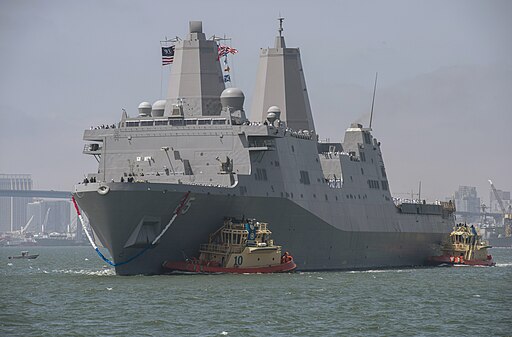
USS Somerset (LPD-25)
USS Somerset (LPD-25) is a San Antonio-class amphibious transport dock commissioned in March 2014. Named in honor of the passengers and crew of United Airlines Flight 93 from Somerset County, Pennsylvania, Somerset’s mission is to embark, transport, and land elements of a landing force by embarked air cushion or conventional landing craft and amphibious vehicles, augmented by helicopters or vertical takeoff and landing aircraft.
Design and Construction
Hull Form and Structure
The ship’s hull is designed with a bulbous bow and flared forecastle to improve fuel efficiency and seakeeping in high sea states. Advanced structural-steel plating and extensive shock-hardening measures enhance survivability against underwater explosions and surface threats. The superstructure employs composite materials to reduce radar cross section, supporting limited stealth characteristics.
Modular Assembly
Built at Ingalls Shipbuilding in Pascagoula, Mississippi, Somerset was constructed using a modular, block-build approach. Major hull sections—forward, midbody, and aft—were outfitted with piping, wiring, and equipment before final joining. This technique accelerated production, improved quality control, and simplified system integration during construction.
Propulsion and Power Systems
Combined Diesel and Gas (CODAG)
Somerset combines two Colt-Pielstick diesel engines with two LM2500 gas turbines in a CODAG arrangement. Diesel engines provide economic cruising at 20 knots, while turbines deliver bursts exceeding 22 knots. Power is routed through two shafts driving controllable-pitch propellers, balancing speed, range, and fuel consumption.
Electrical Generation
Electrical power is generated by four diesel-driven generators rated at 1,500 kW each. A 300 kW emergency generator ensures essential services remain active in casualty scenarios. The ship’s integrated power-management system prioritizes distribution to propulsion auxiliaries, combat systems, and habitability loads, enabling simultaneous high-demand operations without overload.
Mission and Capabilities
Amphibious Operations
Somerset’s well deck can accommodate up to three Landing Craft Air Cushion (LCAC) or a mix of conventional landing craft and amphibious assault vehicles (AAV7A1). Rapid ballasting pumps flood and drain the well deck in under ten minutes, facilitating sequential launch and recovery. Cargo capacity includes 700 tons of combat-loaded vehicles and over 800 m² of stowage for equipment and supplies.
Aviation Facilities
The flight deck supports simultaneous operations of two CH-53E Super Stallions or four MV-22B Ospreys. A hangar bay with overhead cranes provides maintenance capability for embarked helicopters and unmanned aerial vehicles. Aviation fuel storage exceeds 150,000 liters, enabling extended air operations and rapid refueling.
Command, Control, Communications
An advanced Combat Information Center (CIC) integrates Link 16, Cooperative Engagement Capability (CEC), and Global Command and Control System–Maritime (GCCS-M). This networked architecture grants Somerset real-time situational awareness alongside embarked Marine Expeditionary Unit command elements.
Armament and Defense
Self-Defense Weapons
- Two Mk 46 Mod 2 30 mm remote-controlled guns for surface threats
- Two Rolling Airframe Missile (RAM) launchers providing short-range antiaircraft and antimissile defense
- A single Mk 49 NATO Sea Sparrow launcher for medium-range air defense
Electronic Warfare and Countermeasures
The AN/SLQ-32(V)6 electronic-support suite monitors radar and communications emissions, cueing radar decoys and chaff/flare launchers. Four Mk 36 SRBOC (Super Rapid Bloom Offboard Countermeasures) launchers deploy chaff and IR flares in preprogrammed patterns to defeat incoming missiles.
Habitability and Crew
Accommodation
Somerset’s crew comprises roughly 28 officers and 340 enlisted sailors, plus up to 800 embarked Marines. Officer staterooms feature private heads and showers, while enlisted berthing employs modular rack systems. HVAC systems maintain optimal temperature and humidity across all living spaces.
Amenities
Recreational facilities include a gymnasium, a movie screening room, and multipurpose lounge areas. A full galley and expanded mess decks support three meal periods daily for all personnel. Internet and satellite communications ensure connectivity on long deployments.
Operational History
Commissioning and Shakedown
Following her commissioning at Naval Station San Diego, Somerset completed a six-month shakedown cruise in the Eastern Pacific. During this period, the crew validated amphibious launch and recovery procedures, aviation operations, and damage-control drills.
Deployments
- Western Pacific deployment supporting regional exercises and humanitarian assistance
- Multinational amphibious exercises with allied navies, refining joint forcible-entry operations
- Disaster-relief missions delivering heavy equipment and medical teams after typhoons and earthquakes
Periodic maintenance availabilities at Pearl Harbor Naval Shipyard ensure mission-critical systems remain current and fully operational.
Modernization and Upgrades
Under the San Antonio-class mid-life upgrade program, Somerset will receive:
- Improved combat-system software for integrated air and missile defense
- High-bandwidth satellite communications for expanded data throughput
- Enhanced cybersecurity architecture to resist emerging digital threats
- Prototype directed-energy countermeasure suite for advanced missile defeat
These upgrades extend the ship’s operational relevance into the 2040s.
Technical Specifications
| Specification | Value |
|---|---|
| Displacement (full load) | 25,000 long tons |
| Length | 684 ft (208.5 m) |
| Beam | 105 ft (32 m) |
| Draft | 23 ft (7 m) |
| Propulsion | 2 × Colt-Pielstick diesels, |
| 2 × GE LM2500 gas turbines (CODAG) | |
| Speed | 20 knots (diesel); 22+ knots (turbine) |
| Range | 6,000 nm at 12 knots |
| Electrical Generation | 4 × 1,500 kW diesel generators; |
| 1 × 300 kW emergency generator | |
| Well Deck Capacity | 3 × LCAC or combination of landing |
| craft and AAV7A1 vehicles | |
| Flight Deck Operations | 2 × CH-53E or 4 × MV-22B simultaneously |
| Aviation Fuel Capacity | 150,000 L |
| Command and Control Systems | Link 16, CEC, GCCS-M |
| Self-Defense Armament | 30 mm guns, RAM, Sea Sparrow |
| Electronic Warfare | AN/SLQ-32(V)6; 4 × Mk 36 SRBOC launchers |
| Crew | 28 officers, 340 enlisted; |
| Embarked Marines up to 800 |
Future Outlook
As unmanned systems and directed-energy weapons mature, USS Somerset is poised to integrate autonomous landing craft and laser-based point-defense modules. These capabilities will sharpen her amphibious assault profile, enabling rapid, low-signature insertion of troops and vehicles. Somerset’s blend of firepower, transport capacity, and networked command will continue to underpin expeditionary operations and humanitarian missions around the globe.
_arrives_at_its_new_homeport_at_Naval_Base_San_Diego_(13969753071).jpg)