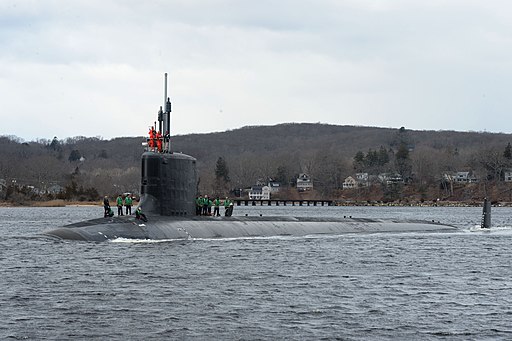
USS South Dakota (SSN-790)
USS South Dakota (SSN-790) is the fourth Virginia-class nuclear-powered fast attack submarine commissioned in March 2019. Named in honor of the Mount Rushmore state, South Dakota embodies advanced undersea warfare capabilities, combining stealth, endurance, and multi-mission flexibility. Designed for operations in both blue-water and littoral environments, she projects power through strike warfare, intelligence gathering, special operations support, and anti-submarine and anti-surface roles.
Design and Construction
Hull Architecture and Acoustic Quieting
The submarine’s external hull features a low-hydrodynamic-drag shape optimized for high-speed transit and silent operation. A polymer-coated anechoic tile layer covers most of the outer hull to absorb active sonar pings, while specially contoured control surfaces minimize flow noise. Internal machinery is mounted on sound-isolating foundation systems and connected by flexible couplings to reduce vibration transmission to the pressure hull.
Pressure Hull Materials and Compartmentalization
South Dakota’s pressure hull utilizes high-strength HY-100 steel, enabling dive depths beyond 800 feet. The internal layout is divided into seven watertight compartments, each sealed by quick-actuating hatches to contain flooding and maintain buoyancy in the event of damage. Critical piping and cables are routed through shock-hardened passages, further enhancing resilience against undersea explosions.
Propulsion and Power Systems
S9G Nuclear Reactor
At the heart of SSN-790 is the S9G pressurized water reactor, delivering thermal power to two steam turbines. Designed for reactor core life exceeding 33 years, the S9G requires no refueling maintenance during the submarine’s anticipated 33- to 42-year service life. A compact steam generator and turbine arrangement drives a high-efficiency alternator, producing all electrical power onboard.
Electric Drive and Propulsion Motors
South Dakota employs a permanent-magnet motor coupled to a single skew-bladed, shrouded propulsor. This design, known as a pump-jet propulsor, reduces cavitation and acoustic signature at high speeds. During normal operations, excess electrical power is diverted to mission systems, hotel loads, and recharging emergency batteries, ensuring continuous readiness under all conditions.
Sensor and Combat Systems
Sonar Suite
The submarine’s undersea awareness centers on an integrated sonar suite: the Bow-mounted Cylindrical Array (BMCA) for passive detection, the High-Frequency Flank Array (HFA) for bearing resolution and target classification, and a Towed Array (TB-29) optimized for deepwater detection. These sensors feed the sonar processor, which fuses data to generate a coherent 360-degree tactical picture.
Fire-Control and Navigation
An advanced Fire Control System (FCS) processes sonar tracks and external targeting data, automatically calculating firing solutions for torpedoes and cruise missiles. Navigation relies on an Inertial Navigation System (INS) supplemented by ring-laser gyros, backed up by satellite positioning when at periscope depth. A low-profile photonic mast replaces the traditional optical periscope, housing high-resolution day/night cameras and laser range-finders.
Armaments
Torpedo Tubes and Payload
USS South Dakota carries four 533 mm bow-mounted torpedo tubes, capable of launching Mk 48 Advanced Capability (ADCAP) heavyweight torpedoes. Typical loadouts include a mix of Mk 48 ADCAP torpedoes for anti-submarine and anti-surface warfare and exercise training rounds. Up to 40 torpedo-tube reloads are stowed in the forward weapons storage area.
Vertical Launch System for Tomahawk
South Dakota is equipped with twelve Vertical Launch System (VLS) tubes in the bow section, each capable of firing BGM-109 Tomahawk cruise missiles. These land-attack missiles provide deep-strike precision options against strategic targets, extending the submarine’s influence from undersea to land operations without surfacing.
Stealth and Countermeasures
Acoustic Signature Management
To maintain ultra-quiet operation, all auxiliary machines—pumps, compressors, and fans—are mounted on active noise-cancellation platforms. Laminated sound-absorbent panels line machinery spaces to suppress high-frequency noise. The pump-jet propulsor minimizes cavitation at typical transit speeds, reducing detectability by passive sonar arrays.
Electronic Warfare and Decoy Systems
South Dakota carries the AN/BLQ-10 electronic support measures suite, passively intercepting and characterizing adversary sonar pings and active sonar transmissions. For self-defense, the submarine deploys countermeasure launchers that dispense acoustic decoys and repeaters, creating false targets to divert incoming torpedoes.
Crew and Habitability
Complement and Accommodations
The standard crew comprises approximately 134 personnel, including officers, enlisted submariners, and a special-operations detachment when embarked. Officer staterooms and Chief’s cabins feature private or semi-private berths; enlisted sailors use modular, stacked rack configurations. All berthing areas are equipped with personal storage lockers and charging ports.
Life Support and Endurance
A high-capacity Environmental Control System maintains air quality through electro-chemical oxygen generation and carbon dioxide removal units. Water-making plants produce fresh water via flash desalination. Provisions for food and consumables support deployments of 70 to 90 days, with emergency reserves for extended operations when access to port is denied.
Operational History
Since her commissioning, USS South Dakota has undertaken multiple Western Pacific deployments, integrating with carrier strike groups and allied submarine forces for joint exercises. She has conducted anti-submarine warfare patrols in contested waters, intelligence-gathering missions under Arctic ice, and precision strike training with Tomahawk missions in live-fire exercises. These operations have validated her systems under real-world conditions and strengthened interoperability with allied navies.
Modernization and Upgrades
Under the Virginia-class Mid-Life Refueling Overhaul (MRO) program, later units receive enhanced sonar arrays and photonic masts with improved sensor suites. While South Dakota does not require reactor refueling, future software updates will integrate new combat algorithms, fuel-efficiency optimizations, and cybersecurity reinforcements. Plans include retrofitting a fly-by-wire control system to streamline maneuvering near the seabed and during special-operations deployments.
Technical Specifications
| Specification | Value |
|---|---|
| Displacement (submerged) | 7,900 long tons |
| Length | 377 ft (115 m) |
| Beam | 34 ft (10.4 m) |
| Draft | 32 ft (9.8 m) |
| Propulsion | S9G nuclear reactor; 30 MW pump-jet |
| Top Speed | 25+ knots submerged |
| Test Depth | >800 ft (244 m) |
| Endurance | 90 days; unlimited range on nuclear |
| Crew Complement | 134 (approx.) |
| Torpedo Tubes | 4 × 533 mm bow tubes |
| Torpedo Payload | 40 reloads, Mk 48 ADCAP |
| Vertical Launch System | 12 × Tomahawk VLS tubes |
| Sonar Suite | BMCA; HFA; TB-29 towed array |
| Combat Systems | AN/BYG-1 FCS; photonic mast; INS |
| Electronic Warfare | AN/BLQ-10 ESM; acoustic decoys |
| Life Support | Electro-chemical O2 generation; CO2 scrubbing; underway water production |
Conclusion and Future Outlook
USS South Dakota stands at the forefront of undersea warfare, seamlessly blending stealth, firepower, and multi-domain mission adaptability. As emerging threats evolve, her architecture allows for incremental technology insertions—directed-energy countermeasures, unmanned undersea vehicle integration, and AI-assisted combat decision aids. South Dakota’s union of proven nuclear endurance and advanced systems ensures she will remain a potent force beneath the waves well into the mid-21st century.
_underway_off_Groton,_Connecticut_(USA),_on_9_January_2019_(190109-N-LW591-045).JPG)