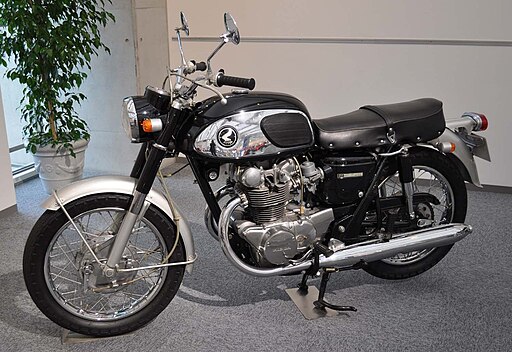
Honda CB450
The Honda CB450 emerged in the mid-1960s as a bold statement of engineering prowess. Blending advanced overhead-cam performance with approachable riding dynamics, it bridged the gap between sport and everyday commuters. From its debut, the CB450 carved out a reputation for reliability, smoothness, and spirited acceleration. This article delves into its design, mechanical architecture, and enduring legacy.
Historical Context
Development and Design Philosophy
Honda set out to redefine the mid-range segment by transplanting race-inspired technology into a street-legal package. The CB450’s double-overhead-cam inline twin represented a departure from the more common pushrod twins of the era. Engineers focused on creating a compact, high-revving powerplant housed within a lightweight, tubular-steel cradle frame. Attention to detail extended to every nut, bolt, and casting, reflecting Honda’s insistence on precision.
Market Reception
Upon launch, the CB450 won praise for its performance and build quality. Reviewers highlighted its smooth power delivery up to the 9,000 rpm redline—remarkable for a production twin in that era. Despite its higher price point, enthusiasts embraced the CB450 for daily commuting, touring, and even club racing. By the early 1970s, it had secured Honda’s foothold in both European and North American markets.
Engine and Performance
Engine Architecture
The heart of the CB450 is a 447 cc, air-cooled, parallel-twin engine featuring double overhead camshafts (DOHC). Each camshaft operates two 29 mm valves per cylinder, optimizing airflow for efficient combustion. The cylinder bores measure 67 mm, complemented by a 50 mm stroke to balance torque and peak power. A single carburetor per cylinder ensures crisp throttle response.
Power Output and Torque
With a peak output of 43 hp at 8,500 rpm, the CB450 surprised many with its energetic acceleration. Maximum torque of 33 Nm at 7,000 rpm delivers robust mid-range punch, making overtakes effortless on open roads. The narrow engine profile reduces gyroscopic resistance, allowing for agile handling at both low and high speeds.
Transmission and Clutch
Power transfers through a five-speed constant-mesh gearbox, lauded for its precise shifts and smooth engagement. The multi-plate wet clutch provides a progressive feel, ideal for city traffic and spirited riding alike. Final drive reliance on a standard roller chain allows for straightforward maintenance and parts availability worldwide.
Chassis and Suspension
Frame Construction
A tubular cradle frame forms the structural backbone, balancing rigidity with a low curb weight of 185 kg (dry). Engine mounting points were optimized to create a stiff yet forgiving chassis, enhancing feedback without compromising comfort.
Front Suspension
Telescopic forks with 130 mm of travel deliver consistent damping and absorb urban imperfections. The fork legs feature triple-clamp bracing to reduce flex during hard braking and spirited cornering.
Rear Suspension
Dual shock absorbers with adjustable preload handle rear compliance. With 110 mm of travel, the system soaks up highway undulations while preserving stability under acceleration and braking.
Brakes and Wheels
Front Brake System
A 260 mm drum brake operated by a dual leading-shoe mechanism brings the front wheel to a controlled stop. Progressive lever travel ensures confident modulation, even under repeated hard stops.
Rear Brake System
The rear wheel also relies on a 160 mm drum, delivering balanced braking force. Brake rods and cables are routed for accessibility, simplifying periodic adjustments.
Wheels and Tires
Matching 18-inch wire-spoked rims support 3.50×18 front and 4.00×18 rear tires. The tire profiles complement the bike’s agile handling, offering a neutral steering feel and predictable grip at lean.
Electrical and Instruments
Ignition and Lighting
Standard points ignition drives spark generation, while a 6 V alternator powers lighting and charging circuits. A large 60/55 W headlamp illuminates the road, and a dual-filament tail/stop lamp enhances visibility to following traffic.
Instrument Cluster
A minimalist cowling houses twin analog gauges: a 160 km/h speedometer and a 12,000 rpm tachometer. Indicator lights for neutral, turn signals, and high beam occupy a central panel, ensuring essential data remains in the rider’s line of sight.
Ergonomics and Bodywork
Rider Comfort
The CB450 features a generously cushioned, flat seat 800 mm above the ground. Wide handlebars and mid-mounted footpegs promote an upright posture, reducing rider fatigue on longer journeys.
Fuel Tank and Seat
A sculpted 13-liter fuel tank balances form and function, offering a range of approximately 200 km between fill-ups. Contoured side panels allow riders to grip the tank with their knees for enhanced stability.
Technical Specifications
| Specification | Details |
|---|---|
| Engine type | 447 cc air-cooled parallel-twin, DOHC |
| Bore × Stroke | 67 mm × 50 mm |
| Compression Ratio | 9.3 : 1 |
| Maximum Power | 43 hp (32 kW) @ 8,500 rpm |
| Maximum Torque | 33 Nm @ 7,000 rpm |
| Carburetion | 2 × 28 mm Keihin CV carburetor |
| Transmission | 5-speed constant mesh |
| Final Drive | Chain |
| Frame | Tubular steel cradle |
| Front Suspension | Telescopic forks, 130 mm travel |
| Rear Suspension | Twin shocks, 110 mm travel |
| Front Brake | 260 mm drum, dual leading shoe |
| Rear Brake | 160 mm drum |
| Wheelbase | 1,435 mm |
| Seat Height | 800 mm |
| Dry Weight | 185 kg |
| Fuel Capacity | 13 L |
| Electrical System | 6 V, points ignition |
Maintenance and Practical Ownership
Routine Servicing
Owners should perform valve clearance checks every 4,000 km, carburetor synchronization at 2,000 km intervals, and oil changes every 1,000 km. The chain requires lubrication and tension adjustment roughly every 500 km.
Common Upgrades and Modifications
Popular enhancements include converting to electronic ignition for improved reliability, upgrading to front disc brakes for enhanced stopping power, and installing modern fork cartridges for better damping control. Custom exhaust systems often boost both performance and sound quality.
Legacy and Influence
The CB450’s DOHC twin became a template for subsequent Honda models, influencing the design of the legendary CB750 four-cylinder. Its blend of technology and practicality paved the way for modern sport-touring motorcycles. Collectors now prize original CB450s for their mechanical ingenuity and authentic 1960s character.
Conclusion
The Honda CB450 stands as a milestone in motorcycle engineering. Its innovative overhead-cam twin, balanced chassis, and unwavering reliability resonated with riders worldwide. Decades after its introduction, the CB450 continues to captivate enthusiasts, serving as a testament to Honda’s commitment to pushing boundaries in two-wheel design.
