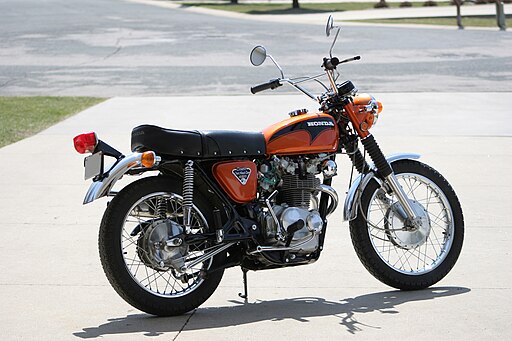
Honda CL450
The Honda CL450 emerged in the late 1960s as a rugged, dual-purpose machine that blended on-road refinement with off-road capability. Built on the proven CB450 platform, it added high-mounted exhaust pipes, knobby tires, and reinforced suspension to carve its niche as one of the era’s most approachable scramblers. Its lively parallel-twin engine, nimble chassis, and minimalist styling captured the imagination of riders seeking adventure both on pavement and dirt.
Historical Background
Origins of the CL450
Honda’s success with the CB450 “Black Bomber” twin inspired a scrambler variant to compete against British and European off-road machines. Introduced in 1968, the CL450 repackaged the CB450’s sophisticated 448 cc DOHC engine into a steel-tube cradle frame with raised exhaust headers, reinforced engine guards, and a slim, high-clearance profile designed for light trail use.
Evolution Through the Years
From 1968 to 1974, the CL450 underwent a series of subtle refinements. Early models featured polished aluminum side covers and kick-start only operation. Later releases added electric starts, revised cam profiles for improved midrange torque, and sturdier rear shocks. Throughout its run, the CL450 retained its signature upswept exhaust and chrome-accented styling, earning a devoted following among scrambler enthusiasts.
Engine and Performance
Parallel-Twin Powerplant
At its core lies a 448 cc air-cooled, DOHC parallel-twin engine. Dual overhead camshafts operate four valves per cylinder, while a 70 mm × 58 mm bore-and-stroke ratio prioritizes quick revving. A compression ratio of 9.7 : 1, along with twin 30 mm Keihin carburetors, yields a broad torque curve that excels both at low RPMs for trail work and high RPMs for spirited road rides.
Power and Torque Figures
- Peak Power: 43 hp at 8 500 rpm
- Peak Torque: 38 Nm (28 lb·ft) at 7 000 rpm
- Redline: 9 000 rpm
A six-speed gearbox channels power smoothly to the rear wheel, while a wet multi-plate clutch offers light lever effort and reliable engagement.
Chassis and Suspension
Frame Construction
The CL450 employs a tubular steel cradle frame that balances rigidity with controlled flex. Its geometry—28° rake and 110 mm trail—delivers sharp turn-in and stable tracking at higher speeds. An elevated stance provides generous ground clearance while preserving a compact footprint for confident maneuvering.
Front Suspension
Telescopic forks with 41 mm stanchions offer 150 mm of travel. Internal damping circuits are tuned for a blend of compliance over ruts and firmness under braking. Fork gaiters protect stanchions from dirt ingress during trail excursions.
Rear Suspension
Dual shock absorbers feature adjustable preload and deliver 130 mm of wheel travel. Progressive springs and damping ensure comfort on rough terrain while resisting bottom-out when landing small jumps or drops.
Braking System and Wheels
Drum Brakes
- Front: 203 mm (8 in) drum brake with full-width shoes
- Rear: 178 mm (7 in) drum brake
While drum brakes lack the outright stopping power of modern discs, their simple design and sealed shoes perform reliably in dusty environments with minimal maintenance.
Wheel and Tire Setup
Spoked rims measuring 19 in both front and rear are wrapped in 3.00-19 front and 3.50-19 rear knobby tires. This combination strikes a balance between off-road traction and on-road stability.
Dimensions and Capacities
| Specification | Metric | Imperial |
|---|---|---|
| Wheelbase | 1 370 mm | 54.0 in |
| Seat Height | 840 mm | 33.1 in |
| Ground Clearance | 190 mm | 7.5 in |
| Fuel Capacity | 11 L | 2.9 US gal |
| Dry Weight | 185 kg | 408 lb |
| Wet Weight | 200 kg | 441 lb |
| Overall Length | 2 070 mm | 81.5 in |
| Overall Width | 790 mm | 31.1 in |
| Overall Height | 1 115 mm | 43.9 in |
Electrical and Controls
Electrical System
A 12 V electrical system, powered by a rotor-stator assembly, supports an electric starter on later models. A rectangular 35 W halogen headlamp ensures nighttime visibility, while an 8 W tail bulb and incandescent turn signals complete the lighting package.
Instrumentation and Switchgear
A minimalist cockpit houses an analog tachometer and speedometer, flanked by indicator lights for neutral, high beam, and turn signals. Handlebar-mounted controls include a simple kill switch and mechanical throttle housing designed for ease of grip and feedback.
Riding Experience
On-Road Character
On pavement, the CL450 feels agile and responsive. The midweight chassis allows quick direction changes, while the parallel-twin’s smooth torque from 3 000 to 8 000 rpm makes cruising effortless. The upright riding position, wide handlebars, and compact fuel tank converge to deliver an engaging posture for winding roads.
Off-Road Capability
Elevated exhaust routing, skid-plate protection, and knobby tires empower light trail adventures. Suspension travel soaks up bumps, while the predictable drum brakes and broad torque curve help maintain control on loose surfaces. The CL450 invites exploration on gravel lanes and fire roads, making it a true dual-purpose machine.
Maintenance and Reliability
Routine servicing is straightforward, with oil changes recommended every 3 000 km and valve clearance inspections every 6 000 km. Carburetor cleaning and synchronization keep throttle response crisp, while periodic chain lubrication safeguards final-drive longevity. Common wear items include fork seals and drive chain adjustment hardware—both accessible for home mechanics.
Legacy and Collector Appeal
Although production ceased in 1974, the Honda CL450 remains a touchstone for classic scrambler aficionados. Its timeless styling, evocative exhaust note, and balanced performance continue to inspire restorations and custom builds. Original examples in good condition command respect at vintage motorcycle shows, highlighting its enduring place in two-wheeled history.
Conclusion
The Honda CL450 captures the spirit of early scramblers with its harmonious blend of reliable engineering, purposeful design, and adventurous potential. Whether carving twisty roads or exploring backcountry trails, it delivers a rider-focused experience that resonates more than five decades after its debut. Its straightforward mechanics, iconic look, and versatile capability secure the CL450’s status as a legendary middleweight scrambler.
