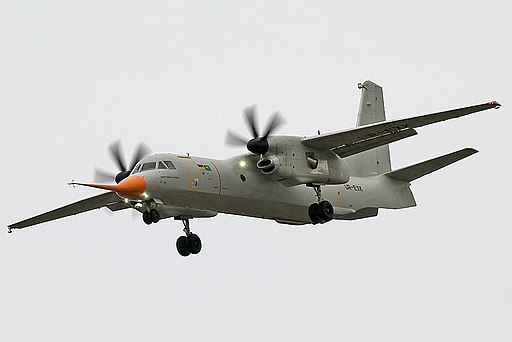
Antonov An-132
The Antonov An-132 is a modernized twin-engine turboprop transport aircraft developed by Ukraine’s Antonov Design Bureau in partnership with Saudi Arabia’s Taqnia Aerospace. It evolved from the proven An-32 airframe, incorporating Western engines, avionics, and composite materials to meet contemporary performance and efficiency benchmarks. Designed for regional logistics, humanitarian missions, and passenger transport, the An-132 emphasizes short-field capability, high payload flexibility, and reduced operating costs.
Design and Development
Origins and Collaboration
The An-132 program launched in 2014 as a joint venture to replace aging An-32 fleets with a globally competitive platform. Antonov provided the basic fuselage, wing structure, and landing gear, while Taqnia committed funding and oversaw integration of Western components. The collaboration aimed to open new markets in the Middle East, Africa, and Asia, offering a versatile aircraft tailored to hot-and-high conditions.
Airframe and Materials
The airframe retains the high-wing, straight-tapered layout of the An-32 but utilizes advanced aluminum-lithium alloys and carbon-fiber composites in non-critical surfaces. Reinforced wing roots and fuselage frames ensure a rugged structure capable of operations from unpaved runways. The redesigned wing features winglets to reduce induced drag and improve cruise efficiency.
Engine and Systems Integration
Replacing the Ukrainian Ivchenko engines, the An-132 mounts two Pratt & Whitney Canada PW150A turboprops, each rated at 5,071 shp. These engines drive six-bladed Dowty R408 composite propellers, delivering enhanced thrust at low speeds and improved fuel burn. An auxiliary power unit (APU) supports ground start-up and environmental control in extreme climates.
Avionics Suite
The An-132 integrates the Rockwell Collins Pro Line 21 digital avionics suite, featuring multi-function displays, a dual-channel autopilot, and satellite navigation (GPS/GLONASS). An onboard health-and-usage monitoring system tracks engine and airframe parameters in real time. Modern cockpit ergonomics reduce pilot workload during long-range missions and adverse weather operations.
Variants and Configurations
- An-132D – Baseline cargo/transport version with rollerized floor and rear loading ramp.
- An-132P – Passenger configuration accommodating up to 70 seats in a single-class layout.
- An-132M – Medevac version for 30 stretchers and medical support stations.
- An-132C – Combi layout with mixed passenger/cargo capability and quick-change fittings.
Technical Specifications
Dimensions
| Parameter | Value |
|---|---|
| Wingspan | 29.20 m |
| Length | 23.80 m |
| Height | 8.80 m |
| Wing Area | 70.8 m² |
Weight and Payload
| Parameter | Value |
|---|---|
| Empty Operating Weight | 13,800 kg |
| Maximum Takeoff Weight | 27,500 kg |
| Maximum Landing Weight | 27,000 kg |
| Maximum Payload | 9,200 kg |
Performance
| Parameter | Value |
|---|---|
| Maximum Speed | 550 km/h |
| Cruise Speed | 450 km/h |
| Stall Speed (Landing) | 115 km/h |
| Service Ceiling | 7,620 m |
| Range (Max Fuel) | 3,500 km |
| Range (Max Payload) | 1,200 km |
| Takeoff Run (MTOW) | 650 m |
| Landing Run | 550 m |
Powerplant
- Engines: 2 × Pratt & Whitney Canada PW150A turboprops
- Power Output: 5,071 shp (3,779 kW) each
- Propellers: 6-bladed Dowty R408 composite
Avionics and Systems
- Rockwell Collins Pro Line 21 integrated flight deck
- Dual-channel autopilot with coupled approaches
- GPS/GLONASS navigation and satellite weather data link
- Health-and-usage monitoring for engines and structures
- Onboard environmental control for −55 °C to +50 °C ambient
Cabin and Cargo
- Cargo bay: 7.40 m (L) × 2.57 m (W) × 2.40 m (H)
- Rollerized floor and 10 pallet positions
- Rear ramp and side cargo door for roll-on/roll-off loading
- Configurable seating for up to 70 passengers
- Quick-change fittings for stretchers, VIP modules, or standard pallets
Operational Trials and Market Prospects
Prototype Flights and Demonstrations
The first An-132 prototype made its maiden flight in August 2016 and logged over 200 flight hours during certification trials. Demonstrations showcased its STOL capabilities from unprepared strips in varying climates, including hot-and-high conditions in Saudi Arabia.
Potential Customers
Interest emerged from regional air forces, humanitarian agencies, and commercial carriers needing a rugged, mid-size transport. Preliminary agreements were explored in Africa and Asia, with operators attracted by the aircraft’s payload-to-cost ratio and interoperability with existing An-32 infrastructure.
Program Status
Despite successful testing, shifting economic conditions and regional defense priorities led to program delays in 2018. Production remains on hold pending renewed investment or strategic partnerships to bring the An-132 into full-scale manufacture.
Maintenance and Support Outlook
The An-132’s use of Western engines and avionics aligns it with global supply chains, simplifying parts availability and maintenance training. A 4,000-hour engine overhaul interval and modular system architecture reduce downtime. Localized maintenance centers in prospective markets could further lower operating costs and boost fleet readiness.
Conclusion
By blending the ruggedness of the An-32 lineage with modern Western propulsion, avionics, and materials, the Antonov An-132 set out to redefine regional turboprop transport. Its performance envelope, flexible cabin configurations, and cost-effective support model position it well for humanitarian, commercial, and military roles. Should production resume, the An-132 could become a cornerstone aircraft for operators seeking versatile, efficient logistics solutions in challenging environments.
.jpg)