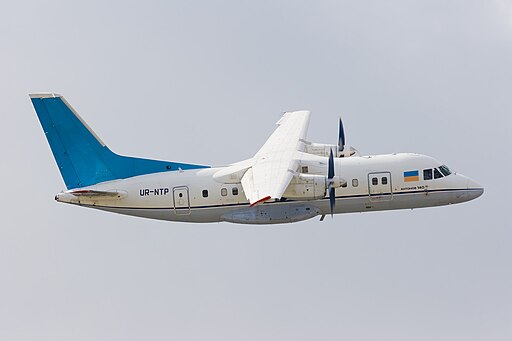
Antonov An-140
The Antonov An-140 is a twin-engine turboprop regional airliner and transport aircraft engineered by Ukraine’s Antonov Design Bureau. Developed in the 1990s to replace aging An-24 fleets, it blends proven high-wing aerodynamics with modern materials, propulsion, and avionics. Certified for commercial passenger service, cargo operations, and military transport roles, the An-140 excels on short and unprepared runways, making it ideal for regional connectivity and remote-field logistics.
Design and Development
Origins and Objectives
The An-140 program launched in 1992 with the goal of delivering a 52-seat regional airliner capable of operations in hot-and-high conditions and from austere airfields. Antonov retained the rugged An-24 undercarriage and high-wing layout, while introducing updated engines, composites, and Western avionics to meet evolving market demands.
Airframe and Materials
The An-140’s airframe employs advanced aluminum-lithium alloys in primary structures and carbon-fiber composites on control surfaces and fairings. The high-mounted wing features a tapered planform and winglets to reduce induced drag. A wide-body fuselage cross-section allows for a six-abreast seating arrangement or flexible cargo layouts. Reinforced keel beams and landing gear are optimized for repeated operations on gravel, grass, and short paved strips.
Propulsion and Environmental Systems
Power comes from two Progress (Motor Sich) AI-22 turboprops, each delivering 1,844 shp. Coupled with six-bladed reversible-pitch composite propellers, these engines provide robust climb performance and STOL capability. An onboard APU (auxiliary power unit) supports environmental control systems in extreme temperatures from –50 °C to +50 °C, ensuring rapid deicing, cabin conditioning, and ground-based electrical power.
Variants and Configurations
An-140 Standard
- 52-seat regional airliner with a single-aisle cabin
- Rollerized cargo floor and rear loading ramp option
- Basic passenger amenities including overhead bins and galley space
An-140TK Cargo
- Full-width cargo door and reinforced pallet tracks
- Payload capacity up to 4,500 kg
- Quick-change fittings for mixed cargo/passenger operations
An-140M Medevac
- Medical module accommodating up to 20 stretchers
- Integrated life-support systems and medical gas outlets
- Dedicated medical crew stations and patient monitoring console
Licensed Production
- Aviakor (Russia) built An-140-100 variant with Rolls-Royce AE 2100 engines
- Iran’s HESA partnership proposed a localized An-140 variant with domestic components
Technical Specifications
Dimensions and Weight
| Parameter | Value |
|---|---|
| Wingspan | 24.54 m |
| Length | 22.50 m |
| Height | 6.40 m |
| Wing Area | 60.2 m² |
| Fuselage Cross-Section | 2.55 m × 2.40 m |
| Empty Operating Weight | 8,940 kg |
| Maximum Takeoff Weight | 14,500 kg |
| Maximum Landing Weight | 14,200 kg |
| Maximum Payload | 4,500 kg |
Performance
| Parameter | Value |
|---|---|
| Maximum Speed | 500 km/h |
| Cruise Speed | 435 km/h |
| Stall Speed (Landing Config) | 180 km/h |
| Service Ceiling | 7,500 m |
| Range (Maximum Payload) | 1,650 km |
| Ferry Range (Minimum Payload) | 2,100 km |
| Rate of Climb | 9.5 m/s |
| Takeoff Distance (MTOW) | 1,400 m |
| Landing Distance | 1,200 m |
Powerplant
- 2 × Progress AI-22 turboprop engines
- Power output: 1,844 shp (1,375 kW) each
- 6-bladed reversible-pitch composite propellers
- Auxiliary power unit for ground start and environmental control
Avionics and Systems
- Fully integrated glass cockpit with EFIS and dual FMS
- GPS/GLONASS navigation and VHF data link
- Dual-channel autopilot with coupled approaches and automatic go-around
- Terrain Awareness Warning System (TAWS) and weather radar
- Health and Usage Monitoring System (HUMS) for real-time diagnostics
Operational History
Certification and Early Service
The An-140 completed its maiden flight in September 1997 and secured Ukrainian certification in December 2000. Russian certification followed in 2003, enabling production by Aviakor and deployment across CIS regional carriers. Early adopters praised its reliability on short-haul routes and adaptability to mixed-cargo roles.
Global Operators
- Ukraine International Airlines (regional feeder service)
- Russia’s regional carriers (S7 Airlines subsidiary operations)
- Iranian civil and military operator HESA (domestic assembly)
- Humanitarian agencies and UN relief missions in Africa and Central Asia
Notable Deployments
- Seasonal operations to remote Kyrgyz mountain airstrips
- Cargo shuttle service to oilfield camps in Western Siberia
- Emergency medevac flights in mountainous Afghanistan terrains
Maintenance and Upgrades
Structural Maintenance
Airframe inspections follow a 1,000-hour base cycle, focusing on wing root fittings, landing gear struts, and composite control surfaces. Corrosion-resistant alloys and improved sealants have extended service intervals.
Avionics and Cabin Refurbishment
Retrofitting programs have introduced next-generation weather radar, satellite communications, and LED cabin lighting. Airlines report reduced fuel burn and enhanced passenger comfort after upgrading to lighter composite interior modules.
Engine Overhaul
AI-22 engines undergo major servicing every 3,500 flight hours, with inline borescope inspections at 1,000 hours. Operators often upgrade to improved compressor blades with anti-erosion coatings, cutting maintenance costs in high-dust environments.
Conclusion
The Antonov An-140 represents a successful fusion of proven Soviet-era aerodynamics with modern propulsion, materials, and avionics. Its STOL performance, versatile cabin configurations, and robust construction make it uniquely suited for regional airlines, military logistics, and humanitarian operations. Ongoing maintenance enhancements and avionics upgrades ensure the An-140 remains a competitive player in the 50-seat turboprop market, serving remote destinations where larger jets cannot venture.
