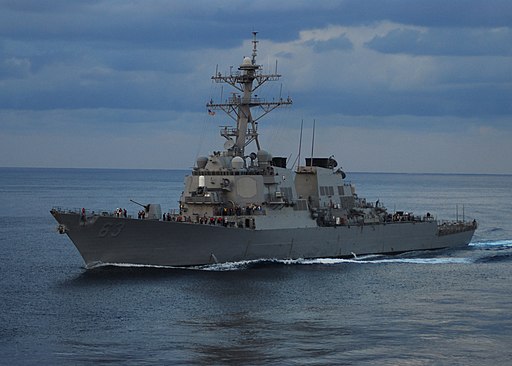
USS Stethem (DDG-63)
USS Stethem (DDG-63) is a Flight I Arleigh Burke–class guided-missile destroyer commissioned into the United States Navy in October 1995. Named for Steelworker 2nd Class Robert Dean Stethem, she carries forward a legacy of courage and resilience. Built to project power across both littoral zones and open oceans, Stethem integrates the Aegis Combat System, advanced propulsion plants, and a versatile suite of weapons and sensors. Home-ported in San Diego, California, she operates primarily with the Pacific Fleet, conducting presence missions, multinational exercises, and regional security operations.
Design and Construction
Hull Form and Materials
USS Stethem employs the classic Arleigh Burke profile with a flared bow and tumblehome superstructure to optimize seaworthiness and reduce radar cross-section. The hull and deckhouse are constructed from HSLA-80 steel, chosen for high tensile strength and fatigue resistance. Precision welding and structural framing ensure robust survivability against battle damage and harsh sea conditions. The design balances a slender underwater hull for high-speed dashes with sufficient beam to support helicopter operations.
Dimensions and Displacement
- Overall length: 505 ft (154 m)
- Beam: 59 ft (18 m)
- Draft: 31 ft (9.4 m) at full load
- Light displacement: approximately 6,800 long tons
- Full-load displacement: approximately 8,900 long tons
These proportions enable a top speed exceeding 30 knots while providing ample deck space for mission systems and aviation support.
Propulsion and Performance
Powerplant Configuration
Stethem is propelled by four General Electric LM2500-30 gas turbines, each rated at 25,000 shaft horsepower. The turbines drive two controllable-pitch propellers via dual shafts, producing a combined 100,000 shp. Full automation of turbine controls streamlines watch rotations and optimizes fuel consumption. Zonal mechanical isolation and resilient mountings reduce vibration signatures, enhancing crew comfort and acoustic stealth.
Speed, Endurance, and Range
- Maximum speed: over 30 knots in calm seas
- Cruising speed: 20 knots for optimal fuel economy
- Range: 4,400 nautical miles at 20 knots
- Endurance: up to 45 days without replenishment
Automated fuel scheduling and advanced diagnostics support long deployments without reliance on frequent logistics calls.
Combat Systems
Aegis Combat System
At Stethem’s heart lies the Aegis Combat System Baseline 5, centered on the AN/SPY-1D phased-array radar. The system tracks hundreds of air and surface targets simultaneously, automatically generating fire solutions and coordinating across the battle group. Aegis Command and Decision processors fuse sensor feeds, prioritize threats, and manage weapon assignments with minimal human intervention, delivering rapid, layered defense.
Vertical Launching System
Stethem carries ninety Mk 41 Vertical Launch System cells in two primary modules: a forward unit of twenty-nine cells and an aft unit of sixty-one cells. This arrangement accommodates a mixed missile loadout, including:
- Standard Missile 2 Medium Range (SM-2MR) for fleet area air defense
- Standard Missile 3 for ballistic missile intercept roles
- Tomahawk Land-Attack Missile for struck-deep precision fires
- RUM-139 Vertical Launch ASROC for anti-submarine warfare
The VLS architecture enables rapid salvo launches without reloading breaks.
Deck and Gun Systems
- One Mk 45 Mod 2 5-inch/54 caliber naval gun mounted forward for naval gunfire support
- Two Mk 15 Phalanx Block 1B Close-In Weapon Systems positioned port and starboard for last-ditch defense against incoming missiles and small craft
- Two Mk 38 Mod 2 25 mm machine-gun systems for fast-reaction surface engagements
- Four .50-caliber heavy machine guns for point-defense and force protection
These systems provide layered counter-threat capability from long-range naval fires down to short-range swarms.
Anti-Submarine Warfare Fit
Stethem integrates dedicated ASW hardware, including dual Mk 32 triple torpedo tubes on the port and starboard sides capable of launching Mk 46, Mk 50, or Mk 54 lightweight torpedoes. Hull-mounted AN/SQS-53C sonar and towed-array AN/SQR-19 sonar allow detection of quiet diesel-electric and nuclear submarines. The flight deck supports embarked helicopters equipped with dipping sonar and airborne torpedoes, extending ASW reach well beyond ship-borne sensors.
Electronic Warfare and Countermeasures
An AN/SLQ-32(V)3 electronic support suite provides comprehensive detection and classification of hostile radar emissions. Mk 36 Super Rapid Bloom Offboard Chaff (SRBOC) launchers and Mk 53 Nulka active-decoy systems deliver both infrared and radar countermeasures. AN/SLQ-25 Nixie torpedo-decoy towlines protect against acoustic homing threats, creating a multi-layered defensive envelope.
Sensor Suites and Communications
Radar and Fire Control
- AN/SPY-1D phased-array 3D air and surface search radar
- AN/SPS-67(V)2 surface-search radar for small-craft detection
- AN/SPQ-9B high-resolution radar optimized for fast surface targets and sea-skimming missiles
- SPG-62 fire-control radars lighting semi-active missile guidance
These radars mesh to offer 360° coverage, high update rates, and target discrimination in littoral clutter.
Sonar and Underwater Systems
- AN/SQS-53C hull sonar array for medium-range active/passive detection
- AN/SQR-19 Tactical Towed Array for passive long-range submarine tracking
- AN/SQQ-28 LAMPS III shipboard system interfaces with airborne sonar helicopters
Combined with VLS-launched ASROC, these systems form a layered ASW network.
C4I and Networking
Stethem’s communications suite includes multi-band satellite links, Link 16 tactical data exchange, and Cooperative Engagement Capability. Secure voice, data, and video streams link the ship to carrier strike groups, land-based command centers, and allied units. Low-probability-of-intercept navigation and timing systems support covert approaches and precision maneuvers.
Aviation Facilities
Flight Deck and Hangar
An aft flight deck and enclosed hangar accommodate two MH-60R Seahawk helicopters or an MQ-8 Fire Scout unmanned rotary-wing aircraft. Hangar facilities feature full-motion doors, blade-folding deck plates, and integrated refueling systems to sustain continuous flight operations. The deck is reinforced to handle repeated helicopter launches and recoveries in diverse sea conditions.
Aviation Support and Maintenance
Onboard support includes intermediate-level maintenance shops, hydraulics test benches, engine-run stands, and weapons-loading rails. JP-5 aviation fuel storage and transfer rigs enable rapid replenishment of embarked aircrews. Condition-based maintenance and digital diagnostic tools streamline component replacements and fault isolation.
Crew and Habitability
Manning Structure
USS Stethem carries a core complement of approximately 280 personnel, divided into:
- 33 commissioned officers
- 38 chief petty officers
- 210 enlisted sailors
Watch rotations cover engineering, combat systems, navigation, and flight-deck duties, with cross-training in damage control and firefighting to maintain resilience.
Living Spaces and Amenities
Officer staterooms and chief petty officer cabins feature private heads and enhanced storage. Enlisted berthing areas use modular rack units with personal lockers. Shared spaces include a high-capacity galley and mess deck, a fitness center, a crewmaster lounge with multimedia consoles, and an onboard library. Upgraded HVAC zoning and acoustic dampening improve comfort on extended deployments.
Construction and Career
Building and Commissioning
Ingalls Shipbuilding in Pascagoula, Mississippi, laid Stethem’s keel on 11 May 1993. She was launched on 17 June 1994 and officially commissioned on 21 October 1995 in Baltimore, Maryland. The vessel met all performance trials ahead of schedule and joined Destroyer Squadron 23 under the Pacific Fleet.
Operational Deployments
Since commissioning, Stethem has completed multiple Western Pacific and Persian Gulf deployments. Missions have included:
- Maritime interception operations enforcing United Nations sanctions
- Multinational exercises such as RIMPAC and Malabar
- Theater ballistic missile defense drills alongside Japanese and South Korean navies
- Anti-piracy patrols in the Gulf of Aden
- Freedom of navigation operations in contested waterways
Her presence has bolstered deterrence and deepened interoperability with allied forces.
Awards and Recognitions
- Navy Unit Commendation for exceptional performance in combatant-ship operations
- Battle “E” Efficiency Awards in recognition of sustained excellence in warfighting readiness
- Retention Excellence Award for superior crew retention and morale
These honors underscore Stethem’s operational proficiency and crew dedication.
Conclusion
USS Stethem (DDG-63) exemplifies the Arleigh Burke–class commitment to multi-mission flexibility, advanced sensor-weapon integration, and sustained global presence. From her steel monohull and powerful gas turbines to the Aegis radar network and VLS missile arsenal, she remains a formidable surface combatant. With a highly trained crew, robust aviation facilities, and continuous modernization, Stethem continues to safeguard maritime security and project naval power across the world’s oceans.
_is_underway_in_the_East_China_Sea.jpg)