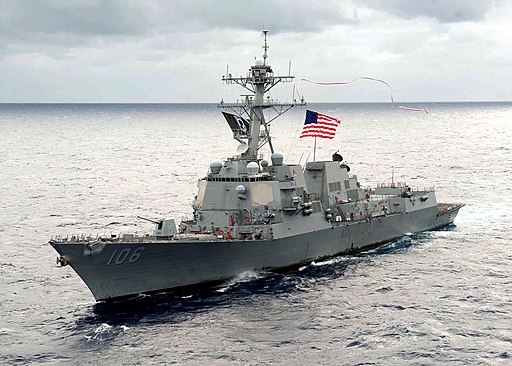
USS Stockdale (DDG-106)
USS Stockdale (DDG-106) is a Flight IIA Arleigh Burke–class guided-missile destroyer in active service with the United States Navy. Named in honor of Vice Admiral James Bond Stockdale, a Medal of Honor recipient and distinguished naval aviator, she was authorized in 2002, constructed by Bath Iron Works, and commissioned on 18 April 2009. Home-ported in San Diego, Stockdale combines advanced propulsion, layered combat systems, and networked sensors to perform air defense, anti-submarine warfare, surface strike, and ballistic missile defense missions worldwide.
Design and Construction
Hull Form and Materials
Stockdale’s hull and superstructure employ HSLA-80 high-strength, low-alloy steel. The flared bow and tumblehome deckhouse reduce radar cross-section and improve seakeeping in high sea states. Precision welding techniques and internal framing create eight watertight, pressure-resistant compartments to enhance survivability against flooding and battle damage. The Flight IIA modification added an enlarged hangar and reinforced helicopter deck without compromising hull integrity.
Dimensions and Displacement
- Length overall: 509 ft 6 in (155.30 m)
- Beam: 66 ft 0 in (20.12 m)
- Draft: 22 ft 0 in (6.71 m)
- Standard displacement: 6,900 long tons
- Full-load displacement: 9,200 long tons
These proportions strike a balance between high-speed maneuvering and the stability required for helicopter operations and missile launches.
Construction Milestones
- Contract awarded: 13 September 2002
- Keel laid: 10 August 2006 at Bath Iron Works, Maine
- Launched: 24 February 2008
- Christened: 10 May 2008
- Delivered to U.S. Navy: 30 September 2008
- Commissioned: 18 April 2009 in Port Hueneme, California
Throughout her build, Stockdale met all performance trials and survivability tests, earning early recognition for construction quality and schedule adherence.
Propulsion and Performance
Gas Turbine Powerplant
Stockdale uses a four-turbine General Electric LM2500-30 configuration. Each turbine produces 25,000 shaft horsepower (shp), driving two controllable-pitch propellers through twin shafts for a combined output of 100,000 shp. The gas turbines are fully automated, enabling rapid startups, automated load sharing, and precision speed control to optimize fuel consumption during both high-speed dashes and economical transits.
Auxiliary Diesel Generators
Three Rolls-Royce 501 K34 diesel generators provide up to 6 megawatts of electrical power for hotel loads, combat systems, and damage-control pumps. These generators support a 4,400 nautical-mile range at 20 knots and permit continuous operations for up to 45 days without refueling.
Performance Profile
- Maximum speed: in excess of 30 knots in calm seas
- Cruising speed: 20 knots
- Range: 4,400 nmi at 20 knots
- Endurance: 45 days without replenishment
The combination of powerful turbines and efficient diesel auxiliaries allows Stockdale to sprint alongside carrier strike groups or loiter in patrol zones with minimal logistic footprint.
Combat Systems Architecture
Aegis Combat System
Stockdale’s centerpiece is the Aegis Combat System Baseline 7, headlined by the AN/SPY-1D(V) phased-array radar. It performs continuous 360° air and surface surveillance, tracking hundreds of contacts simultaneously. Integrated Command and Decision processors automatically fuse radar, sonar, and electronic-warfare data to assign engagement orders and allocate weapons with minimal operator intervention.
Vertical Launching System
Two Mk 41 Vertical Launching System (VLS) modules house 96 cells total:
- Forward module: 32 cells
- Aft module: 64 cells
Typical missile load-out options include:
- Standard Missile-2 MR (SM-2MR) for area air defense
- Standard Missile-6 (SM-6) for extended-range anti-air and anti-surface
- Standard Missile-3 (SM-3) for exo-atmospheric ballistic missile defense
- Evolved Sea Sparrow Missile (ESSM) in quad-packed configuration
- Tomahawk Land-Attack Missiles (TLAM) for deep-strike missions
- RUM-139 Vertical Launch ASROC for anti-submarine engagements
The VLS architecture provides rapid salvo fire and flexible re-arming in port.
Gun and Close-In Defenses
- One 5-inch/62-caliber Mk 45 Mod 4 naval gun mounted on the forecastle for shore bombardment and surface engagements
- One Mk 15 Phalanx Block 1B Close-In Weapon System (CIWS) amidships for last-ditch missile defense
- Two Mk 38 Mod 2 25 mm remote-controlled machine guns for fast close-in surface targets
- Four .50-caliber (12.7 mm) heavy machine guns for point defense and force protection
These layered guns defend against threats ranging from sea-skimming missiles to small boat swarms.
Sensor and Electronic Warfare Suites
Radar and Fire Control
- AN/SPY-1D(V) 3D phased-array radar for air and surface tracking
- AN/SPS-67(V)2 surface-search radar optimized for small targets
- AN/SPQ-9B I-band radar for high-resolution sea-skimming missile detection
- SPG-62 illuminators to guide semi-active homing missiles
Collectively, these radars provide over-the-horizon threat detection and precision fire control.
Undersea Warfare Sensors
- AN/SQS-53C hull-mounted sonar array for active/passive medium-range submarine detection
- AN/SQR-19 Tactical Towed Array Sonar for passive long-range acoustic surveillance
- AN/SLQ-61 Lightweight Tow (LWT) C3 sonar countermeasure to lure torpedoes
Integration with the VLS-launched ASROC rocket torpedo enables rapid prosecution of submarine threats at standoff ranges.
Electronic Support and Countermeasures
- AN/SLQ-32(V)3 electronic support measures detect, classify, and locate hostile radar emissions
- Mk 36 Super Rapid Bloom Offboard Chaff (SRBOC) launchers deploy radar-confusing chaff and infrared flares
- Mk 53 NULKA active-decoy system projects a hovering rocket decoy to seduce anti-ship missiles
- AN/SLQ-25 Nixie towed acoustic decoy deflects torpedoes
These EW systems automatically analyze threat signatures and deploy the appropriate countermeasure mix.
Aviation Facilities
Flight Deck and Hangar
The Flight IIA upgrade added an enclosed hanger and expanded flight deck capable of accommodating two MH-60R Seahawk helicopters or an MQ-8 Fire Scout unmanned rotorcraft. The hangar features:
- Powered blade-folding deck plates
- Integrated JP-5 fuel storage and transfer
- Maintenance stands, hydraulic test benches, and an engine-run enclosure
These facilities enable continuous air operations, supporting anti-submarine warfare, surface surveillance, and search-and-rescue missions without shore-based support.
Aviation Support Systems
Stockdale carries hangar-bay handling systems and weapons-loading rails compatible with Hellfire missiles, torpedoes, and sonobuoys. Digital fault-diagnostic consoles and condition-based maintenance tools streamline helicopter repairs and reduce aircraft downtime.
Crew Composition and Habitability
Manning and Watch Organization
USS Stockdale sails with approximately 380 personnel:
- 32 commissioned officers
- 348 enlisted sailors
Crew departments include operations, engineering, combat systems, supply, and air operations. Cross-decking of duties and automated damage-control monitoring spread responsibilities to ensure rapid response to casualties.
Living Quarters and Amenities
- Officer staterooms with private heads and stowage
- Chief petty officer cabins with enhanced berthing
- Modular rack-style berthing for junior enlisted with individual lockers
- Galley and mess decks serving over 500 meals per watch rotation
- Fitness center, crew lounge with multimedia consoles, and a small library
Acoustic dampening panels and zoned HVAC maintain comfort during extended deployments.
Service History
Early Deployments
After commissioning, Stockdale completed acceptance trials in the Pacific and transited the Panama Canal en route to her new homeport in San Diego. Her maiden deployment in 2010–2011 with the Seventh Fleet involved multinational exercises, freedom-of-navigation operations, and port visits across Southeast Asia.
Ballistic Missile Defense Operations
Stockdale integrated with Theater Ballistic Missile Defense task forces in the Pacific, launching SM-3 interceptors during live-fire exercises. She participated in RIMPAC and joint drills alongside Japanese and South Korean navies, refining cooperative engagement tactics.
Middle East Deployments
Subsequent forward deployments to the U.S. Fifth Fleet saw Stockdale conduct maritime security operations in the Arabian Gulf and Gulf of Aden. Missions included anti-piracy patrols, Visit-Board-Search-and‐Seizure operations, and escorting coalition merchant shipping.
Recent Operations
In 2021–2022, Stockdale joined Carrier Strike Group One in the Western Pacific, operating in the Philippine Sea and South China Sea. A sonar dome repair at Yokosuka enabled her return to intensive fleet exercises and bilateral naval drills before redeploying to San Diego.
Awards and Recognitions
Throughout her career, USS Stockdale has earned:
- Navy Unit Commendation for superior performance during high-tempo operations
- Battle “E” Efficiency Award multiple years for combat readiness excellence
- Retention Excellence Award for exemplary personnel retention and morale
Her crew’s proficiency and the ship’s reliability have garnered consistent commendations from fleet commanders.
Conclusion
USS Stockdale (DDG-106) represents the Arleigh Burke–class ethos of networked warfare, modular flexibility, and relentless forward presence. From her HSLA-80 hull to the Aegis radar panes, and from gas-turbine engines to VLS missiles, she embodies a multi-domain combatant prepared for peer threats and asymmetric challenges. With continuous upgrades to weapons, sensors, and support systems, Stockdale remains a cornerstone of U.S. naval power projection across the globe’s oceans.
_flies_a_240-foot_long_homeward_bound_pennant_from_its_mast_as_it_steams_through_the_Pacific_Ocean_on_131105-N-ZZ999-003.jpg)