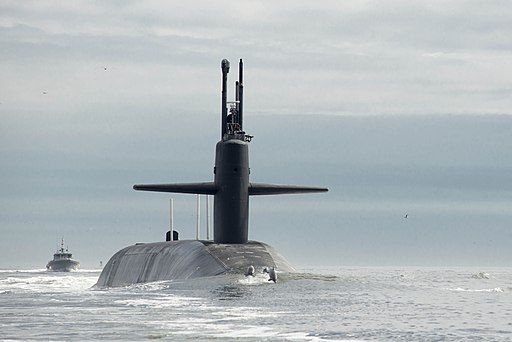
USS Tennessee (SSBN-734)
USS Tennessee (SSBN-734) stands among the United States Navy’s Ohio-class fleet ballistic missile submarines, serving as a cornerstone of strategic deterrence since her commissioning in December 1988. As the fourth Ohio-class vessel and the first submarine to bear the name of the 16th state, she embodies decades of silent readiness, projecting undersea power with a stealthy hull, a potent nuclear propulsion plant, and a full load of Trident II D-5 missiles.
Design and Construction
Ohio-Class Strategic Platform
Ohio-class submarines were conceived in the 1970s to replace the aging Lafayette and James Madison classes. Designed around a longer missile compartment to house 24 Trident II D-5 ballistic missiles, these submarines feature a hydrodynamic teardrop hull form optimized for high-speed, low-noise operations. USS Tennessee shares the class’s emphasis on strategic patrol endurance, survivability, and acoustic discretion.
Construction Timeline
- Contract Award: January 7, 1982
- Keel Laid: June 9, 1986, at Electric Boat Division, General Dynamics, Groton, Connecticut
- Launch Date: December 13, 1986
- Commissioning: December 17, 1988, with Captain Dennis Witzenburg (Blue Crew) and Captain Kenneth Barker (Gold Crew)
The build sequence proceeded rapidly for a submarine of her complexity, incorporating block-construction methods that minimized schedule risk and enabled the first successful submerged Trident II test by August 1989.
Dual-Crew Operational Model
To maximize at-sea deterrent patrols, Tennessee employs Blue and Gold crews. Each crew comprises approximately 155 personnel—15 officers and 140 enlisted—who rotate through the submarine, reducing crew fatigue and increasing overall mission availability without extended downtime between patrols.
Hull and Stealth Characteristics
Structural Materials and Form
Tennessee’s pressure hull and outer hull plating utilize HY-80 high-yield steel for optimal strength-to-weight ratio. The double-hull design features a circular pressure hull enveloped by a hydrodynamic outer mold line. Internal framing and transverse bulkheads create discrete watertight zones, enhancing survivability if the hull is compromised.
Acoustic Signature Reduction
- Anechoic Tiles: Special rubber coatings on the outer hull absorb incoming active sonar pings and dampen machinery noise.
- Machinery Isolation: Critical mechanical systems rest on vibration-damping mounts to decouple noise from the pressure hull.
- Propulsor Design: A single skewback propeller minimizes cavitation by operating at lower blade loading, reducing acoustic detectability at flank speed.
Propulsion System
Nuclear Reactor Plant
USS Tennessee is powered by a single S8G pressurized-water reactor producing approximately 150 MWt. Fueled with highly enriched uranium, the reactor core delivers thermal energy for the submarine’s entire designed service life, eliminating the need for refueling over a 30-plus-year career.
Turbine and Drive Train
Steam from the reactor enters two geared turbines that collectively generate 60,000 ship horsepower. Through a single reduction gearbox, power is transmitted to the lone propulsor shaft. An auxiliary 325 hp retractable motor provides low-noise maneuvering when stealth takes priority over speed.
Electrical and Auxiliary Systems
Three diesel-driven generators supply hotel power and emergency electrical loads when reactor maintenance is underway or if the reactor plant is offline. These generators ensure redundancy for lighting, environmental control, combat systems, and damage-control pumps.
Performance Characteristics
Speed and Depth
- Top Speed Submerged: Greater than 25 knots
- Test Depth: Exceeds 800 feet (244 meters)
- Quiet-Speed Transit: Between 2 and 5 knots for maximum stealth during patrol ingress and egress
Endurance and Logistics
- Patrol Duration: Up to 90 days on station without replenishment
- Crew Endurance: Dual-crew rotations enable continuous deterrent presence
- Reactor Endurance: Core life designed to last more than 30 years, matching planned hull and system life cycles
Armament and Payload
Ballistic Missile Capability
USS Tennessee carries 24 missile tubes loaded exclusively with Trident II D-5 submarine-launched ballistic missiles. Each D-5 missile can deliver multiple independently targetable reentry vehicles over ranges exceeding 4,000 nautical miles. The missile compartment’s reinforced structure and automated launch control system enable rapid salvo firing while submerged.
Torpedo Armament
- Four 21-inch Mk 48 heavyweight torpedo tubes located forward of the sail
- Mk 48 Advanced Capability torpedoes for anti-submarine and anti-surface warfare
- Capacity for up to 20 torpedoes and torpedo-tube-launched anti-ship missiles for self-defense
Sensors and Combat Systems
Sonar Suite
- BQQ-5 Sonar Combat System: Integrates hull-mounted active/passive arrays with a passive towed array for long-range submarine detection
- Flank Array Panels: Extending along the outer hull, these panels improve bearing resolution and target tracking fidelity
Navigation and Underwater Communications
An inertial navigation system augmented by hydroacoustic fixes and secure underwater telephone links maintains the submarine’s covert positional awareness and command connectivity during deep-water patrols.
Fire Control and Combat Management
A multi-function combat control system automates missile targeting and torpedo engagements. It fuses sonar, navigation, and weapons data to generate fire orders and conducts post-launch performance monitoring.
Crew and Habitability
Personnel Organization
Each crew complements the submarine’s mission areas: reactor, engineering, weapons, sonar, navigation, communications, and support. Cross-trained damage-control teams remain on constant alert, ensuring rapid response to casualties or equipment failures.
Living Quarters and Amenities
- Crew Cabins: Modular rack-style berthing for enlisted sailors, staterooms with private heads for officers
- Mess and Galley: Two-shift dining arrangements with automated food-storage systems for extended patrols
- Recreation: Small gym area, multimedia console, and library modules to sustain morale on long deployments
- Environmental Control: Zoned HVAC and fresh-water generation systems maintain comfort and hygiene
Service History
Commissioning and Maiden Patrols
Upon commissioning in December 1988, USS Tennessee completed shakedown cruises and missile test launches in the Atlantic. She then embarked on her first strategic deterrent patrol out of Kings Bay, Georgia, demonstrating the D-5 missile’s submerged launch reliability.
Overhaul and Life-Extension Program
Between 2021 and 2023, Tennessee underwent an extensive engineered refueling overhaul at Kings Bay’s Trident Refit Facility. This modernization refreshed hull coatings, updated combat systems to Block 1A standards, and replaced auxiliary machinery to extend her operational life into the 2040s.
Recent Operations
In 2024, Tennessee completed two deterrent patrols, participating in joint exercises with NATO allies. Her Gold Crew conducted a successful live-fire demonstration of the D-5 missile, affirming the system’s accuracy and resilience under challenging acoustic environments.
Awards and Recognition
Over her service, Tennessee and her crews have earned multiple accolades for mission readiness and excellence in operations, including:
- Strategic Deterrent Patrol Pin awards for both Blue and Gold crews
- Battle Efficiency E Awards for sustained operational effectiveness
- Meritorious Unit Commendations during high-tempo deterrent deployments
Conclusion
USS Tennessee (SSBN-734) exemplifies the silent service’s fusion of nuclear endurance, acoustic stealth, and strategic firepower. Her HY-80 steel hull, S8G reactor, and complement of 24 Trident II D-5 missiles underpin a continuous at-sea deterrent that has safeguarded U.S. national security for more than three decades. With recent overhauls and system upgrades, Tennessee remains poised to carry America’s strategic undersea presence far into the 21st century.
.jpg)