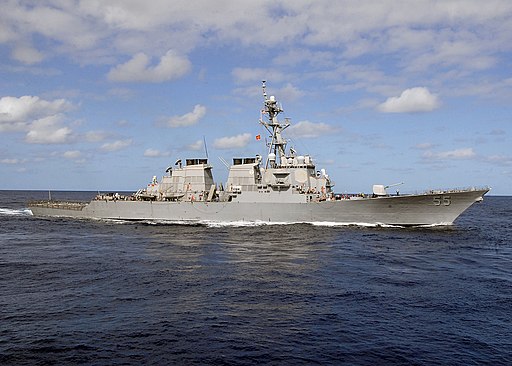
USS Stout (DDG-55)
USS Stout (DDG-55) is an Arleigh Burke-class guided-missile destroyer commissioned into service on 13 August 1994. Constructed by Ingalls Shipbuilding in Pascagoula, Mississippi, she represents the Flight I configuration of the Aegis destroyer series. Home-ported at Naval Station Norfolk and assigned to Destroyer Squadron 28, Stout projects naval power through air defense, anti-submarine warfare, ballistic missile defense, and precision strike capabilities.
Design and Construction
Hull Form and Materials
The hull of Stout is built from high-strength, low-alloy steel sections fused through precision welding techniques. Her flared bow enhances seakeeping in rough seas while reducing radar signature. Eight watertight, pressure-resistant compartments span the length of the hull to contain flooding and improve battle damage survivability.
Dimensions and Displacement
- Length overall: 505 ft (154 m)
- Beam: 59 ft (18 m)
- Draft: 31 ft (9.4 m)
- Light displacement: approximately 6,800 long tons
- Full-load displacement: approximately 8,900 long tons
These dimensions permit a stable weapons-launch platform and sufficient freeboard for helicopter operations.
Build Timeline
- Contract awarded: 13 December 1988
- Keel laid: 8 August 1991
- Launched: 16 October 1992
- Commissioned: 13 August 1994
During construction Stout integrated the baseline Aegis Combat System hardware and Mk 41 Vertical Launching System modules without major design delays.
Propulsion and Performance
Gas Turbine Propulsion
Stout is powered by four General Electric LM2500-30 gas turbine engines delivering 25,000 shaft horsepower each. These turbines drive two controllable-pitch propellers through twin shafts for a total output of 100,000 shp. Automated controls balance turbine load sharing and optimize fuel efficiency during variable speed operations.
Auxiliary Electrical Generation
Three Rolls-Royce 501 K34 diesel generators supply 3,000 kW each for hotel services, combat system electronics, and damage-control pumps. The generators support a 4,400-nautical-mile range at an economical speed of 20 knots.
Performance Profile
- Maximum speed: in excess of 30 knots
- Cruising speed: 20 knots
- Range: 4,400 nautical miles at cruising speed
- Endurance: up to 45 days without refueling
This propulsion arrangement allows rapid maneuvering alongside carrier strike groups and sustained patrols in forward areas.
Combat Systems Architecture
Aegis Combat System
At the heart of Stout’s combat capability lies the Aegis Combat System Baseline 5.1, anchored by the AN/SPY-1D phased-array radar. The system processes air and surface contacts in three dimensions, fusing data from ship-board sensors and off-board links to generate fire control solutions with minimal operator intervention.
Vertical Launching System
Stout carries two Mk 41 VLS modules totaling 90 launch cells (29 forward, 61 aft). Typical missile load-outs include:
- Standard Missile-2 for area air defense
- Standard Missile-3 for exo-atmospheric ballistic missile defense
- Evolved Sea Sparrow Missile in quad-packed configuration
- Tomahawk Land-Attack Cruise Missile for long-range strike
- RUM-139 Vertical Launch ASROC for anti-submarine warfare
The VLS architecture supports rapid salvo launches and flexible re-armament options in port.
Naval Gun and Close-In Defenses
- One 5-inch/54-caliber Mk 45 lightweight gun for surface targets and shore bombardment
- Two 20 mm Phalanx CIWS units for last-ditch missile defense
- Two 25 mm Mk 38 Mod 2 automatic guns for small surface threats
- Four .50-caliber heavy machine guns for close-range force protection
This layered gun suite defends against missiles, fast attack craft, and asymmetric surface dangers.
Sensor and Electronic Warfare Suite
Radar and Fire Control
- AN/SPY-1D 3D phased-array radar for continuous 360° surveillance
- AN/SPS-67(V)3 surface-search radar tuned for small target detection
- AN/SPQ-9B I-band radar specialized in high-resolution sea-skimmer detection
- SPG-62 illuminators guiding semi-active homing weapons
Together these radars deliver over-the-horizon detection and precision engagement control.
Undersea Warfare Sensors
- AN/SQS-53C hull-mounted sonar for active/passive submarine detection
- AN/SQR-19 Tactical Towed Array for passive long-range acoustic surveillance
- AN/SLQ-61 Lightweight Tow (LWT) acoustic decoy to lure incoming torpedoes
Integrated with VLS-deployed ASROC rockets, these systems prosecute submarine threats beyond the ship’s acoustic bubble.
Electronic Support and Countermeasures
- AN/SLQ-32(V)3 electronic support measures to detect and classify radar emissions
- Mk 36 Super Rapid Bloom Offboard Chaff launchers for radar confusion
- Mk 53 Nulka hovering rocket decoys to seduce anti-ship missiles
- AN/SLQ-25 Nixie towed acoustic decoys against torpedo threats
Automated threat analysis algorithms select optimal countermeasure mixes and employment sequences.
Aviation Facilities
Flight Deck and Hangar
A single MH-60R Seahawk helicopter operates from Stout’s aft flight deck and hangar. The enclosed hangar incorporates folding blade supports, JP-5 storage and transfer systems, and maintenance stands, enabling continuous helicopter sortie generation for anti-submarine and surface surveillance missions.
Aviation Support Systems
Weapons-loading rails accommodate aerial torpedoes, Hellfire missiles, and sonobuoys. Digital diagnostic consoles and condition-based maintenance hardware streamline rotorcraft servicing and reduce downtime during underway replenishment cycles.
Crew Composition and Habitability
Complement and Organization
USS Stout embarks approximately 282 personnel, including 33 commissioned officers, 38 chief petty officers, and 211 enlisted sailors. Departments span operations, engineering, combat systems, supply, and air operations. Cross-trained damage control teams ensure rapid casualty response throughout the ship.
Living Quarters and Amenities
Officers and chiefs have private staterooms with heads and stowage. Junior enlisted personnel berth in modular rack systems with individual lockers. Common spaces include a two-level mess deck, a fitness center, and a crew lounge with multimedia consoles, all supported by zoned HVAC and acoustic insulation for crew comfort on extended deployments.
Service History
Early Deployments
Following acceptance trials in 1994, Stout joined the Atlantic Fleet and participated in joint exercises in the Mediterranean Sea. Her initial deployments focused on carrier escort duties, maritime interdiction operations, and joint training with NATO allies.
Ballistic Missile Defense Integration
Stout integrated into the U.S. Fourth and Sixth Fleet ballistic missile defense task forces, conducting SM-3 live-fire tests and exercising with allied BMD-capable ships. Her performance refined cooperative engagement tactics and long-range intercept procedures.
Middle East Operations
From 2004 onward, Stout deployed regularly to the U.S. Fifth Fleet area, conducting maritime security patrols in the Arabian Gulf and Gulf of Aden. Missions included anti-piracy escorts, Visit-Board-Search-and-Seizure operations, and support for maritime coalition logistics.
Recent Activity
In the past five years, Stout has rotated through carrier strike group deployments in the eastern Atlantic and Mediterranean. Refits at Norfolk Naval Shipyard upgraded her combat system to Baseline 7, improved electronic warfare capabilities, and refreshed habitability systems for another decade of service.
Awards and Recognitions
- Multiple Battle Efficiency E Awards for overall combat readiness
- Navy Unit Commendation for exceptional performance in high-threat environments
- Meritorious Unit Commendation for excellence during coalition operations
- Retention Excellence Award recognizing outstanding personnel morale and career development
Conclusion
USS Stout (DDG-55) exemplifies the versatility and resilience of the Arleigh Burke class. From her steel hull and gas turbine heart to the Aegis sensor sweep and missile salvo punch, she remains a frontline naval asset. Continuous modernization of weapons, sensors, and support systems ensures that Stout will continue to safeguard sea lanes, deter aggression, and uphold maritime security well into the 21st century.
_is_underway_during_routine_training_operations.jpg)