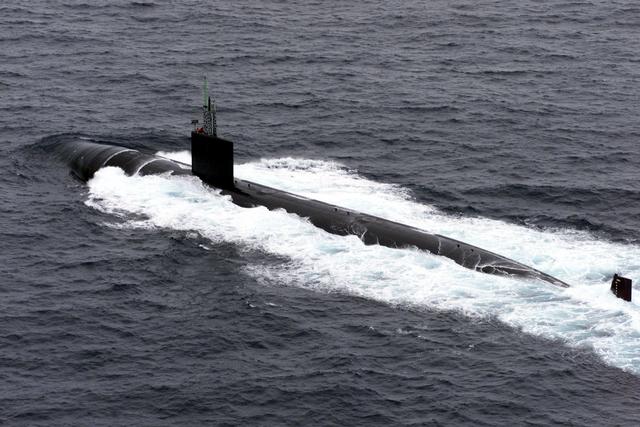
USS Tucson (SSN-770)
USS Tucson (SSN-770) is a Los Angeles-class nuclear-powered attack submarine commissioned in September 1995. Built by Newport News Shipbuilding, she represents the improved Flight IIA (688i) variant, featuring enhanced quieting measures, a Tomahawk vertical launch system, and advanced sensor suites. Home-ported at Naval Base Pearl Harbor, Tucson conducts undersea warfare, intelligence collection, special-operations support, and precision strike missions across the world’s oceans.
Hull and Structural Design
Double-Hull Construction
Tucson’s pressure hull is fashioned from HY-80 high-yield steel, providing strength to withstand deep submergence. An outer hydrodynamic hull encloses the pressure shell and machinery spaces, creating a streamlined form that reduces flow noise and drag.
Reinforcements and Stealth Features
Critical compartments—such as the reactor and torpedo magazine—are surrounded by reinforced framing and Kevlar-lined bulkheads to improve damage resistance. Anechoic rubber tiles cover the outer hull to absorb enemy active-sonar pulses, while machinery is mounted on vibration-damping cushions to minimize radiated noise.
Dimensions and Displacement
| Parameter | Specification |
|---|---|
| Surfaced displacement | 5,726 long tons |
| Submerged displacement | 6,131 long tons |
| Overall length | 362 ft (110.3 m) |
| Beam (max) | 33 ft (10.1 m) |
| Draft | 31 ft (9.4 m) |
| Test depth | 800+ ft (244+ m) |
These proportions balance internal volume for weapons, sensors, and crew accommodations with a slender external profile optimized for stealthy submerged transit.
Propulsion System
Nuclear Reactor and Steam Plant
At the heart of Tucson lies a single S6G pressurized-water reactor. Its highly enriched uranium core generates steam that drives two high-speed turbines. Reactor fuel is designed to last the submarine’s full service life, eliminating the need for mid-life refueling.
Propulsion Machinery
- Steam turbines rated at 33,500 shaft-horsepower
- Single-shaft configuration turning a seven-blade, skewed screw
- Auxiliary propulsion motor for slow-speed maneuvering and silent operations
This arrangement delivers a top submerged speed in excess of 25 knots and virtually unlimited endurance limited only by food and maintenance windows.
Sensors and Combat Systems
Sonar Suite
Tucson combines a bow-mounted, spherical active/passive sonar array with a towed linear array. Advanced digital processors sort and classify contacts, enabling detection of quiet adversary submarines and undersea obstacles at extended ranges.
Electronic Warfare and Communications
- Passive intercept capabilities to locate hostile radar and communications emissions
- SLQ-25 Nixie decoy system to lure incoming torpedoes away from the hull
- Secure Link 11/16 tactical data links and satellite terminals for real-time integration with carrier and ground command networks
Weapon Systems
Torpedo Launchers
Four 533 mm bow tubes fire Mk 48 Advanced Capability (ADCAP) heavyweight torpedoes. The fire-control computer computes optimal firing solutions for various engagement profiles, from direct attacks to defensive counterattacks.
Vertical Launch System
A 12-cell Tomahawk vertical launch system amidships allows rapid engagement of land targets. Tucson routinely embarks a mix of Block III and IV Tomahawk missiles, providing sub-hundred-meter strike accuracy against hardened inland objectives.
Mine Warfare and Countermeasures
In addition to torpedoes and cruise missiles, the submarine can deploy sea mines through its torpedo tubes. Combined with acoustic decoys and hull quieting, this capability allows covert area denial and sea-lane interdiction operations.
Crew and Habitability
Complement and Watch Organization
USS Tucson operates with a core crew of 12 officers and 98 enlisted personnel. Watch rotations ensure continuous manning of navigation, sonar, reactor engineering, weapons, and damage-control stations during extended deployments.
Living Spaces and Amenities
Berthing compartments feature staggered rack arrangements, personal storage lockers, and climate control. A modern galley serves fresh meals three times daily, while a small fitness alcove, multimedia lounge, and library help sustain morale during months-long patrols.
Operational History
Since entering service, Tucson has completed multiple Western Pacific and Indian Ocean deployments. Highlights include:
- Intelligence-gathering patrols under Arctic ice
- Support for special-operations insertions in littoral environments
- Integrated exercises with allied navies during RIMPAC and Malabar
- Precision Tomahawk strikes in support of strike-fighter tasking
Her performance in both high-intensity and clandestine missions underscores the versatility of the Los Angeles-class design.
Modernization and Upgrades
During scheduled availabilities, Tucson has received:
- Digital upgrades to combat-system processors for faster target processing
- Enhanced inertial navigation integration with GPS for precise position fixes
- New satellite communications antenna for higher-bandwidth data exchange
- Refreshed anechoic coatings and hull-mounted sensor calibrations to refine stealth
Future modernization may encompass structural provisions for directed-energy defenses and unmanned undersea vehicle control stations.
Conclusion
USS Tucson (SSN-770) stands as a testament to undersea warfare innovation: blending nuclear endurance, low acoustic signature, and potent weapons into a compact, lethal platform. As she receives incremental upgrades and executes missions worldwide, Tucson will remain at the forefront of silent deterrence and precision strike capability for decades to come.
.jpg)