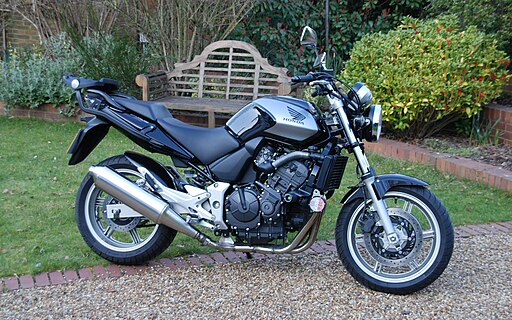
Honda CBF600
The Honda CBF600 strikes a remarkable balance between everyday usability and spirited performance, making it a versatile choice for riders of all skill levels. Its blend of reliability, comfortable ergonomics, and approachable power delivery has cemented its reputation as a standout middleweight standard motorcycle.
Historical Evolution
First Generation (2004–2007)
Honda unveiled the CBF600 in 2004, building on the proven CBR600F engine platform to meet evolving European emission standards. This initial model featured Euro2 compliance, an adjustable seat with three height settings, and an emphasis on smooth power delivery and rider confidence.
Second Generation (2007–2013)
In 2007, the CBF600 received a significant facelift that introduced modernized bodywork and upgraded PGM-FI fuel injection. By 2008, Honda added the half-faired CBF600S variant with optional ABS, followed by chassis refinements and lighter brake components in 2010. Production continued until 2013, concluding with a final edition celebrated for its well-balanced pricing and proven engineering.
Engine and Performance
Engine Architecture
The heart of the CBF600 is a liquid-cooled inline-four displacing 599 cm³. Its 16-valve DOHC head, paired with a bore and stroke of 67 × 42.5 mm and an 11.3 : 1 compression ratio, delivers a broad torque curve optimized for real-world riding conditions.
Power Delivery
Fuel injection via Honda’s PGM-FI system ensures crisp throttle response, while a six-speed gearbox and oil-bath multidisc clutch offer precise, effortless shifts whether carving through backroads or navigating urban streets. Peak output is 57 kW (78 hp) at 12 500 rpm, with 52 Nm of torque arriving at 10 500 rpm for lively midrange thrust.
Technical Specifications Summary
Key specifications of the Honda CBF600 are summarized below:
| Parameter | Value |
|---|---|
| Engine type | Liquid-cooled inline-4 |
| Displacement | 599 cm³ |
| Bore × Stroke | 67 × 42.5 mm |
| Compression Ratio | 11.3 : 1 |
| Fuel System | PGM-FI injection |
| Max Power | 57 kW @ 12 500 rpm |
| Max Torque | 52 Nm @ 10 500 rpm |
| Transmission | 6-speed; chain drive |
| Clutch | Multidisc wet-bath |
| Frame | Steel twin-tube |
| Front Suspension | 41 mm inverted telescopic fork |
| Rear Suspension | Prolink monoshock; preload adjustable |
| Front Brakes | Dual 296 mm discs; four-piston calipers |
| Rear Brakes | Single 220 mm disc; two-piston caliper |
| Front Tire | 120/70 ZR17 |
| Rear Tire | 180/55 ZR17 |
| Fuel Capacity | 19.5 L |
| Dry Weight | 191 kg |
| Seat Height | 805 mm |
Chassis and Handling
Frame and Suspension
A compact steel twin-tube frame underpins the CBF600, delivering a blend of rigidity and lightness. Up front, a 41 mm inverted fork provides 120 mm of travel, while the Prolink rear monoshock features adjustable preload and rebound damping, accommodating both sporty and comfort-oriented setups.
Braking System
Braking performance is led by two 296 mm front discs clamped by four-piston calipers, supported by a single 220 mm rear disc and two-piston caliper. Models equipped with ABS offer enhanced safety on unpredictable road surfaces.
Dimensions, Weight, and Ergonomics
The CBF600’s overall design promotes confidence for a wide range of riders. With a seat height of 805 mm and a dry weight of 191 kg, it strikes a manageable footprint. The 19.5 L fuel tank balances capacity with narrow ergonomics, keeping rider movement fluid during long days on the road.
Variants and Model Differences
Honda offered two core versions: the naked CBF600N and the half-fairing CBF600S, the latter distinguished solely by its front cowling and headlamp assembly. Mid-cycle upgrades included Euro3 compliance in 2008, a switch to an aluminum chassis, a one-litre increase in tank capacity, and refreshed color schemes through 2010 and beyond.
Real-World Performance and Fuel Efficiency
Fuel Consumption and Range
Owners report average consumption between 5 and 7 L/100 km (around 47 mpg), translating to a practical range of over 300 km per fill when riding conservatively, thanks to the 19 L tank capacity.
Top Speed
Despite its standard orientation, the CBF600 can top out around 199 km/h, combining highway stability with a strong midrange that keeps pace with sportier companions on open stretches.
Rider Experience
Day-to-day usability is a hallmark of the CBF600. Upright ergonomics reduce fatigue on long commutes, while predictable handling and accessible power delivery invite confidence–whether threading through city traffic or attacking twisty backroads. The optional ABS module gives an added peace of mind in variable conditions.
Conclusion
With its proven engine, versatile chassis, and user-friendly ergonomics, the Honda CBF600 remains a compelling choice for riders seeking a dependable, all-rounder middleweight. Its blend of comfort, performance, and everyday practicality ensures the CBF600 still resonates in a market crowded with specialized machines.
