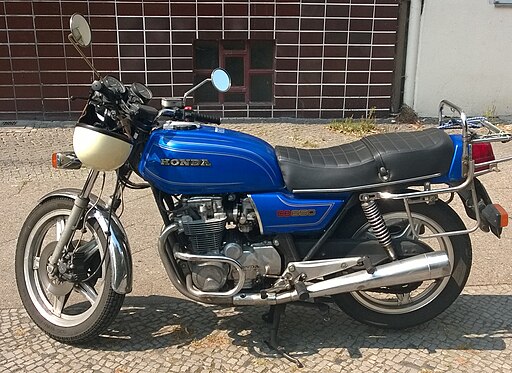
Honda CB650
The Honda CB650 emerged in 1979 as a refined successor to the CB550, marking the culmination of Honda’s air-cooled SOHC four-cylinder lineage. It combined accessible performance, reliable engineering, and versatile ergonomics to set new standards for middleweight street motorcycles.
Historical Development
Birth of the CB650 Series
Honda introduced the CB650 in 1979, leveraging the CB550’s production tooling and frame design while increasing displacement to 627 cc. The new model retained a stud-compatible block layout but featured a fresh cylinder head and carburetion system, allowing for a seamless upgrade in performance without extensive retooling.
Second Generation and Nighthawk
In 1980, styling updates refreshed the tank and bodywork but left mechanicals largely unchanged. From 1981, the CB650 adopted constant-velocity carburetors and offered two configurations: a standard model with wire-spoke wheels and 4-into-2 exhaust, and a custom version featuring 4-into-4 pipes, cast Comstar wheels, and a cruiser-style airbox cover. A 1983 revamp introduced a rubber-mounted DOHC engine with hydraulic lash adjusters and shaft drive on later CB650 variants, transitioning the platform toward the Nighthawk series.
Engine and Drivetrain
SOHC Four-Cylinder Engine
The heart of the original CB650 is a 626.8 cc, air-cooled, transverse inline-four with a single overhead camshaft and two valves per cylinder. A bore and stroke of 59.8 × 55.8 mm and a 9.0 : 1 compression ratio provide a harmonious balance between rev-friendly power and tractable midrange torque.
Carburetion and Ignition
Fuel delivery is handled by four 26 mm Keihin carburetors, ensuring smooth throttle response across the rev range. A transistorized ignition system offers reliable spark timing, while electric start eliminates kick-start dependency and enhances user convenience.
Transmission and Final Drive
A five-speed gearbox channels output through a chain final drive. The wide-ratio transmission prioritizes low-end acceleration and flexibility, making city riding and open-road cruising equally effortless. The O-ring-sealed chain reduces wear and extends service intervals.
Chassis, Suspension, and Brakes
Frame Design
A double-cradle steel frame underpins the CB650, delivering predictable flex characteristics and a stable platform at speed. Its familiar geometry provides intuitive handling for riders transitioning from smaller machines.
Front Suspension
Telescopic forks with a centre-axle coil spring design offer 135 mm of travel. The setup balances compliance over bumps with sufficient damping for confident corner entry and mid-corner stability.
Rear Suspension
Dual Showa shocks at the rear feature adjustable spring preload and deliver 91 mm of wheel travel. The setup mimics a hardtail aesthetic while providing modern comfort and roadholding under solo or passenger loads.
Braking System
Stopping duties fall to a single 275 mm front disc with a one-piston caliper and a rear 180 mm drum brake. This combination provides progressive feel and adequate braking force for the bike’s performance envelope.
Dimensions, Performance, and Fuel Economy
Key Dimensions and Weights
The CB650 spans 2 250 mm in length with a 1 475 mm wheelbase, balancing agility with straight-line stability. A wet weight of 212 kg and an 18 L fuel tank yield a manageable package for two-up riding and extended trips.
Power and Torque Outputs
Peak power reaches 46.9 kW (63 hp) at 9 000 rpm, while maximum torque of 51.5 Nm arrives at 8 000 rpm. This configuration delivers strong midrange thrust, making overtakes and highway cruising effortless.
Top Speed and Acceleration
The CB650 achieves a factory-rated top speed near 190 km/h and completes the standing quarter-mile in approximately 13.4 seconds. Its broad powerband ensures effortless acceleration from low to high revs.
Fuel Capacity and Consumption
With an 18 L tank, the CB650 covers over 300 km on a full fill when ridden conservatively. Average fuel consumption hovers near 5.8 L/100 km, making it economical for daily commuting and weekend touring.
Rider Ergonomics and Features
Seating Position and Controls
A low 790 mm seat height and relaxed handlebar sweep create an upright posture, reducing rider fatigue on long stints. Forward foot controls allow comfortable leg extension without compromising ground clearance in lean.
Instrumentation
The CB650’s cockpit houses analog speedometer and tachometer dials, along with essential indicator lights. The straightforward display emphasizes functionality and clear readability under varied lighting conditions.
Maintenance and Reliability
Routine service intervals include oil changes every 6 000 km and valve clearance checks every 24 000 km. Owners praise the SOHC engine for its durable valve guides and forgiving nature, noting that chain adjustments and brake pad replacements are the most frequent maintenance items.
Conclusion
The Honda CB650 stands as a testament to Honda’s ability to refine and extend a successful platform over time. Its blend of reliable four-cylinder performance, agile chassis dynamics, and rider-friendly ergonomics defined the standard motorcycle genre and laid the groundwork for subsequent CB models.
Technical Specifications Summary
| Parameter | Value |
|---|---|
| Engine type | Air-cooled SOHC inline-4 |
| Displacement | 626.8 cc |
| Bore × Stroke | 59.8 × 55.8 mm |
| Compression Ratio | 9.0 : 1 |
| Induction | Four 26 mm Keihin carburetors |
| Ignition | Transistorized digital |
| Max Power | 46.9 kW @ 9 000 rpm |
| Max Torque | 51.5 Nm @ 8 000 rpm |
| Transmission | 5-speed manual |
| Final Drive | O-ring-sealed chain |
| Frame | Double cradle steel |
| Front Suspension | Telescopic fork; 135 mm travel |
| Rear Suspension | Dual Showa shocks; adjustable preload; 91 mm travel |
| Front Brakes | Single 275 mm disc; 1-piston caliper |
| Rear Brakes | 180 mm drum |
| Front Tire | 3.50-19 |
| Rear Tire | 4.50-17 |
| Wheelbase | 1 475 mm |
| Wet Weight | 212 kg |
| Fuel Capacity | 18 L |
| Top Speed | 190 km/h |
