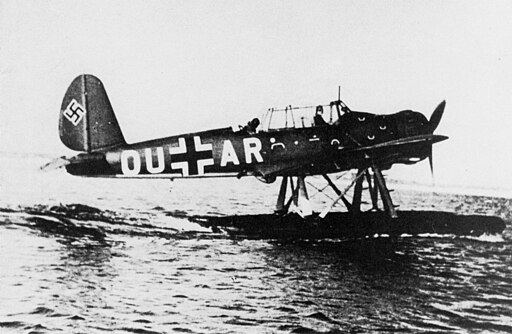
Arado Ar 196
The Arado Ar 196 stands as the Kriegsmarine’s primary shipboard reconnaissance floatplane during the Second World War. Developed by Arado Flugzeugwerke, it combined a two-seat configuration with all-metal construction to fulfill observation, patrol, and light-attack roles from capital ships and coastal bases.
Design and Development
Background and Requirements
In the mid-1930s, the German Navy sought a replacement for the biplane Heinkel He 60. Arado’s submission was a low-wing monoplane featuring twin pontoons and a rugged airframe optimized for catapult launches and deck operations. Its monoplane layout contrasted with rival biplane designs, offering superior speed and handling.
Prototype Trials
Four prototypes took to the sky in May 1937, experimenting with both twin-float and central-float arrangements. Trials demonstrated excellent stability, rapid climb rates, and reliable deck handling. Formal service tests began in early 1939, leading to production authorization later that year.
Technical Specifications
General Characteristics
| Parameter | Value |
|---|---|
| Crew | 2 |
| Length | 11.00 m (36 ft 1 in) |
| Wingspan | 12.47 m (40 ft 11 in) |
| Height | 4.42 m (14 ft 6 in) |
| Wing area | 28.4 m² (306 ft²) |
| Empty weight | 2 990 kg (6 592 lb) |
| Max takeoff weight | 3 730 kg (8 223 lb) |
| Powerplant | 1 × BMW 132K nine-cylinder radial engine |
| Power output | 706 kW (947 hp) |
| Max speed | 309 km/h (192 mph) at sea level |
| Range | 1 070 km (665 mi) |
| Service ceiling | 7 020 m (23 031 ft) |
| First flight | May 1937 |
| Production | 1938–1944 |
| Number built | 541 |
Data compiled from German and aviation sources.
Airframe and Float Gear
The Ar 196 featured a welded steel-tube fuselage with stressed-skin metal panels and a gull-wing center section to improve pilot visibility. Twin aluminum floats bolted beneath the wings allowed beaching and catapult operations with minimal maintenance.
Armament and Equipment
Offensive Payload
- Two 20 mm MG FF/M cannon mounted in wing roots
- One flexible 7.92 mm MG 15 machine gun in rear cockpit
- Up to two 110 lb bombs under fuselage racks
This light armament enabled both reconnaissance defense and limited anti-shipping strikes.
Reconnaissance Suite
Standard fit included a fixed camera for aerial photography, a folding periscope for sea search missions, and FuG 10 radio gear for ship-to-shore communications and coordination with naval units.
Variants
A-1 and A-4 (Shipboard Series)
Built for capital-ship catapults, these models featured corrosion-resistant fittings, foldable wings, and catapult lugs. The A-4 incorporated minor aerodynamic refinements to floats and tailplanes.
A-2 and A-3 (Coastal Series)
Designed for shore-based coastal patrols, they had reinforced floats for rough-sea operations and enhanced fuel capacity, extending on-station endurance.
A-5
An experimental upgrade with improved radio equipment and a second flexible machine gun for the observer. This variant remained limited in production due to shifting wartime priorities.
Operational History
Kriegsmarine Service
From late 1938 onward, every German capital ship and numerous coastal reconnaissance squadrons operated the Ar 196. It performed submarine spotting, convoy escort, and artillery-spotting missions across the Atlantic, Mediterranean, and Baltic theatres with high reliability.
Export and Allied Use
Beyond Germany, Bulgaria and Romania procured limited numbers. Following the war, several surviving Ar 196s were evaluated by Allied services and operated in civilian maritime patrol roles into the mid-1950s.
Production and Legacy
Manufacturing took place at Arado’s Brandenburg facilities and under license in occupied France and Denmark, culminating in 541 units by 1944. Today, a handful of airframes survive in museums, offering insight into Kriegsmarine reconnaissance tactics and floatplane engineering practices.
