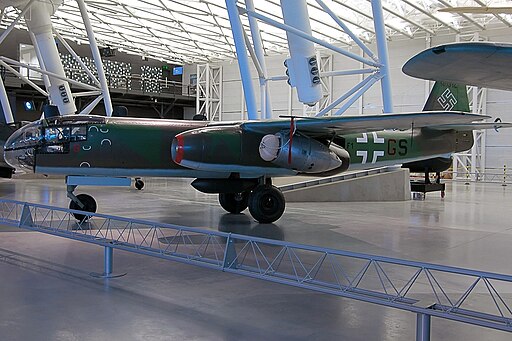
Arado Ar 234 Blitz
The Arado Ar 234 Blitz holds the distinction of being the world’s first operational jet-powered bomber, introduced into Luftwaffe service in September 1944. It combined cutting-edge turbojet propulsion with a sleek, slender fuselage to achieve unprecedented speeds for its era. A total of 214 airframes were completed between 1944 and 1945, with the type seeing its maiden flight on 30 July 1943 before entering combat reconnaissance and bombing roles in the closing months of World War II.
Design and Development
Origins and Prototypes
In late 1940, the Reichsluftfahrtministerium issued a requirement for a high-speed reconnaissance aircraft powered by turbojet engines. Arado’s experimental E 370 project answered this call, yielding the first three prototypes—V1 through V3—each trialing different undercarriage schemes, including a jettisonable three-wheel trolley and fixed skids for landing. The arrival of the Junkers Jumo 004A-0 engines in early 1943 enabled the Ar 234 V1 to conduct its first successful flight on 30 July 1943, marking a pivotal moment in jet-age aviation.
Powerplant and Airframe
The production Ar 234B-series adopted two Junkers Jumo 004B-1 turbojets, each delivering 8.8 kN of thrust. These engines were housed in streamlined underwing pods fed by side-mounted intakes and cylindrical diffusers. The all-metal, duralumin stressed-skin fuselage featured distinctive cut-away panels over a welded truss structure. To simplify operations from improvised fields, the aircraft employed a jettisonable undercarriage consisting of a detachable three-wheel trolley and a retractable tail ski with integrated braking.
Technical Specifications
Dimensions and Weights
- Crew: 1 pilot
- Length: 12.64 m
- Wingspan: 14.10 m
- Height: 4.30 m
- Wing area: 26.4 m²
- Empty weight: 5 200 kg
- Maximum takeoff weight: 9 850 kg
Performance
- Maximum speed: 743 km/h at sea level
- Cruise speed: 700 km/h
- Range: 1 100 km
- Service ceiling: 10 000 m
- Rate of climb: approximately 15 m/s
Powerplant
- Engines: 2 × Junkers Jumo 004B-1 turbojets
- Thrust per engine: 8 800 N
- Propellers: three-bladed, ground-adjustable pitch (for engine starting)
Armament and Payload
- Reconnaissance (B-1): provision for three aerial cameras; no bombload
- Bomber (B-2): internal payload bay carrying up to 4 × 250 kg SC 250 bombs or 2 × 500 kg bombs
- Emergency armament: on select series, two 20 mm cannon in wing roots and optional flexible machine gun in rear cockpit position
Operational History
Reconnaissance Role
Beginning in late 1944, the Ar 234 Blitz predominantly served as a high-speed photo-reconnaissance platform. Its velocity and altitude capability rendered it nearly invulnerable to Allied fighters and flak. It achieved the final Luftwaffe overflight of the United Kingdom in April 1945, gathering critical intelligence on troop movements and infrastructure targets deep behind enemy lines.
Bomber Missions
Although optimized for reconnaissance, the slender fuselage limited internal bomb capacity, relegating external bomb racks to the B-2 variant. Notably, Ar 234s were tasked with repeated attacks on the Ludendorff Bridge at Remagen between 7 and 17 March 1945. Engine shortages, fuel scarcity, and the slow rate of production curtailed these bombing efforts, leading to many aircraft being destroyed or captured before they could sortie.
Variants and Production
Pre-Production Series
The initial batch comprised seven pre-production Ar 234 V21-V27 airframes built in early 1944. These machines validated structural modifications, cockpit glazing improvements, and the jettison undercarriage concept before full-scale manufacture commenced.
Series B-1 and B-2
From mid-1944 onward, Ar-234B-1 reconnaissance models and B-2 bomber models rolled off production lines at Brandenburg, with licensed assembly also undertaken in occupied France and Denmark. Despite ambitious plans to produce 500 aircraft per month by late 1945, only 214 were completed, largely due to critical shortages of Jumo 004 engines and strategic materials.
Legacy and Surviving Aircraft
A handful of Arado Ar 234 Blitz airframes endure in museum collections, providing tangible links to the dawn of jet-powered warfare. The Smithsonian’s Steven F. Udvar-Hazy Center houses an Ar 234B-2 restored to display condition, offering aviation enthusiasts a chance to study firsthand the pioneering engineering that reshaped aerial reconnaissance and bombing tactics in the jet age.
