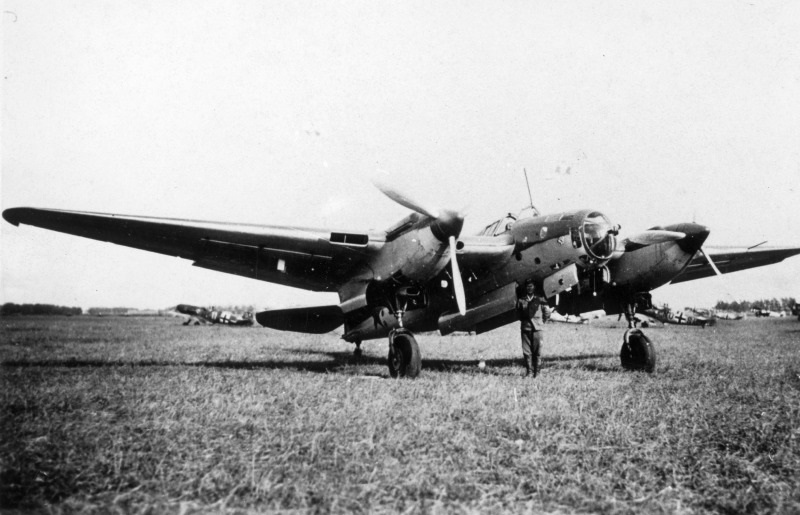
Arkhangelsky Ar-2
The Arkhangelsky Ar-2 emerged in 1940 as a Soviet dive bomber developed to extend and modernize the aging Tupolev SB design. Under Alexander Arkhangelsky’s oversight, it incorporated aerodynamic refinements and dive-bombing features to meet a requirement for a high-speed, precision-strike aircraft. Although only about 190 units entered service before production ceased in early 1941, the Ar-2 represented a crucial transition in Soviet bomber development.
Design and Development
Origins and Objectives
When Andrei Tupolev was detained during Stalin’s purges, Alexander Arkhangelsky assumed leadership of the Tupolev design bureau. He was tasked with enhancing the SB platform to achieve a top speed nearing 600 km/h at altitude and integrate the new PB-3 bombsight for dive-bombing missions. Initial work on a refined SB variant proved underwhelming, prompting a more extensive redesign that would become the Ar-2.
Prototype Trials and Evaluation
Two prototypes, initially designated SB-RK, took flight in October 1940. Key changes included streamlined engine nacelles housing more powerful engines, newly tapered outer wing panels for improved lift-to-drag ratio, and a fully glazed nose for better bomb-aiming visibility. The engine cooling system was relocated into the wings with leading-edge inlets and underwing outlets, and dive brakes were fitted to control descent rates. Soviet flight-testing in November 1940 confirmed enhanced handling and effective dive-bombing performance, though persistent engine cooling and defensive-armament shortcomings were noted. Following positive evaluations, the type was officially renamed Ar-2 in December 1940.
Technical Specifications
| Parameter | Specification |
|---|---|
| Role | Dive bomber |
| Manufacturer | Zavod 22 |
| Designer | Alexander Arkhangelsky |
| First flight | October 1940 |
| Introduction | 1940 |
| Number built | Approximately 190 |
| Crew | 3 |
| Length | 15.60 m |
| Wingspan | 22.12 m |
| Height | 4.15 m |
| Wing area | 61.5 m² |
| Empty weight | 6 008 kg |
| Maximum takeoff weight | 8 450 kg |
| Powerplant | 2 × Klimov M-105 V-12 liquid-cooled engines |
| Power output | 889 kW (1 190 hp) each |
| Maximum speed | 530 km/h at 4 500 m |
| Cruise speed | 435 km/h |
| Range | 1 350 km |
| Service ceiling | 10 200 m |
| Armament | 4 × 7.62 mm ShKAS machine guns; 1 × 12.7 mm UBT |
| Bomb load | Up to 1 000 kg internal; additional underwing racks |
Variants
SB-RK Prototype
The initial two prototypes retained SB-style outer wings with modified nacelles and served to validate dive-brake effectiveness, cockpit glazing, and new cooling ducts. Testing revealed the need for further streamlining and stronger defensive mounts.
Ar-2 Production Model
This series featured fully redesigned outer wings of greater taper, optimized engine nacelle fairings, and the complete dive-bombing apparatus. Defensive firepower was arranged around the glazed nose and dorsal positions, though it remained lighter than contemporary multi-engine bombers. Production ran from late 1940 until the facility was retooled for the emerging Petlyakov Pe-2 in early 1941, limiting output to under 200 airframes.
Operational History
The Ar-2 entered front-line service in 1941 with select dive-bomber regiments. Its improved speed and precise bombing capability offered advantages over the original SB, yet persistent engine overheating and insufficient defensive armament constrained its effectiveness against well-equipped Axis adversaries. As newer designs like the Pe-2 and Tupolev Tu-2 became available, the Ar-2 was rapidly phased out. By mid-1941, most surviving examples were relegated to training or withdrawn from service entirely.
Legacy
Although produced in limited numbers, the Arkhangelsky Ar-2 highlighted the potential of dive-bombing tactics for the Soviet Air Force and informed the design of subsequent high-speed bombers. Its aerodynamic revisions and integrated dive-brake system foreshadowed features later perfected on the Pe-2. Today, the Ar-2 serves as a case study in iterative aircraft development under tight political and industrial pressures of the early war years.
